THE GREAT EXPERIMENT: SOUTH AFRICA
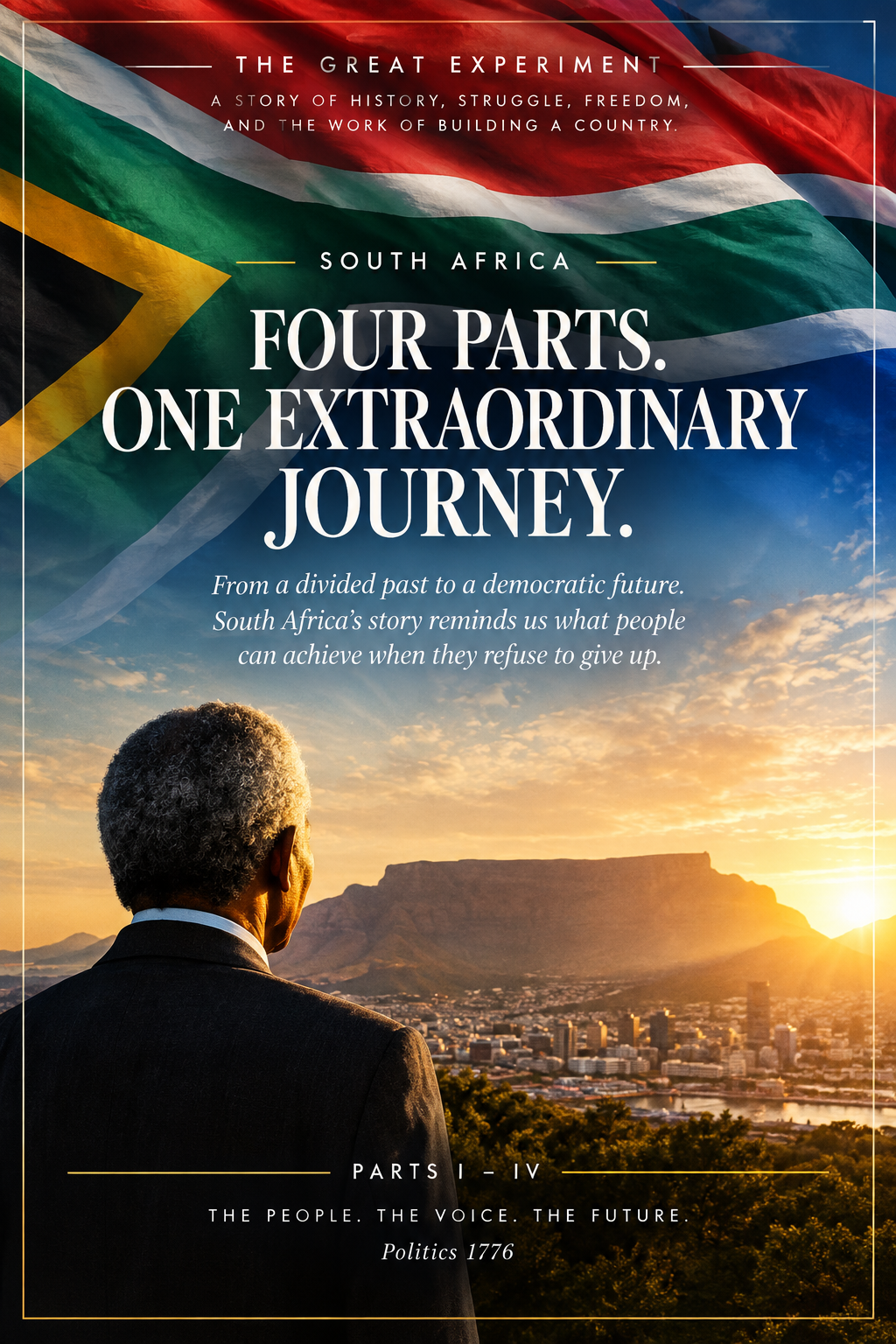
THE GREAT EXPERIMENT: SOUTH AFRICA
A STORY OF HISTORY, STRUGGLE, FREEDOM, AND THE WORK OF BUILDING A COUNTRY
PART I OF V
THE COUNTRY BEFORE MANDELA
Before We Can Understand the Man, We Have to Understand the Country
When most people hear the words South Africa, they probably think of Nelson Mandela.
They may think of apartheid.
They may think of Robben Island.
They may think of the 1994 election.
They may think of the famous photographs of Mandela walking free after 27 years in prison.
But Mandela's story did not begin with his imprisonment.
And South Africa's story certainly did not begin with apartheid.
Long before Nelson Mandela was born, South Africa was already a country shaped by thousands of years of human history, Indigenous societies, migration, trade, conflict, European settlement, colonial expansion, wars, mineral wealth, industrialization, and political competition.
To understand how South Africa eventually reached apartheid—and later found its way out of it—we have to go back.
Way back.
Because countries are rarely created by one event.
They are built over generations.
Sometimes peacefully.
Sometimes violently.
Sometimes through cooperation.
Sometimes through conquest.
And often through decisions whose consequences are not fully understood until generations later.
This is the story of the country Nelson Mandela was born into.
BEFORE EUROPEAN COLONIZATION
South Africa was not an empty land waiting to be discovered.
People had lived there for thousands of years.
The region was home to diverse Indigenous communities, including Khoisan peoples and many Bantu-speaking societies that developed complex political, agricultural, pastoral, and trading systems over centuries.
These societies were not one single people.
They had different languages.
Different political structures.
Different economies.
Different traditions.
Different territories.
And, like societies everywhere, they sometimes cooperated and sometimes fought.
The history of southern Africa before European colonization is therefore not a simple story of one group living peacefully until another group arrived.
It was already a complicated human landscape.
That matters.
Because history becomes dangerous when we turn entire continents into blank spaces before Europeans arrive.
There were already people there.
There were already communities.
There were already leaders.
There were already economies.
There was already history.
THE CAPE AND THE ARRIVAL OF THE DUTCH
In 1652, Jan van Riebeeck arrived at the Cape on behalf of the Dutch East India Company.
The original purpose was not to create a massive inland empire.
The Dutch established a settlement at the Cape to provide food, water, and other supplies for ships traveling between Europe and Asia.
But settlements have a way of growing.
Farmers moved beyond the immediate settlement.
Land use expanded.
Competition over resources increased.
Relationships between European settlers and Indigenous communities became increasingly difficult.
Trade gave way to conflict in some places.
Land became increasingly important.
And over time, European settlement expanded.
The consequences would last for centuries.
South African History Online notes that colonial land dispossession did not begin with the twentieth-century apartheid government; it had roots reaching back to the expansion of Dutch settlement at the Cape and subsequent conflicts involving Indigenous communities.
This is an important distinction.
Apartheid did not create every racial or land conflict in South Africa.
It inherited and expanded upon systems that had developed over a much longer period.
THE BRITISH ARRIVE
The British later took control of the Cape.
British influence expanded during the nineteenth century.
The population became increasingly complicated.
Dutch-descended settlers developed their own identity.
British settlers brought another political and cultural influence.
Indigenous African societies defended their territories.
There were conflicts between African kingdoms and European settlers.
There were conflicts between British forces and Afrikaner settlers.
There were conflicts between African societies themselves.
And there were enormous economic changes underway.
South Africa was becoming something very different from the small European settlement that had existed around the Cape.
THE GREAT TREK
In the 1830s and 1840s, many Dutch-descended settlers—later known as Afrikaners or Boers—moved away from British-controlled areas in an event remembered as the Great Trek.
They established communities and eventually independent Boer republics.
Among them were the South African Republic, commonly called the Transvaal, and the Orange Free State.
But this was not simply a story of settlers looking for empty land.
Their movement occurred within an already populated region.
The expansion of Boer settlements brought new conflicts over land and political authority with African societies.
The nineteenth century became a period of enormous upheaval.
Zulu power expanded dramatically in southeastern Africa.
The Zulu kingdom became one of the region's major political powers.
The British expanded their influence.
Afrikaner republics developed.
African kingdoms resisted.
Wars followed.
The borders of political control repeatedly changed.
And then something arrived that would transform everything.
GOLD
In 1867, diamonds were discovered near the Orange River.
Then, in 1886, gold was discovered on the Witwatersrand.
The discovery of gold changed South Africa forever.
Johannesburg grew rapidly.
Capital poured into the region.
Mining expanded.
Railways expanded.
Workers moved across the country.
Businesses developed.
South Africa became increasingly industrialized.
The country was no longer simply a collection of agricultural settlements and colonial territories.
It was becoming an industrial economy.
And industrial economies create new political questions.
Who owns the land?
Who owns the mines?
Who works in them?
Who controls labor?
Who receives the wealth?
Who has political power?
Who benefits?
And who does not?
The mineral revolution helped make South Africa one of the most important economic centers in Africa, but it also intensified conflicts over land, labor, race, and political authority.
THE ANGLO-BOER WAR
Britain and the Boer republics eventually went to war.
The South African War, also known as the Anglo-Boer War, began in 1899.
It lasted until 1902.
It was a brutal conflict.
The British ultimately defeated the Boer republics.
The war left enormous destruction behind.
But something else happened.
Former enemies eventually had to figure out how to live under one political system.
That would become one of the defining challenges of twentieth-century South Africa.
How do you take people who have fought each other and create one country?
It is a question South Africa would face repeatedly.
And eventually, it would become a question Nelson Mandela would have to confront.
1910 — THE UNION OF SOUTH AFRICA
On May 31, 1910, the Union of South Africa was established.
The Cape, Natal, Transvaal, and Orange Free State were brought together into one political entity within the British Empire.
On paper, South Africa had become a unified country.
But there was a fundamental problem.
Not everyone was included equally in that new political system.
The negotiations that created the Union largely excluded Black South Africans from meaningful participation in the constitutional settlement.
The new Union was dominated politically by the white population.
The Cape retained limited forms of nonwhite political participation based on property qualifications, but this was the exception rather than the rule, and the national political system was overwhelmingly controlled by whites.
South Africa had united.
But it had not united everyone politically.
That distinction would matter enormously.
THE AFRICAN NATIONAL CONGRESS
In 1912, two years after Union, the South African Native National Congress was founded.
It would later become known as the African National Congress, or ANC.
The organization was created in response to the political exclusion and discriminatory policies facing Black South Africans.
Its founders were not simply demanding a different government.
They were demanding political recognition.
They wanted a place in the country they already called home.
The ANC would eventually become the political organization most closely associated with Nelson Mandela.
But Mandela was not born into a political vacuum.
The movement already existed before he was born.
The struggle already existed.
The arguments already existed.
The country already had people trying to change its political future.
Mandela would inherit that struggle.
THE LAND QUESTION
One of the most important issues in South African history was land.
And it is impossible to understand the later history of South Africa without understanding this.
In 1913, the Union government passed the Natives Land Act.
The law restricted where Black South Africans could acquire and occupy land and established a legal framework for territorial separation.
South African History Online describes the Act as allocating roughly 7% of the country's land to African reserves while restricting acquisition outside those areas. Later additions and legislation altered the precise boundaries, but the basic effect was enormous: the law legally entrenched racialized land division.
The law was about much more than property.
Land means economic opportunity.
Land means housing.
Land means farming.
Land means independence.
Land means community.
Land means security.
When a government controls who can own land and where people can live, it is also affecting their ability to build wealth and determine their own future.
The 1913 Land Act therefore became one of the most consequential pieces of legislation in South African history.
And its consequences would last for generations.
SEGREGATION BEFORE APARTHEID
This is where history requires precision.
It is common to say:
“Apartheid began in 1948.”
That is broadly correct when referring to apartheid as the formal governing ideology and system introduced by the National Party after its 1948 election victory.
But racial discrimination and segregation were already deeply embedded in South African law and government before 1948.
Land restrictions existed.
Labor restrictions existed.
Political exclusion existed.
Movement restrictions existed.
Segregated institutions existed.
Racial hierarchy existed.
The National Party did not invent every one of these things from nothing.
It expanded, systematized, and intensified them into the apartheid system.
That distinction matters because history is almost never as simple as:
Problem begins → one person or party creates it → problem ends.
South Africa's history was more complicated.
And that is precisely why it is worth studying.
INDUSTRY, LABOR, AND THE MODERN SOUTH AFRICAN ECONOMY
Mining transformed the country's economy.
But mining also created enormous demand for labor.
Large numbers of Black South Africans became part of the industrial workforce.
The mining economy depended heavily on a labor system that separated workers from their families and communities and restricted their economic choices.
The government and mining interests developed systems designed to control labor and maintain a supply of workers.
This created another contradiction.
South Africa was becoming increasingly modern and industrial.
Its mines produced enormous wealth.
Its cities expanded.
Its railways expanded.
Its industries grew.
But political and economic opportunity remained sharply divided along racial lines.
A country could modernize economically while remaining deeply unequal politically.
That contradiction would become one of South Africa's defining problems.
TWO SOUTH AFRICAS
By the early twentieth century, South Africa was becoming a country of enormous contrasts.
Modern cities.
Industrial mines.
Railroads.
Farms.
Universities.
Businesses.
Growing political institutions.
And enormous poverty and political exclusion.
One population possessed overwhelming political power.
Another population formed the majority but remained largely excluded from national political power.
The country was developing.
But it was not developing equally.
And that creates a dangerous situation.
Because eventually people begin asking:
Why?
Why should the law treat one person differently from another?
Why should one family be able to own land while another cannot?
Why should one person have political representation while another does not?
Why should someone's race determine where they can live, work, study, or travel?
Those questions were becoming impossible to ignore.
THE YEARS BEFORE MANDELA
The 1920s and 1930s brought further political and economic changes.
The country industrialized.
Afrikaner nationalism grew.
Labor conflicts intensified.
The Great Depression affected South Africa.
Political coalitions shifted.
The government continued developing racial policies.
And resistance continued.
The ANC remained active.
Other political movements emerged.
Indian South Africans organized against discriminatory laws.
Workers organized.
Intellectuals organized.
Community leaders organized.
South Africa was becoming politically restless.
Then came another generation.
A generation that would include a young man named Nelson Rolihlahla Mandela.
1918 — NELSON MANDELA IS BORN
On July 18, 1918, Nelson Rolihlahla Mandela was born in the village of Mvezo in the Transkei region of South Africa.
He was born into the Thembu royal family.
His father, Gadla Henry Mphakanyiswa, was a traditional leader and counselor to the Thembu king.
Mandela's childhood was not the childhood of someone born into the middle of Johannesburg's political struggle.
He grew up in a rural environment.
He learned about Thembu traditions.
He listened to community discussions.
He observed traditional leadership.
He attended school.
He eventually went to institutions where he encountered a broader South African society.
And little by little, his world became larger.
Eventually, he would leave his rural home.
Eventually, he would arrive in Johannesburg.
Eventually, he would study law.
Eventually, he would meet people who would change his life.
Eventually, he would join a political movement.
Eventually, he would become a revolutionary.
Eventually, he would become a prisoner.
Eventually, he would become president.
But none of that had happened yet.
For now, he was simply a young man growing up in a complicated country.
SOUTH AFRICA IN 1918
Imagine the country Mandela was born into.
The Union was only eight years old.
The First World War had just ended.
The country was still part of the British Empire.
The ANC was only six years old.
The great mining boom had transformed the economy.
Racial segregation was already deeply embedded.
The 1913 Land Act had already changed the relationship between land and race.
Political power was overwhelmingly concentrated in white hands.
And nobody could know what the next seventy-five years would bring.
Nobody could know that the boy born in 1918 would become one of the most famous political prisoners in modern history.
Nobody could know that he would spend 27 years behind bars.
Nobody could know that he would walk out of prison and become president.
Nobody could know that he would help lead South Africa from apartheid to democracy.
History rarely announces where it is going.
People simply live through it.
THE ROAD WAS ALREADY BEING BUILT
This is perhaps the most important lesson from South Africa's early history.
When we look backward, history can appear inevitable.
We know Mandela eventually became president.
We know apartheid eventually ended.
We know South Africa eventually held a democratic election.
But the people living in 1918 didn't know any of that.
The people living in 1913 didn't know.
The people living in 1940 didn't know.
The people living in 1950 didn't know.
History did not come with a script.
It was built through millions of decisions.
Some were wise.
Some were terrible.
Some were courageous.
Some were selfish.
Some created opportunity.
Some created suffering.
And many decisions made decades earlier would eventually shape the choices available to people who had not even been born yet.
That is how countries work.
BEFORE WE MEET MANDELA
South Africa's history before Mandela was already a story of enormous contradictions.
A land with ancient civilizations and Indigenous societies.
A country transformed by European settlement.
A society reshaped by colonialism.
A region torn apart by wars.
A nation transformed by diamonds and gold.
A modern industrial economy built alongside racial inequality.
A unified country created in 1910 while millions of its people remained politically excluded.
A growing political movement demanding representation.
A legal system increasingly separating people according to race.
And finally, a young boy born into this complicated country who would grow up to challenge the system that shaped it.
That boy was Nelson Mandela.
But before we follow him into Johannesburg...
Before we enter the world of the ANC...
Before we walk into the courtroom at Rivonia...
Before we go to Robben Island...
There is one more chapter we have to understand.
Because the South Africa Mandela inherited in adulthood was about to become something even more rigid.
In 1948, the National Party came to power.
It brought with it a formal political program called apartheid.
What followed would transform South Africa—and Nelson Mandela's life—forever.
NEXT: PART II
THE GREAT EXPERIMENT: SOUTH AFRICA
PART II OF V
WHEN SEPARATION BECAME LAW
How apartheid transformed South Africa—and created the system Nelson Mandela would spend his life fighting
The laws.
The pass books.
The forced removals.
The segregated schools.
The divided cities.
The resistance.
Sharpeville.
The ANC.
And the young lawyer who would eventually decide that fighting the system required him to risk everything.
The story continues.
The People. The Voice. The Future.
Politics 1776
Sources & Further Reading
South African Government
History of South Africa
South African political history
Union of South Africa
The Presidency of the Republic of South Africa
Historical development of the Union and Republic
South African constitutional and political history
South African History Online
Colonial conquest and resistance
Union of South Africa
ANC origins
Natives Land Act of 1913
Land, labor, and segregation
Historical timeline
South African Department of Basic Education
Historical timeline of apartheid and South African political development
Nelson Mandela Foundation
Nelson Mandela biography
Historical background and Mandela's life
South African historical archives and primary documents
South Africa Act of 1909
Natives Land Act of 1913
Early ANC records
Historical legislation and parliamentary records