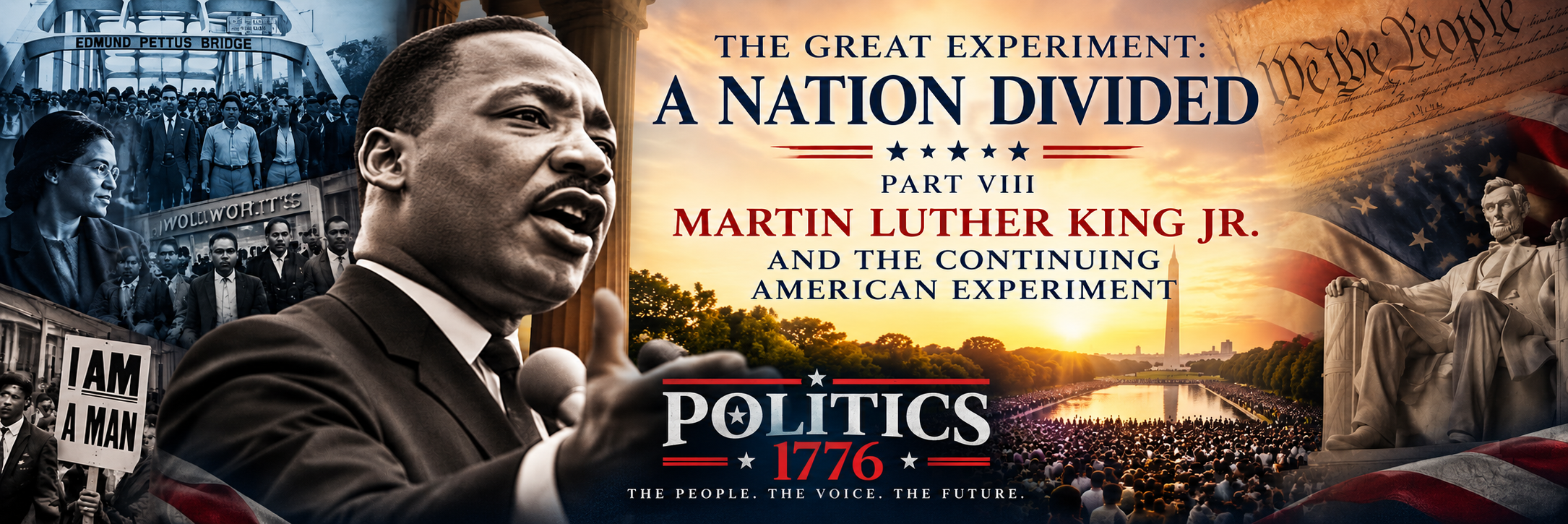
THE GREAT EXPERIMENT: A NATION DIVIDED
PART I — THE UNFINISHED QUESTION
Slavery, Liberty, and the Founding of America
Before there was a Civil War, there was a question.
It existed before Abraham Lincoln.
Before the Confederacy.
Before Gettysburg.
Before the Louisiana Purchase.
Before the Constitution itself.
It was present at the birth of the United States.
Could a nation founded on liberty continue to permit slavery?
The generation that declared American independence did not answer that question.
Some challenged slavery.
Some defended it.
Some believed it would eventually disappear.
Some depended upon it economically.
Some enslaved other human beings while speaking and writing about liberty.
And millions of people who would eventually live under the government they created were left outside the political promise being proclaimed.
The question remained.
And as the country grew, it became increasingly difficult to avoid.
Liberty and Slavery Existed Together
Slavery did not begin with the United States.
It had existed in Britain's North American colonies for generations before independence.
By the time Americans declared independence in 1776, enslaved people were part of the economies and societies of several colonies, particularly in the South.
But the American Revolution introduced powerful language into that existing world.
The Declaration of Independence announced:
“We hold these truths to be self-evident, that all men are created equal…”
It continued by declaring that people possessed unalienable rights, including:
“Life, Liberty and the pursuit of Happiness.”
And it made another extraordinary claim:
Government received its legitimate authority from “the consent of the governed.”
Those principles became part of America's founding philosophy.
But they immediately presented a contradiction.
Hundreds of thousands of people living in the new nation were enslaved.
They did not control their own labor.
They did not possess political power.
They could be bought and sold.
Families could be separated.
Their freedom depended upon decisions made by other people.
America had declared a principle of liberty while continuing a system that denied liberty to an entire population.
The contradiction was there from the beginning.
The Founders Were Not One Voice
Just as the Founders disagreed about government, taxation, banking, commerce, and federal power, they also disagreed about slavery.
It is important not to turn the founding generation into one side of an argument.
There wasn't one.
Some Americans opposed slavery on moral or religious grounds.
Some supported gradual emancipation.
Some wanted restrictions on the slave trade.
Some believed slavery would eventually disappear without immediate abolition.
Others defended the institution or resisted attempts to restrict it.
And many Americans benefited from it.
The contradiction could exist within individual people as well.
Thomas Jefferson wrote the Declaration of Independence and its famous statement that “all men are created equal.”
He also enslaved hundreds of people during his lifetime.
Jefferson criticized slavery at different points in his life and participated in some efforts to restrict it, while simultaneously benefiting from and perpetuating the institution himself.
That contradiction was not merely Jefferson's.
It reflected a contradiction inside the country being created.
Enslaved Americans Had Their Own Voice
The history of slavery and freedom cannot be told only through presidents, legislators, and constitutional delegates.
Enslaved people were not simply waiting for political leaders to decide their future.
African Americans sought freedom themselves.
Some escaped.
Some petitioned governments and courts.
Some served during the American Revolution.
Some negotiated for freedom.
Some resisted enslavement.
Free Black Americans also organized and participated in the growing argument over what the Revolution's promises actually meant.
If liberty was a natural right, they could ask, who possessed it?
If government rested upon consent, whose consent counted?
If all men were created equal, how far did those words reach?
Those questions would survive long after the Revolution ended.
Change Had Already Begun
The country was not moving uniformly in one direction.
During and after the Revolution, several northern states began taking steps toward ending slavery.
Vermont prohibited slavery in its 1777 constitution before entering the Union.
Pennsylvania adopted a gradual abolition law in 1780.
Other northern states followed different paths toward abolition.
The process was often gradual rather than immediate, and racial discrimination did not disappear with slavery.
But an important division was beginning to emerge.
Different parts of the country were developing different relationships with slavery.
That difference would become increasingly important as America expanded.
Then Came the West
Even before the Constitution was completed, Americans were confronting a question that would eventually become central to the Civil War:
Would slavery expand into new American territory?
In 1787, the Confederation Congress adopted the Northwest Ordinance.
It established a system for governing territory northwest of the Ohio River and eventually admitting new states.
And it contained an important provision:
Slavery and involuntary servitude were prohibited in the territory, except as punishment for a crime.
The ordinance also contained a provision permitting people escaping legally claimed labor or service to be reclaimed.
The significance was enormous.
The country was already beginning to establish rules about where slavery could and could not exist as America expanded westward.
That question was not settled.
It was only beginning.
Philadelphia — 1787
That same year, delegates gathered in Philadelphia to confront another problem.
The government created under the Articles of Confederation was struggling.
The delegates eventually decided not merely to revise the Articles but to construct an entirely new federal system.
They argued about representation.
Federal power.
State power.
Taxation.
Commerce.
The presidency.
The courts.
And slavery.
Slavery became one of the difficult issues threatening agreement among the states.
Once again, the delegates faced a choice.
They could attempt to resolve the institution itself.
Or they could construct compromises that allowed states with very different systems to remain together.
They chose compromise.
The Three-Fifths Compromise
One dispute concerned representation in the House of Representatives.
Representation would depend partly upon population.
That created an immediate question:
How would enslaved people be counted?
The result became known as the Three-Fifths Compromise.
For purposes of representation and direct taxation, the Constitution counted the entire free population and three-fifths of the enslaved population described in the document as “all other Persons.”
This point is sometimes misunderstood.
The Constitution was not declaring that an enslaved person was literally three-fifths of a human being.
The fraction determined how enslaved populations would be counted for congressional representation and direct taxation.
But the political consequences were substantial.
Enslaved people could not vote for representatives, yet a portion of their population count increased the representation of the states in which they were enslaved.
The compromise helped make agreement on the Constitution possible.
It also incorporated slavery into the political structure of the new government.
The Slave Trade
Another dispute concerned the international slave trade.
Some delegates wanted Congress to have the ability to prohibit it.
Delegates from states particularly resistant to such restrictions objected.
Another compromise followed.
The Constitution prevented Congress from prohibiting the importation of enslaved people before 1808.
Congress later acted, and the federal prohibition on importing enslaved people took effect in 1808.
But ending legal participation in the international trade did not abolish slavery.
Nor did it end the buying and selling of enslaved people inside the United States.
The domestic slave trade continued.
People Who Escaped
The Constitution contained another provision involving slavery.
A person legally held to “Service or Labour” in one state who escaped into another could not simply become free because the laws of the second state treated the situation differently.
The person could be claimed and returned.
This became known as the Fugitive Slave Clause.
Its importance would grow dramatically in later decades.
As northern states moved further away from slavery and abolitionist activity increased, Americans would increasingly clash over whether governments and citizens in free states should be required to participate in returning people to slavery.
That fight was still decades away.
But part of its constitutional foundation was already present in 1787.
What the Constitution Did Not Do
Perhaps the most consequential fact is what the Constitution didn't do.
It did not abolish slavery.
It did not create a national timetable for emancipation.
It did not resolve whether slavery would be allowed throughout America's future western territories.
Instead, the Constitution created a national government in which states permitting slavery and states moving away from slavery would exist together.
That helped make the new Union possible.
But it also meant that one of the country's deepest disagreements remained inside that Union.
The Constitution created a stronger country without settling the question of slavery.
Why Compromise?
It is easy, more than two centuries later, to look at the result and ask why the delegates did not simply abolish slavery in 1787.
But understanding history requires understanding the choices people believed they faced at the time.
The Constitutional Convention was attempting to create a government acceptable to states with very different economic systems, political interests, populations, and attitudes toward slavery.
The Union itself was uncertain.
Delegates compromised repeatedly because enough states had to accept the new Constitution for the new government to exist.
That explains why compromises happened.
It does not erase their consequences.
Those are two different questions.
Why was a compromise made?
And:
What did that compromise leave unresolved?
Both matter.
A Country Moving in Two Directions
By the end of the eighteenth century, the United States contained competing developments.
Some states were moving toward abolition.
The Northwest Ordinance prohibited slavery in a large federal territory.
Antislavery organizations existed.
Black Americans were asserting claims to freedom and citizenship.
Yet slavery remained firmly established elsewhere.
The Constitution accommodated it.
The domestic slave system continued.
And the country was preparing to expand.
That last point would change everything.
Because slavery was no longer only a question about the states that already existed.
Soon America would acquire enormous new territories.
Every new territory raised the possibility of another state.
And every potential state raised a question with enormous political consequences:
Would it permit slavery?
The Question Moves West
This is where the story begins to change.
At the founding, slavery was already a profound moral, economic, political, and constitutional problem.
But expansion would transform it into something even larger.
A new state could alter the balance of power in Congress.
A new slave state could increase the political influence of states permitting slavery.
A new free state could increase the influence of states where slavery was prohibited.
Land therefore became connected to political power.
Political power became connected to slavery.
And slavery became connected to the future shape of the United States.
The country could postpone some arguments.
It could compromise.
It could draw boundaries.
It could attempt to preserve political balance.
But every time America grew, the question returned.
Would slavery grow with it?
The Unfinished Question
The Founders created a remarkable constitutional system.
They established representative government.
They divided political power.
They created mechanisms for elections.
They protected important liberties.
They created a Constitution that could be amended.
But they also left one enormous contradiction unresolved.
A country declaring liberty as a founding principle continued to permit human beings to own other human beings.
For a time, the Union held that contradiction together.
But America was not going to remain thirteen states along the Atlantic coast.
It was going west.
And soon an opportunity would appear that would nearly double the size of the country.
President Thomas Jefferson would face an extraordinary decision.
The United States would acquire the Louisiana Territory.
And suddenly the unfinished question inherited from the founding would become much larger:
What happens to slavery when the nation itself expands?
That is where the next chapter begins.
NEXT — PART II
A Nation Expands
The Louisiana Purchase and the Question of Slavery
The Louisiana Purchase opened an enormous new chapter in American history.
It also opened an enormous new question.
As new territories became states, Americans would repeatedly have to decide whether slavery would be permitted to expand with them.
The arguments that followed would produce compromises.
Political parties would fracture.
Sections of the country would grow further apart.
And one of the questions the Founders had left unresolved would move steadily toward a national crisis.
THE GREAT EXPERIMENT CONTINUES.
Our Money Matters.
Our Choices Matter.
Our Voice Matters.
The People. The Voice. The Future.
Politics 1776