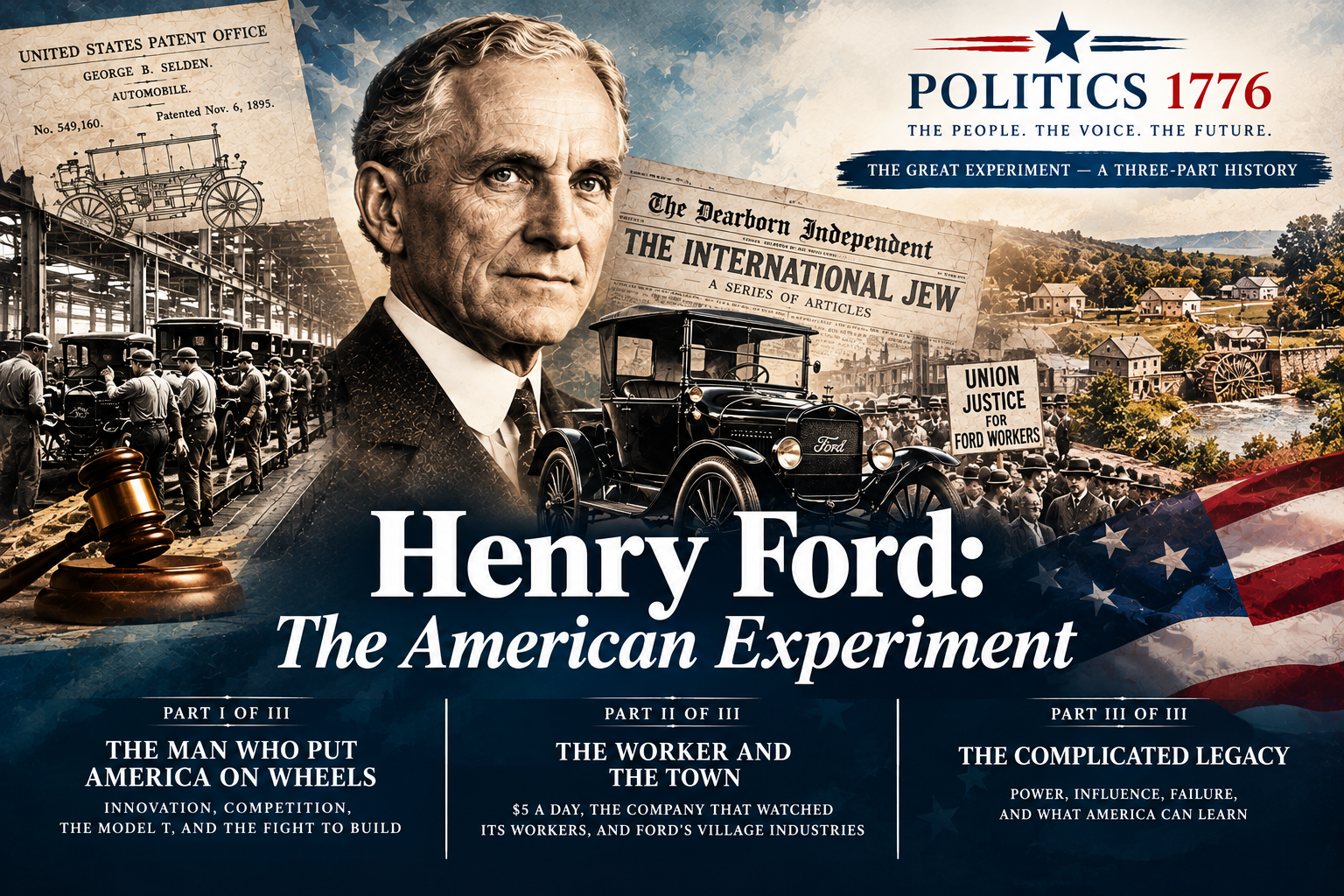
HENRY FORD: THE AMERICAN EXPERIMENT
Power, Influence, Failure, and a Complicated American Legacy THE GREAT EXPERIMENT — A THREE-PART HISTORY
PART III OF III
THE COMPLICATED LEGACY
What Henry Ford Changed, What He Got Wrong, and What America Can Learn
Henry Ford died in 1947.
By then, the automobile had transformed America.
The factory had transformed American manufacturing.
Mass production had transformed the relationship between price and production.
Millions of people had purchased automobiles.
Millions more had worked in factories.
The American economy had entered a new industrial age.
Ford had helped make much of it possible.
But Henry Ford's story cannot end by simply calling him a genius.
It cannot end by calling him a villain either.
History is rarely that convenient.
Ford was an extraordinary innovator.
He was also a deeply flawed human being.
He expanded opportunity for millions while attempting to control the lives of some of the people who worked for him.
He helped create a mass consumer economy while expressing hostility toward aspects of modern society.
He promoted rural and small-town life while building one of the world's largest industrial enterprises.
And he used his enormous public influence to promote ideas that caused real harm.
That is the part of the story that cannot be ignored.
SUCCESS DOES NOT MAKE A PERSON INFALLIBLE
There is a temptation when studying successful Americans to turn them into symbols.
The successful businessman becomes a hero.
The inventor becomes a genius.
The industrialist becomes proof that one person's determination can change the world.
There is some truth in that.
But there is also danger in it.
Success does not make a person right about everything.
Money does not create wisdom.
Fame does not create moral authority.
And changing the world does not mean every idea a person holds deserves to be followed.
Henry Ford is one of the clearest examples.
His accomplishments were enormous.
So were some of his mistakes.
THE POWER OF A PUBLIC VOICE
Ford understood something that many businessmen of his era did not fully appreciate:
His name had power.
People knew Henry Ford.
They trusted his reputation.
They bought his automobiles.
They followed his opinions.
And Ford eventually decided that he wanted his own platform from which to speak.
In 1918, Ford purchased the Dearborn Independent, a newspaper published in Dearborn, Michigan.
At first, the paper served as a vehicle for Ford's opinions about American society, politics, business, war, immigration, and modern life.
Then it became something much darker.
THE INTERNATIONAL JEW
Beginning in 1920, the Dearborn Independent published a series of articles titled:
“The International Jew.”
The series promoted antisemitic conspiracy theories accusing Jewish people of controlling or manipulating American business, finance, politics, media, and world affairs.
These claims were false.
The material also drew heavily from the Protocols of the Elders of Zion, a notorious antisemitic forgery that falsely presented itself as evidence of a Jewish plan for world domination.
The fraud had already been exposed.
That did not stop Ford's newspaper from using it.
The newspaper's influence was substantial.
The material was republished in book form.
It circulated internationally.
It was translated into multiple languages.
And Ford's reputation gave the material credibility that it otherwise might not have possessed.
This was not simply a private opinion written in a diary.
Ford used a public platform to spread false accusations about an entire people.
That matters.
WORDS HAVE CONSEQUENCES
The lesson here is bigger than Henry Ford.
A person with influence has a greater responsibility for what they put into the world.
Free speech protects the right to express opinions.
It does not transform falsehood into truth.
And having the right to speak does not mean other people are required to accept what is said.
Ford's antisemitism was not a harmless eccentricity.
It helped spread hatred and conspiracy theories to a mass audience.
Some Nazi leaders in Germany admired Ford for his antisemitic writings.
That does not mean Ford was responsible for Nazism.
History should not make claims the evidence cannot support.
But it does mean his writings had an international influence that went far beyond his automobile company.
That is an important part of his legacy.
FORD EVENTUALLY APOLOGIZED
Ford eventually attempted to distance himself from the material.
The Dearborn Independent was closed in 1927.
Ford issued a public apology expressing regret that he had been portrayed as an enemy of Jewish people.
He also agreed to stop the publication and distribution of the antisemitic material.
The apology matters.
But an apology does not erase history.
Both facts can be true:
Ford apologized.
And:
Ford had already used his enormous influence to spread antisemitic propaganda.
A serious historical account has to acknowledge both.
THE LESSON OF POWER
This may be one of the most important lessons from Ford's entire life.
Power magnifies everything.
If an unknown person has a bad idea, the damage may remain limited.
If a powerful industrialist has a bad idea and millions of people listen, the consequences can be much greater.
The same principle applies to governments.
It applies to corporations.
It applies to media organizations.
It applies to political movements.
It applies to wealthy individuals.
And it applies to ordinary citizens when they gain influence through modern technology.
The more influence a person has, the more important judgment becomes.
FORD'S CONTRADICTIONS
Henry Ford's life contains contradictions that are difficult to reconcile.
He believed in efficiency.
Yet he could be remarkably resistant to change.
He believed workers should be productive.
Yet he became deeply involved in their personal lives.
He wanted people to have access to automobiles.
Yet he fought organized labor when workers demanded a greater voice.
He admired small-town America.
Yet he built enormous industrial facilities.
He promoted higher wages.
Yet his company resisted unions.
He wanted independence from established institutions.
Yet he himself accumulated enormous economic power.
He promoted ideas about American self-sufficiency.
Yet his company eventually became an international enterprise.
These contradictions are not a reason to dismiss Ford.
They are a reason to study him.
THE GREAT EXPERIMENT IS FULL OF CONTRADICTIONS
America itself contains contradictions.
We believe in individual freedom.
We also create laws to protect people from harm.
We believe in private property.
We also regulate markets.
We believe businesses should be free to succeed.
We also believe workers should have legal rights.
We believe in freedom of speech.
We also understand that speech can have consequences.
We believe government should be limited.
We also expect government to perform certain essential functions.
The American system has never been perfectly consistent.
It is an ongoing argument.
That is why it is called an experiment.
FORD AND THE AMERICAN DREAM
Despite his failures, Ford's industrial achievements had an enormous effect on the American idea of opportunity.
The automobile gave ordinary people greater mobility.
Mass production lowered the cost of manufactured goods.
Higher wages gave some workers greater purchasing power.
Industrial jobs created opportunities for millions.
And the growth of mass production helped establish the consumer economy that became central to twentieth-century America.
Ford demonstrated something important:
A product becomes transformative when ordinary people can actually afford it.
That principle reaches far beyond automobiles.
Technology matters.
But access matters too.
Innovation matters.
But affordability matters too.
Production matters.
But the people who benefit from production matter too.
FROM FARM TO FACTORY
Ford also understood that economic change could destroy as well as create.
Industrialization pulled people toward cities.
Small farms struggled.
Traditional trades disappeared.
Communities changed.
The old way of life was not simply replaced by something better.
It was replaced by something different.
Ford's Village Industries were one attempt to deal with that tension.
He experimented with smaller factories in rural communities so that people could combine industrial employment with farming and local life.
The experiment had limitations.
But the idea was significant:
Economic progress should not automatically require communities to disappear.
That remains a powerful question for America.
What happens to the town when the factory closes?
What happens to the family farm?
What happens when the young people leave because there are no jobs?
Economic policy is not just about statistics.
It is about people and places.
WHAT FORD GOT RIGHT
It is possible to criticize Ford honestly while still recognizing what he accomplished.
He understood the importance of:
Competition
A market where new businesses can challenge established interests.
Productivity
Finding better ways to produce more with fewer wasted resources.
Affordability
Making useful products available to ordinary people.
Worker compensation
Recognizing that productive workers should have an opportunity to share in economic success.
Local opportunity
Understanding that communities need productive work if they are going to remain healthy.
Practical innovation
Taking existing ideas and combining them into systems that work at scale.
These are important lessons.
WHAT FORD GOT WRONG
The other side matters just as much.
Control
An employer should be careful about crossing the boundary between managing a workplace and controlling an employee's private life.
Labor rights
Workers are not simply inputs in a production system.
They have interests and voices of their own.
Concentrated power
The larger a person's economic influence becomes, the greater the consequences of his decisions.
Prejudice
No amount of innovation excuses hatred toward an ethnic or religious group.
Public influence
A famous person's platform creates responsibility.
Human dignity
Efficiency is valuable.
But people are not machines.
THE BIGGEST LESSON
Henry Ford's greatest lesson may have nothing to do with automobiles.
It may be this:
Do not confuse success with wisdom.
A person can build something extraordinary and still be wrong.
A company can create enormous wealth and still mistreat people.
A government can accomplish important things and still overreach.
A regulation can solve one problem and create another.
A technological breakthrough can improve millions of lives and create new problems at the same time.
History is complicated because people are complicated.
That does not mean we should abandon judgment.
It means we should use it.
WHY HENRY FORD STILL MATTERS
More than a century after the Model T, America is still wrestling with many of the same fundamental questions.
How much regulation is necessary?
How much freedom should businesses have?
How should workers be protected?
What is a fair wage?
How should technological change affect employment?
How do we preserve opportunity?
How do we keep communities economically healthy?
How do we prevent concentrated power from becoming abusive?
How do we protect individual freedom without ignoring legitimate public concerns?
These questions did not disappear when Ford died.
They became more important.
THE AMERICAN EXPERIMENT IS NOT A HERO STORY
The American story is not a collection of perfect heroes.
It is a collection of people.
People who built.
People who failed.
People who fought.
People who innovated.
People who made terrible decisions.
People who corrected themselves.
People who refused to change.
People who changed the country anyway.
Henry Ford belongs in that story because he represents both sides of American possibility.
He shows what individual initiative can accomplish.
And he shows why concentrated power must always be examined carefully.
BUILD — BUT REMEMBER WHO YOU ARE BUILDING FOR
There is a lesson here for every entrepreneur, worker, inventor, policymaker, and citizen.
Build something.
Take risks.
Compete.
Innovate.
Create jobs.
Lower costs.
Make things better.
But remember the people affected by what you build.
A company exists to produce something of value.
A government exists to serve the public.
A worker deserves dignity.
A customer deserves choice.
A community deserves opportunity.
And an individual deserves the freedom to live his or her life without unnecessary interference.
Economic success should expand human possibility.
It should not reduce people to numbers.
THE GREAT EXPERIMENT
Henry Ford changed America.
He helped put the country on wheels.
He transformed manufacturing.
He helped make mass production a defining feature of modern capitalism.
He helped create new opportunities for workers and consumers.
He experimented with ways to connect industry and community.
He also tried to control workers.
He fought unions.
He spread antisemitic conspiracy theories.
He used his enormous public influence irresponsibly.
And eventually, he apologized for some of the harm he had helped create.
None of those facts cancels the others.
That is the point.
The goal of history is not to build statues.
It is to understand people.
To understand institutions.
To understand power.
And to understand consequences.
WHAT CAN WE LEARN FROM HENRY FORD?
1. Give people room to build.
Innovation requires opportunity.
2. Keep competition alive.
Established interests should not be allowed to unnecessarily shut out legitimate competitors.
3. Reward productivity.
When people create more value, there should be room for wages, prices, and living standards to improve.
4. Remember the human being behind the worker.
Employees are people before they are production numbers.
5. Respect individual freedom.
A paycheck should not purchase control over a person's private life.
6. Give workers a voice.
Economic power should not automatically mean absolute control.
7. Protect communities.
Economic development should create opportunity without automatically destroying the communities where people live.
8. Question concentrated power.
No person, corporation, organization, or government should be above scrutiny.
9. Separate achievement from authority.
Being brilliant at one thing does not make someone right about everything.
10. Learn from the whole story.
Do not erase accomplishments because of failures.
Do not erase failures because of accomplishments.
Study both.
THE FINAL LESSON
Henry Ford wanted to change the world.
He did.
But the story of Henry Ford ultimately leaves us with a question that is much bigger than automobiles.
When one person has the ability to change the lives of millions:
Who holds that person accountable?
When a corporation becomes enormously powerful:
Who protects the individual?
When technology transforms work:
Who decides how the benefits are shared?
When government creates rules:
Who makes sure those rules still serve their purpose?
And when ordinary citizens disagree with the people and institutions holding power:
Do they still have a voice?
Those are not questions for Henry Ford's generation alone.
They are questions for ours.
The American Experiment was never supposed to be finished.
It was never supposed to depend on one leader.
One company.
One political party.
Or one generation.
It depends on citizens who are willing to learn, question, participate, build, and hold power accountable.
Henry Ford's story gives us both inspiration and warning.
Build boldly.
Compete fairly.
Respect the worker.
Protect individual freedom.
Question concentrated power.
And never assume that success makes anyone above accountability.
That is the lesson.
That is the experiment.
And it continues.
THE GREAT EXPERIMENT CONTINUES.
THE PEOPLE. THE VOICE. THE FUTURE.
Politics 1776
SOURCES & FURTHER READING
U.S. Holocaust Memorial Museum — “Antisemitism and Henry Ford's ‘The International Jew’”
Historical documentation of Ford's use of the Dearborn Independent to spread antisemitic conspiracy theories, the International Jew series, its international circulation, and Ford's later apology.
The Henry Ford — “Henry Ford and Anti-Semitism”
Historical research concerning Ford's purchase of the Dearborn Independent, the origins and development of the antisemitic campaign, the Sapiro lawsuit, and Ford's eventual apology and closure of the newspaper.
The Henry Ford — The International Jew
Primary-source archival material documenting the publication and distribution of the antisemitic series.
U.S. Department of Labor — Americans in Depression and War
Historical material concerning Ford's labor relations, unionization, the 1937 Battle of the Overpass, the 1941 strike, and the Ford-UAW agreement.
The Henry Ford — Village Industries
Archival records documenting Ford's experiments with small rural factories, local employment, farming, and community-based industrial production.
Library of Congress — Ford and the Moving Assembly Line
Historical documentation concerning Ford's manufacturing methods and the development of mass production.
The Henry Ford — Ford Motor Company Archives
Primary-source materials concerning Ford's production system, workforce, compensation policies, labor relations, and industrial development.