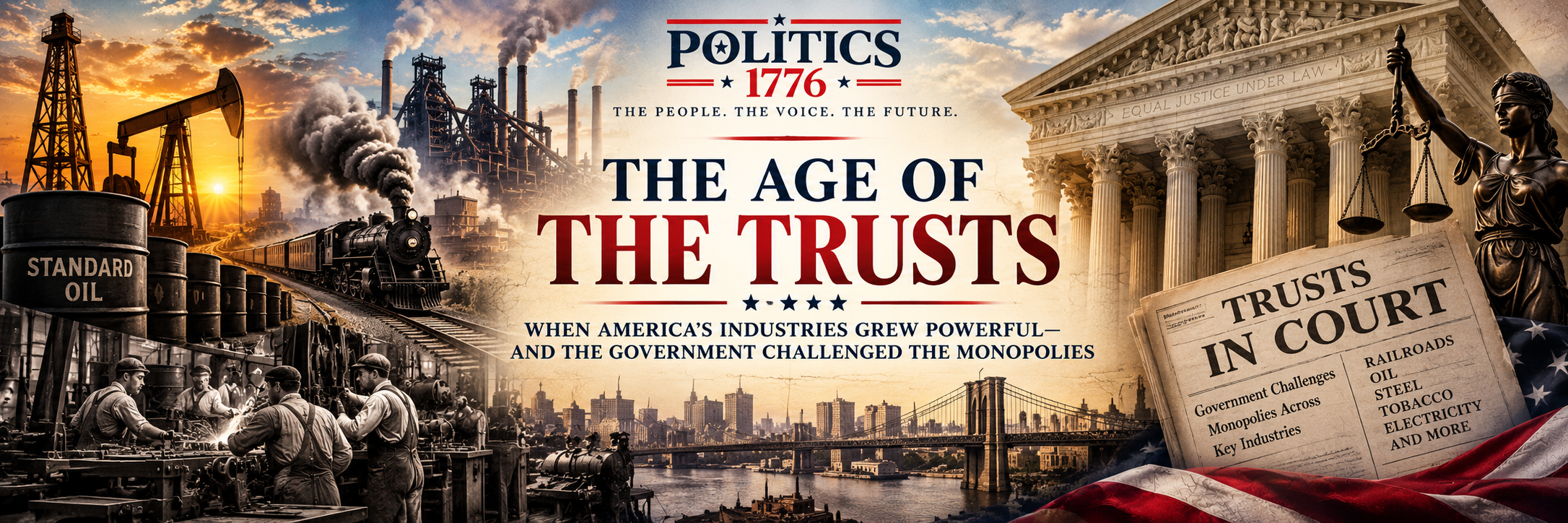
THE AGE OF THE TRUSTS
When America's Industries Grew Powerful—and the Government Challenged the Monopolies
A Story of Industry, Competition, Economic Power, and the American Free-Enterprise System
America was changing.
Railroads stretched across the continent.
Oil powered a growing industrial economy.
Steel transformed cities.
Electricity began lighting homes and businesses.
Factories produced goods on a scale earlier generations could scarcely have imagined.
New inventions created new industries.
And some American entrepreneurs accumulated extraordinary wealth.
But something else was happening.
As businesses expanded, some began acquiring competitors, controlling transportation routes, influencing prices, and consolidating entire industries under a relatively small number of owners.
For smaller businesses, competing could become increasingly difficult.
For consumers, the question was whether concentrated economic power would limit their choices.
For government, the question was more complicated.
How could America protect the freedom to build a successful business while also protecting the competition that made free enterprise possible?
That question would help shape some of the most important economic laws in American history.
It would lead to courtroom battles, new federal legislation, and the breakup or restructuring of some of the country's most powerful business combinations.
This was the Age of the Trusts.
The Rise of Industrial America
Following the Civil War, the United States entered a period of extraordinary industrial expansion.
Railroads connected distant markets.
Steel production increased.
Oil refining became a major industry.
New manufacturing technologies transformed production.
Telecommunications began connecting businesses and communities.
American companies could now operate on a national scale.
This growth created enormous opportunities.
Products could be manufactured more efficiently.
Transportation became faster.
National distribution networks developed.
New jobs appeared.
Goods that had once been expensive or difficult to obtain became increasingly accessible.
Large businesses played a central role in that transformation.
But industrial growth also brought new questions about the concentration of economic power.
What Was a Trust?
During the late nineteenth century, the word trust became closely associated with large business combinations.
In one common arrangement, shareholders of several companies transferred control of their stock to a group of trustees.
Those trustees could then direct businesses that had previously operated independently.
The companies might retain separate names.
But important decisions could be controlled by the same people.
Such arrangements could reduce competition among the participating businesses.
A trust could coordinate production, pricing, expansion, and other business decisions across an industry.
Not every large corporation was a trust.
Not every business combination was unlawful.
And the word monopoly did not automatically mean that a company had violated the law.
The legal concern was whether businesses used their power to unlawfully restrain trade, exclude competitors, or monopolize markets.
That distinction would become central to American antitrust law.
Standard Oil and the Rise of John D. Rockefeller
One of the most famous industrial enterprises of the period was Standard Oil.
John D. Rockefeller helped build the company into an enormous oil-refining and distribution business.
Standard Oil developed efficient operations, extensive transportation arrangements, and a nationwide business network.
Its growth reflected both industrial innovation and aggressive business practices.
The company acquired competitors and consolidated operations.
It also used arrangements and practices that critics argued unfairly disadvantaged rival businesses.
By the early 1880s, Standard Oil controlled a dominant share of American oil refining.
In 1882, the Standard Oil Trust brought numerous companies under centralized control.
To supporters, Standard Oil demonstrated the efficiencies possible through large-scale industrial organization.
To critics, it demonstrated the dangers of allowing one business combination to gain overwhelming influence over an essential industry.
The debate would eventually reach the Supreme Court.
Railroads: The Networks That Connected America
Railroads were essential to America's industrial growth.
They carried agricultural products, raw materials, manufactured goods, and passengers.
They connected cities with farms, factories, ports, and mines.
Without railroads, much of the country's industrial expansion would have been considerably more difficult.
But railroad companies also possessed enormous economic influence.
In communities dependent upon one railroad, businesses and farmers often had limited transportation alternatives.
Disputes arose over freight rates, discriminatory pricing, rebates, and preferential treatment.
Some large customers could negotiate favorable arrangements unavailable to smaller shippers.
Farmers and merchants complained that transportation costs could determine whether their businesses succeeded.
These concerns helped produce the Interstate Commerce Act of 1887, which created the Interstate Commerce Commission.
It was an early attempt to regulate important aspects of interstate railroad operations.
But the debate over concentrated corporate power was only beginning.
The Sherman Antitrust Act of 1890
In 1890, Congress passed the Sherman Antitrust Act.
It became the foundation of federal antitrust law.
The legislation prohibited certain contracts, combinations, and conspiracies in restraint of interstate or foreign trade.
It also prohibited monopolization and attempts to monopolize.
The law did not declare that every successful or large company was illegal.
Instead, it established a legal basis for challenging unlawful restraints of trade and monopolistic conduct.
Its language was broad.
Courts would have to determine how it applied to particular businesses and arrangements.
And that process would take years.
Early enforcement was uneven.
Some Supreme Court decisions limited the government's ability to apply the law.
But by the beginning of the twentieth century, antitrust enforcement was becoming a major national issue.
Theodore Roosevelt and the Trustbusters
When Theodore Roosevelt became president in 1901, the country was confronting the growing influence of large corporations.
Roosevelt did not believe that every large business should be dismantled.
He recognized that large-scale industrial organization could produce economic benefits.
But he also believed that corporations should remain subject to the law and public oversight.
His administration pursued cases against business combinations considered unlawful.
One of the most important involved the railroad industry.
Northern Securities: The Railroad Case
In 1901, powerful financiers organized the Northern Securities Company.
The holding company acquired controlling interests in major competing railroads, including the Great Northern and Northern Pacific.
The arrangement raised concerns that competition between important rail systems would be eliminated.
Roosevelt's administration brought an antitrust case.
In 1904, the Supreme Court upheld the government's challenge.
The Northern Securities combination was ordered dissolved.
The decision became one of the defining victories of Roosevelt's antitrust efforts.
It also demonstrated something significant.
The federal government could use existing law to challenge powerful corporate combinations.
But Roosevelt's approach was not simply to oppose size.
It was to distinguish between large businesses operating lawfully and combinations that violated antitrust law.
The Standard Oil Breakup
The federal government brought its major antitrust case against Standard Oil in 1906.
The case examined the company's methods of acquiring competitors and maintaining its position in the petroleum industry.
In 1911, the Supreme Court upheld the dissolution of the Standard Oil combination.
The company was separated into 34 businesses.
Some of those businesses later became major oil companies in their own right.
The ruling was historically significant for another reason.
The Supreme Court applied what became known as the rule of reason.
Under that approach, the Sherman Act was understood to prohibit unreasonable restraints of trade rather than every commercial agreement that might restrict competition in some way.
The decision helped shape American antitrust law for generations.
It also showed that breaking up a business combination did not necessarily mean destroying its productive operations.
Refineries, distribution systems, and other assets continued operating under separate corporate ownership.
The legal structure changed.
The industry continued.
American Tobacco
Standard Oil was not alone.
The American Tobacco Company had also become a powerful combination through acquisitions and consolidation.
In 1911, the Supreme Court ruled against the company's unlawful restraints of trade and monopolization.
The combination was ordered reorganized.
Major portions of its operations were separated into competing businesses.
Together, the Standard Oil and American Tobacco decisions demonstrated that the federal government was prepared to pursue large industrial combinations through the courts.
But they also showed that antitrust enforcement required detailed legal analysis.
Each case depended upon the company's conduct, organization, and effects on competition.
William Howard Taft and Antitrust Enforcement
Although Theodore Roosevelt is frequently remembered as the great trustbuster, William Howard Taft also played an important role.
During Taft's presidency, the federal government continued bringing antitrust cases.
The Standard Oil and American Tobacco Supreme Court decisions occurred during his administration.
Antitrust enforcement had become an established feature of federal economic policy.
But Americans continued debating how far it should go.
Some believed stronger enforcement was necessary to protect smaller businesses and consumers.
Others worried that excessive government intervention could discourage investment, efficiency, and economic growth.
These disagreements were not simply about whether business was good or bad.
They concerned the rules under which businesses should compete.
The Clayton Act and the Federal Trade Commission
In 1914, Congress enacted the Clayton Antitrust Act.
The legislation addressed specific business practices that could threaten competition, including certain acquisitions, exclusive arrangements, and discriminatory pricing practices under specified conditions.
That same year, Congress established the Federal Trade Commission.
The FTC was given responsibility for addressing unfair methods of competition.
Together, these measures expanded the federal government's ability to investigate and challenge anticompetitive conduct.
They also reflected a growing recognition that waiting until an entire industry became dominated by one unlawful combination might not be sufficient.
Government could also examine practices that threatened competition before the damage became more extensive.
Steel: A Different Outcome
Not every large industrial corporation was broken up.
Consider United States Steel.
Formed in 1901, U.S. Steel brought together major steel-producing businesses under one corporation.
It became one of the largest companies in the world.
The federal government eventually challenged the company under antitrust law.
But in 1920, the Supreme Court ruled in favor of U.S. Steel.
The company remained intact.
The decision illustrated a central distinction in antitrust law.
Being large was not, by itself, enough to establish an unlawful monopoly.
Courts examined conduct and the legal requirements for proving a violation.
The outcome of an antitrust case was not predetermined simply because a corporation controlled substantial assets or held an important market position.
Electricity and Gas: A Different Kind of Industry
Electricity and gas presented another challenge.
These industries required expensive infrastructure.
Power plants.
Transmission lines.
Distribution systems.
Pipelines.
Local service networks.
Building multiple competing sets of wires or pipes along the same streets was often impractical.
As a result, many utility systems developed characteristics of what economists call natural monopolies.
A natural monopoly can arise when one provider can serve a market at lower total cost than multiple competing providers because of the infrastructure and scale involved.
This created a different policy problem.
If direct competition was impractical, how could customers be protected?
One answer was regulation.
States increasingly established public utility commissions to oversee rates and service.
But the ownership structures of electric and gas companies were also changing.
And those structures would eventually attract federal attention.
The Utility Holding Companies
During the early twentieth century, some electric and gas businesses became part of large holding-company systems.
A holding company could own controlling interests in multiple operating utilities.
Some systems extended across many states.
These arrangements could help businesses obtain financing and coordinate operations.
But they could also create complicated corporate structures.
Some holding-company systems relied on excessive debt, questionable accounting, and transactions between affiliated businesses that disadvantaged investors or consumers.
The problem was not simply that a company supplied electricity or gas to a large area.
It was also how ownership, financing, and control were organized.
When the Great Depression arrived, weaknesses in some of these financial structures became especially apparent.
The Public Utility Holding Company Act of 1935
In 1935, Congress enacted the Public Utility Holding Company Act.
The law addressed abuses involving electric and gas utility holding companies.
It placed important restrictions on holding-company structures and gave the Securities and Exchange Commission authority over specified aspects of their organization and financial practices.
The SEC subsequently worked to simplify and reorganize many holding-company systems.
This was not identical to the Standard Oil breakup.
Nor was it an attempt to make every local electric or gas utility compete through duplicate infrastructure.
It was a combination of corporate restructuring, financial oversight, and utility regulation.
The difference matters.
Oil companies, railroads, steel manufacturers, and utilities presented different economic and legal problems.
The government did not use one identical solution for all of them.
What About Smaller Businesses?
The antitrust debate was not limited to the largest corporations.
It also concerned the ability of smaller companies to enter markets and compete.
A business might develop a new product.
An inventor might introduce a new technology.
An entrepreneur might discover a more efficient method of production.
But competition could become difficult when an established company controlled essential transportation, distribution, or other market access.
Antitrust law was intended, in part, to protect the competitive process.
That did not guarantee that every small business would succeed.
Nor did it require that large businesses be prevented from growing.
It meant that success was supposed to occur within a system of lawful competition.
This was one of the central tensions of the industrial age.
America wanted innovation.
It wanted investment.
It wanted expanding industries.
But it also had to decide what rules would govern the exercise of economic power.
The Question of Government Power
Antitrust enforcement introduced another debate.
How much authority should the federal government possess over private business?
The Constitution gives Congress authority to regulate commerce among the states.
Federal antitrust legislation relied upon that constitutional foundation.
Supporters of stronger enforcement argued that national corporations operating across state lines required national rules.
They believed competition could be undermined when powerful businesses restrained trade or excluded rivals.
Critics of particular enforcement policies worried about uncertainty, excessive intervention, and the possibility that government might interfere with legitimate business efficiency.
Others favored regulation rather than forced breakups.
Still others believed certain industries required more direct public oversight.
These debates produced different policies across different administrations.
They also shaped the relationship between American government and the private economy.
The Difference Between Big Business and Monopoly
One of the most important lessons of this period is that large businesses and unlawful monopolies are not automatically the same thing.
A company can grow because it makes a better product.
It can become successful because it reduces costs.
It can develop more efficient manufacturing methods.
It can attract customers through quality, price, and innovation.
None of those things automatically violates antitrust law.
But a company can also use unlawful agreements or exclusionary conduct to restrain competition.
That is where antitrust concerns arise.
The purpose of antitrust enforcement was not to guarantee that every competitor survived.
It was to protect competition from unlawful restraints and monopolistic conduct.
That distinction remains essential to understanding the history.
Did Breaking Up the Trusts Work?
There is no single answer that applies to every industry.
The Northern Securities decision disrupted a railroad combination that eliminated competition between major lines.
The Standard Oil decision separated an enormous petroleum combination into independently owned companies.
The American Tobacco decision required restructuring.
U.S. Steel remained intact after its legal challenge.
Electric and gas utility holding companies faced a different system of federal oversight and reorganization.
Some reforms changed ownership.
Others changed business practices.
Still others created regulatory structures.
And the results continued evolving long after the original cases.
Antitrust laws did not eliminate large corporations.
They did not end disputes over market power.
But they established lasting legal mechanisms for challenging certain restraints on competition.
How This Shaped America
The Age of the Trusts helped establish the framework of the modern American economy.
Large corporations remained central to manufacturing, transportation, energy, communications, and commerce.
But their conduct became subject to a growing body of federal competition law.
The government acquired additional tools to investigate business practices.
Courts developed legal standards for determining when conduct violated antitrust law.
State and federal regulators developed different approaches to industries with limited practical competition.
And Americans continued debating the proper balance between private enterprise and public oversight.
The country did not choose to eliminate large businesses.
Nor did it leave every form of corporate conduct beyond government scrutiny.
Instead, it developed a changing system of laws, courts, enforcement agencies, and regulation.
That system emerged from decades of economic conflict and political debate.
The Lessons of the Trustbusters
The history offers several important lessons.
Industrial growth can create enormous benefits.
Railroads, petroleum, steel, electricity, and other industries helped transform American life.
Economic power can also become concentrated.
Large-scale ownership and control can raise questions about market access, competition, and consumer choice.
Not every industry requires the same response.
The economic realities of a railroad, oil refinery, steel mill, and electric distribution system are different.
The rule of law matters.
Major antitrust cases were argued through the courts, where the government had to establish legal grounds for its claims.
Government power also requires scrutiny.
Antitrust policy involves decisions about private property, commerce, competition, and the appropriate limits of public authority.
And perhaps most importantly:
Protecting free enterprise and protecting competition are related goals, but determining how to accomplish both has never been simple.
THE GREAT EXPERIMENT CONTINUES
The industrial age changed America.
It created extraordinary wealth.
It expanded opportunity.
It transformed transportation, manufacturing, energy, and everyday life.
But it also raised difficult questions about the concentration of economic power.
The response was not one law.
It was not one president.
It was not one court case.
It was a decades-long process involving Congress, presidents, courts, businesses, workers, consumers, and voters.
The country debated.
It legislated.
It litigated.
It regulated.
And it continued changing.
The Age of the Trusts reminds us that America's economic system did not emerge fully formed.
Like its political institutions, it developed through competing ideas, disagreements, decisions, and experience.
Understanding that history helps explain why competition law exists, how it developed, and why debates over business and government remain part of American civic life.
Because the questions that shaped industrial America were ultimately questions about how a free society organizes economic power.
And those questions remain part of the American experiment.
Our Money Matters.
Our Choices Matter.
Our Voice Matters.
The People. The Voice. The Future.
Politics 1776