

THE GREAT EXPERIMENT: THE AMERICAN CIVIL WAR
PART I
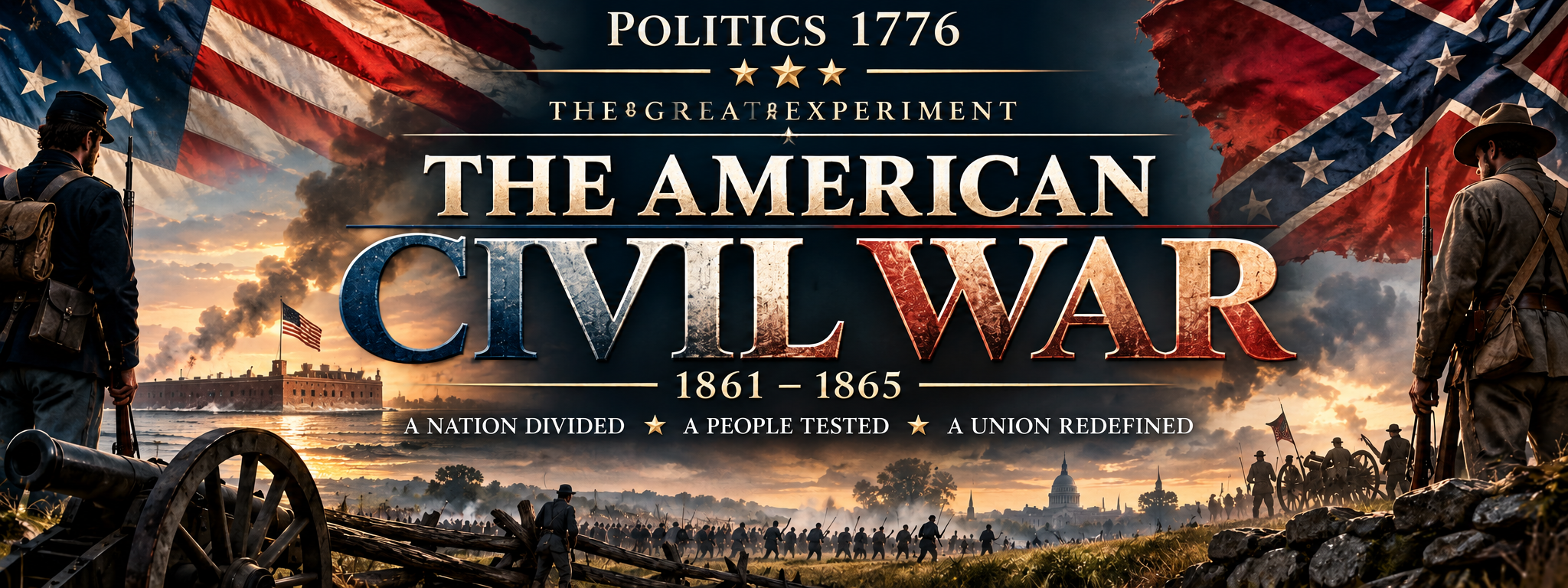
PART I OF V — A NATION AT WAR
The First Shots, the First Battles, and the Realization That America Was Fighting Itself
1861
The Morning Everything Changed
In the early morning hours of April 12, 1861, artillery fire broke the darkness over Charleston Harbor, South Carolina.
Confederate forces had opened fire on Fort Sumter, a United States military installation surrounded by territory claimed by the newly formed Confederate States of America.
Inside the fort, Major Robert Anderson commanded a small federal garrison.
His men were running short of supplies.
Outside, Confederate batteries stood ready to force their surrender.
For months, Americans had watched a political crisis deepen.
Southern states had declared their separation from the United States following the election of Abraham Lincoln. A new Confederate government had formed under President Jefferson Davis.
The seceding states had challenged the authority of the federal government, and the future of the Union was uncertain.
Now the confrontation had become an armed conflict.
For approximately thirty-four hours, Confederate artillery bombarded Fort Sumter.
Anderson's garrison returned fire, but its position was increasingly untenable.
On April 13, Anderson agreed to surrender. The following day, federal troops evacuated the fort.
No soldier had been killed by enemy fire during the bombardment, although two Union soldiers died in an accident during the departure ceremonies.
The immediate military consequences were limited.
The historical consequences were enormous.
The American Civil War had begun.
The conflict would ultimately become the deadliest war in American history, transform the federal government, destroy the legal institution of slavery, and leave consequences that would shape the United States for generations.
But in April 1861, few Americans understood the scale of what lay ahead.
A Country Divided Against Itself
The political disagreements leading to the Civil War had developed over decades.
The expansion of slavery into western territories, the constitutional relationship between states and the federal government, and the future of slavery within the United States had become increasingly contentious.
The central role of slavery in secession is documented in the declarations and statements issued by seceding states and Confederate leaders.
For many white Southerners who supported secession, preserving slavery and the social and political order built around it was fundamental.
Other Southerners opposed secession or remained loyal to the United States.
Northern opinion was also divided.
Many Northerners opposed the extension of slavery, but not all supported immediate abolition or racial equality.
For President Abraham Lincoln, the immediate objective at the beginning of the war was to preserve the Union.
The constitutional and political crisis that brought the country to Fort Sumter is examined in the existing Politics 1776 series:
A Nation Divided — Part IV: Why the Civil War Happened
Our story now turns from the causes of the conflict to the war itself.
How did the two governments prepare to fight?
Why did Americans believe victory might come quickly?
And how did the first year of war begin changing the country?
Lincoln's First Great Decision
Abraham Lincoln had been president for little more than a month when Fort Sumter fell.
He faced a crisis unlike any encountered by his predecessors.
Seven states had seceded before his inauguration.
The federal government had lost control of military installations and property in parts of the South.
The Confederacy had established its own political institutions and armed forces.
Now Confederate troops had attacked a federal fort.
Lincoln responded on April 15, 1861, by calling for 75,000 militia to suppress the rebellion.
He also summoned Congress to meet in a special session.
The decision made clear that the administration would use military force to maintain federal authority.
But the call for troops had consequences beyond Washington.
Several slaveholding states that had not initially seceded now faced a choice.
Would they remain in the Union and support federal military action?
Or would they join the Confederacy?
Virginia, Arkansas, North Carolina, and Tennessee ultimately joined the secession movement.
The Confederacy now consisted of eleven states.
The geography of the war had changed dramatically.
Virginia's secession placed the Confederate capital, soon relocated to Richmond, only about one hundred miles from Washington.
The two opposing governments were separated by a relatively short distance.
Yet the war would spread across an enormous portion of the continent.
Eleven States — But Not One United South
It is easy to imagine the Civil War as a simple contest between a united North and a united South.
The reality was more complicated.
Not every slaveholding state joined the Confederacy.
Delaware, Maryland, Kentucky, and Missouri remained in the Union.
Their populations were divided, and their political situations differed considerably.
Maryland was especially important because Washington, D.C., bordered the state on several sides.
If Maryland had joined the Confederacy, the federal capital would have faced an even more dangerous strategic position.
Kentucky occupied a vital location along major rivers and transportation routes.
Missouri provided access to the Mississippi River and the western territories.
The loyalty of these border states was essential to Union military planning.
Lincoln's administration therefore faced a difficult balance.
It needed to preserve the Union while avoiding actions that might drive additional slaveholding states into the Confederacy.
This influenced early decisions concerning slavery, military operations, and federal authority.
The border states also revealed that political loyalties did not always follow geographic boundaries.
Families divided.
Neighbors supported opposing governments.
Some communities sent soldiers to both armies.
The war was not simply being fought between regions.
It was being fought within communities and, sometimes, within families.
The Divided State of Virginia
Virginia's decision to secede created another conflict.
Many residents of the state's western counties opposed leaving the Union.
The region had different economic interests and political relationships from much of eastern Virginia.
Opposition to secession was particularly strong in several western communities.
Unionist leaders organized a rival state government that claimed to represent loyal Virginia.
Military operations followed as Union and Confederate forces competed for control of the region.
The Union's early successes in western Virginia helped secure important transportation routes and strengthen the position of local Unionists.
The political division would eventually lead to the creation of West Virginia in 1863.
But in 1861, the outcome remained uncertain.
The situation raised questions about state sovereignty and constitutional government.
Could a state leave the Union?
And could part of a state separate from the rest while remaining loyal to the United States?
These issues were no longer confined to legislative debate.
They were being decided amid war.
Two Governments Prepare for War
Both the Union and the Confederacy began mobilizing armies.
The United States possessed important advantages.
The Union had a larger population, greater industrial capacity, more extensive railroad infrastructure, and a stronger navy.
Northern factories could produce weapons, ammunition, uniforms, and other military supplies on a large scale.
The federal government also possessed established financial institutions and a longstanding international diplomatic presence.
The Confederacy had different advantages.
Its armies would often fight closer to home, where local knowledge and shorter defensive routes could be useful.
Many Confederate officers had served in the United States Army.
Southern leaders hoped that defending their territory would prove less difficult than the Union's task of conquering it.
Confederate officials also believed that the economic importance of cotton might encourage European powers, particularly Great Britain and France, to support or recognize their government.
Neither side possessed a guarantee of victory.
The Union had to determine how to restore federal authority across a vast rebellious region.
The Confederacy had to survive against a government with greater population and industrial resources.
Both faced the challenge of building, supplying, and directing large armies.
And both initially underestimated how difficult the conflict would become.
The Men Who Would Lead the Armies
The Civil War brought several military leaders into national prominence.
Some had fought in the Mexican-American War.
Others had spent years serving on the frontier or in small peacetime military posts.
Many had attended the United States Military Academy at West Point.
They knew one another.
Some had served together.
Now they would command opposing armies.
One of the most significant figures was Robert E. Lee.
Lee was a Virginia-born officer who had served for decades in the United States Army.
When Virginia seceded, he resigned his federal commission and accepted a role commanding Virginia's forces.
He would later become the Confederacy's most prominent field commander.
For the Union, the aging General Winfield Scott initially served as general-in-chief.
Scott had extensive military experience and understood that defeating the Confederacy would require more than a single battlefield victory.
Other officers, including George B. McClellan, Irvin McDowell, and Ulysses S. Grant, would emerge as the war developed.
But in the spring of 1861, the military leadership on both sides was still taking shape.
The country had entered a war without knowing which commanders would succeed, which strategies would work, or how long the fighting would continue.
The Anaconda Plan — A Strategy for a Long War
General Winfield Scott proposed a broad strategy for defeating the Confederacy.
Rather than relying entirely on a rapid march against Richmond, Scott favored using the Union's naval and economic advantages.
His plan included blockading Confederate ports and gaining control of the Mississippi River.
The objective was to restrict Southern trade, divide Confederate territory, and weaken the Confederacy's ability to sustain the war.
Critics mocked the strategy as the Anaconda Plan, comparing it to a snake slowly constricting its prey.
Many Americans wanted a quicker victory.
But Scott understood that the Confederacy occupied a vast region.
Even if Union troops captured one city or defeated one army, the war might continue elsewhere.
The Union began establishing a naval blockade along the Confederate coastline.
Maintaining it would be difficult.
The coastline stretched thousands of miles and included numerous ports, inlets, and waterways.
The Navy needed more vessels, sailors, and logistical support.
Nevertheless, the blockade would become an increasingly important element of Union strategy.
Control of the Mississippi River would also become a central military objective.
The river connected the agricultural interior to the Gulf of Mexico.
If Union forces could dominate it, they could disrupt Confederate transportation and separate western Confederate territories from those farther east.
The war was already becoming a struggle over transportation, commerce, and industrial resources as well as battlefield tactics.
Soldiers Answer the Call
Across the country, men volunteered for military service.
Some believed the war would be brief.
Others enlisted out of loyalty to their states, communities, or political principles.
Union volunteers often spoke of defending the Constitution and preserving the United States.
Confederate volunteers commonly described themselves as defending their states, homes, and the new Confederate government.
The governments' stated purposes and the causes of the conflict were not identical to every individual soldier's personal motivation.
People enlisted for many reasons.
Military service offered pay, purpose, social recognition, and the opportunity to serve alongside neighbors.
Volunteer companies frequently formed within individual towns and counties.
Friends enlisted together.
Brothers served in the same units.
Local communities organized ceremonies to send soldiers away.
But enthusiasm could not substitute for training.
Many new soldiers had little military experience.
Officers struggled to organize inexperienced volunteers into effective armies.
Weapons and uniforms were sometimes inadequate or inconsistent.
Camp sanitation was often poor.
Disease would become one of the war's greatest dangers.
Even before the major battles began, the armies were learning that mobilizing thousands of men required enormous organization and resources.
The First Battle of Bull Run — July 21, 1861
By the summer of 1861, public pressure for military action was growing.
Many Northerners wanted the Union Army to move against Confederate forces in Virginia.
Some believed that a decisive victory might end the rebellion quickly.
General Irvin McDowell commanded the Union force advancing toward Manassas Junction, Virginia.
Confederate troops under General P. G. T. Beauregard occupied defensive positions near Bull Run.
On July 21, the armies met.
The battle became known in the North as the First Battle of Bull Run and in the South as First Manassas.
At first, Union forces made progress.
Confederate troops were pushed back.
But reinforcements arrived, including soldiers under General Joseph E. Johnston.
The fighting intensified around Henry House Hill.
Confederate officer Thomas J. Jackson gained the nickname Stonewall during the battle.
As the day continued, the Confederate position strengthened.
Union attacks lost momentum.
Eventually, Union troops began retreating.
The withdrawal deteriorated into disorder as soldiers and civilians moved along crowded roads toward Washington.
The Confederates had won the first major land battle of the war.
But their own forces were exhausted and disorganized, preventing an effective pursuit.
The result shocked many Americans.
The Union had not achieved the quick victory some expected.
The Confederacy had demonstrated that its armies could resist a major federal offensive.
And both sides had suffered substantial casualties.
The first great battle made clear that the Civil War would not be settled easily.
A Different Understanding of War
The Battle of Bull Run changed public expectations.
Before the battle, some Americans imagined that one decisive confrontation might determine the outcome.
Afterward, military leaders increasingly recognized that the conflict could require prolonged campaigns.
The Union began strengthening the defenses around Washington.
New troops arrived.
Military training expanded.
George B. McClellan was placed in command of the principal Union army defending the capital.
He reorganized the force that became known as the Army of the Potomac.
McClellan emphasized training, discipline, and preparation.
His organizational abilities helped transform inexperienced volunteers into a more substantial army.
But disagreements soon developed over the pace of military operations.
Lincoln wanted progress toward defeating Confederate forces.
McClellan was cautious about advancing before he believed his army was ready.
Their relationship would become one of the central military and political stories of the following year.
Meanwhile, Confederate leaders celebrated their victory but faced their own challenges.
Winning a battle was not the same as winning independence.
The Confederacy still needed to defend a vast territory, secure supplies, maintain transportation networks, and gain international support.
Bull Run had changed expectations.
It had not settled the war.
The War Beyond Virginia
Although Virginia became the focus of national attention, the conflict extended far beyond the region around Washington and Richmond.
In Missouri, Union and Confederate supporters struggled for control of the state.
Violence and political divisions had already shaped Missouri's history during the disputes over slavery in Kansas.
Now those tensions became part of a larger war.
On August 10, 1861, Union forces under General Nathaniel Lyon fought Confederate-aligned troops and Missouri State Guard forces at Wilson's Creek.
Lyon was killed.
The Union force withdrew.
The battle demonstrated that the Confederacy and its supporters could challenge federal authority west of the Mississippi River.
Kentucky also became strategically important.
The state initially attempted to remain neutral.
But the presence and movement of opposing armies made neutrality increasingly difficult.
By the autumn of 1861, military operations had drawn Kentucky into the conflict.
Its rivers, roads, and rail connections would become important to future campaigns.
In the western territories, the war also affected communities far from the principal eastern battlefields.
Confederate forces sought influence in New Mexico Territory and along important transportation routes.
Indigenous nations, including those in Indian Territory, faced difficult and sometimes coercive choices as Union and Confederate officials sought alliances, resources, and military support.
Some Indigenous governments and leaders allied with the Confederacy.
Others supported the Union or attempted to avoid the conflict.
Internal disagreements divided several nations.
The Civil War was becoming a continental conflict.
The War and the Question of Freedom
From the beginning, enslaved people understood that the war might create opportunities to challenge their bondage.
As Union forces entered Confederate territory, enslaved men, women, and children began approaching federal military positions.
Some escaped plantations.
Others provided information, labor, or assistance to Union forces.
Their actions confronted federal commanders with a difficult question.
What should the United States Army do when people held in slavery sought refuge behind Union lines?
In May 1861, General Benjamin Butler faced such a situation at Fort Monroe, Virginia.
Three enslaved men who had been used for Confederate military labor escaped to the Union-held fort.
Butler declined to return them.
He reasoned that if the Confederacy treated enslaved people as property and used their labor to support military operations, federal forces could refuse to return that property to an enemy.
The men became associated with the term contraband of war.
The term reflected the legal and military framework officials used at the time, not the humanity or identity of the people seeking freedom.
More enslaved people soon arrived at Union positions.
The growing number of freedom seekers forced the federal government to confront slavery in practical terms.
Even though Lincoln's initial public war aim emphasized preserving the Union, the conflict was beginning to undermine the institution of slavery.
Enslaved people themselves played an active role in that transformation.
The First Confiscation Act
In August 1861, Congress passed the First Confiscation Act.
The law authorized confiscation proceedings involving property used to support the Confederate war effort.
It also provided that enslavers would forfeit claims to enslaved people employed in certain ways to aid the rebellion.
The act was limited.
It did not abolish slavery throughout the country.
It did not immediately free everyone held in bondage within Confederate territory.
But it represented an important shift in federal policy.
The United States government was beginning to use wartime powers against slavery when enslaved labor supported Confederate military operations.
The development reflected both military necessity and growing pressure from abolitionists, members of Congress, and enslaved people seeking freedom.
The relationship between the war and emancipation would become more significant during 1862.
For now, the federal government was still struggling to define its policy.
The war had begun as a military effort to preserve the Union.
It was increasingly raising the question of what preserving the Union would mean for slavery.
The Civil War Reaches the Coast
The Union Navy began operations intended to restrict Confederate commerce.
In August 1861, federal forces captured the Confederate defenses at Hatteras Inlet in North Carolina.
The victory gave the Union an important position along the Atlantic coast.
In November, a larger Union expedition captured Port Royal Sound in South Carolina.
The operation established a significant naval base near the heart of the Confederate coastline.
It also produced consequences beyond military strategy.
Many white plantation owners fled the Sea Islands as Union forces approached.
Thousands of enslaved people remained.
Federal officials, missionaries, and aid organizations soon confronted questions involving freedom, wages, education, land, and the future of plantation labor.
These developments helped lay the groundwork for what became known as the Port Royal Experiment.
The Sea Islands would become an important early setting for the transition from slavery toward freedom.
The naval war was therefore connected to the social transformation occurring wherever Union forces gained control of Confederate territory.
War, Government, and Constitutional Authority
The Civil War placed extraordinary demands on the federal government.
Lincoln's administration needed soldiers, supplies, transportation, weapons, and money.
Congress enacted new measures to support military operations.
The Revenue Act of 1861 established the first federal income tax, although it would be revised before the tax was collected.
The government also expanded borrowing and pursued other financial measures to sustain the war.
At the same time, the administration confronted questions about civil liberties.
In areas affected by military threats and disrupted transportation, Lincoln authorized suspensions of the privilege of the writ of habeas corpus.
The Constitution permits suspension of that privilege in cases of rebellion or invasion when public safety requires it, but disputes arose over who possessed the authority to order a suspension.
Chief Justice Roger B. Taney challenged the administration's actions in Ex parte Merryman.
The administration did not accept his interpretation.
The disagreement reflected the tension between preserving constitutional government and exercising emergency wartime powers.
The country was fighting to determine whether the Union would survive.
But it was also debating how much authority the federal government could exercise during the emergency.
These questions would continue throughout the war.
The International Question
The Confederacy hoped that foreign governments might recognize its independence.
Cotton exports had been an important part of the international economy.
Confederate leaders believed European dependence on Southern cotton might give them diplomatic leverage.
But Great Britain and France had interests extending far beyond cotton.
Both governments had to consider international law, trade, public opinion, and the risks of becoming involved in the American conflict.
In May 1861, Britain issued a proclamation of neutrality recognizing the conflict as a war in which belligerent rights applied.
That did not amount to recognition of Confederate independence.
The distinction mattered.
The Confederacy sought diplomatic legitimacy.
The United States wanted foreign powers to treat secession as an internal rebellion rather than the creation of a separate sovereign nation.
The issue became more dangerous in November 1861.
A United States naval vessel stopped the British mail steamer Trent and removed two Confederate diplomatic representatives traveling toward Europe.
Britain protested the seizure.
For a time, the incident threatened to produce a serious confrontation between the United States and Great Britain.
The Lincoln administration ultimately released the envoys.
The immediate crisis passed.
The episode demonstrated that the Civil War could affect international relations and potentially draw other powers into the conflict.
The United States was fighting a domestic war under the watchful eyes of the world.
The Human Cost Begins to Grow
By the end of 1861, the scale of the conflict was becoming clearer.
Thousands of men had been killed, wounded, captured, or reported missing in battles and skirmishes.
Disease spread through military camps.
Families waited for letters.
Communities received news of deaths and injuries.
Women managed farms, businesses, and households while relatives served in the armies.
Many also organized aid societies, collected supplies, or worked as nurses.
Enslaved families faced uncertainty and danger as armies moved through the South.
Free Black communities watched the conflict closely, organized assistance, and pressed for broader opportunities to participate in the struggle against slavery.
Indigenous communities confronted new military and political pressures.
The war affected people who never carried a weapon.
It disrupted trade.
It changed local economies.
It divided families.
It forced governments to make decisions whose consequences extended far beyond the battlefield.
The Civil War was becoming a national experience of loss, uncertainty, and transformation.
A Country Preparing for a Longer War
As 1861 drew to a close, neither side had achieved its ultimate objective.
The United States had not restored federal authority over the seceded states.
The Confederacy had not secured recognized independence.
The Union controlled important positions along the coast and maintained its capital.
The Confederacy held Richmond and much of the territory claimed by its government.
Both sides continued recruiting and organizing armies.
Railroads carried troops and supplies.
Factories produced weapons and equipment.
Governments searched for ways to finance increasingly expensive military operations.
Commanders prepared new campaigns.
In the East, George B. McClellan assembled and trained a large Union army.
In the West, officers such as Ulysses S. Grant were beginning to gain experience.
The Union's naval blockade was expanding.
And the question of slavery was becoming more closely connected to military policy.
The war that many had hoped would last only weeks or months was entering its second year.
The greatest battles still lay ahead.
WHAT 1861 CHANGED
The first year of the Civil War revealed several important realities.
First, the Union could not be restored through a single easy victory.
The defeat at Bull Run demonstrated that the Confederacy possessed substantial military strength.
Second, the conflict extended far beyond Virginia.
Missouri, Kentucky, the western territories, and the Atlantic coastline were already part of the war.
Third, preserving the Union would require enormous national resources.
The federal government had to expand its military, financial, and administrative capabilities.
Fourth, the war could not remain separate from slavery.
Enslaved people sought freedom, Union commanders confronted the consequences, and Congress began changing federal policy.
Finally, the Civil War was becoming a test of the constitutional republic itself.
The conflict raised questions about national sovereignty, presidential authority, civil liberties, and the survival of representative government.
The founding generation had established a constitutional system intended to manage disagreement through law and political institutions.
In 1861, that system faced armed rebellion.
Its future was uncertain.
THE GREAT EXPERIMENT UNDER FIRE
The United States had been founded on the principle that government derived its authority from the people.
Its Constitution established a framework for representation, lawmaking, elections, and the peaceful transfer of political power.
But the founders had also left major contradictions unresolved, most notably slavery.
By 1861, those contradictions had contributed to a crisis that political compromises had failed to settle.
The Civil War was not simply a contest between military commanders.
It was a struggle over whether the United States would remain one nation, whether a state could leave the Union unilaterally, and what would become of slavery.
The war's outcome would profoundly alter the meaning and operation of American constitutional government.
But those changes had not yet occurred.
At the end of 1861, the armies were preparing for another year of fighting.
And millions of Americans were waiting to discover what kind of country would emerge.
THE STORY CONTINUES
PART II — THE WAR EXPANDS (1862)
The second year of the Civil War would bring fighting on a scale the country had never experienced.
Union forces would advance into Tennessee and along the Mississippi River.
The battles of Fort Donelson and Shiloh would reveal the growing intensity of the conflict.
In Virginia, the Peninsula Campaign and the Seven Days Battles would change the military situation around Richmond.
Robert E. Lee would emerge as the Confederacy's leading field commander.
The war would reach Maryland, where the Battle of Antietam would become one of the most consequential engagements in American history.
And President Lincoln would take a major step toward transforming the Union's war effort through the preliminary Emancipation Proclamation.
The struggle to preserve the United States was becoming inseparable from the struggle over slavery and freedom.
Our Money Matters. Our Choices Matter. Our Voice Matters.
The People. The Voice. The Future.
Politics 1776