THE GREAT EXPERIMENT: THE AMERICAN CIVIL WAR
PART V
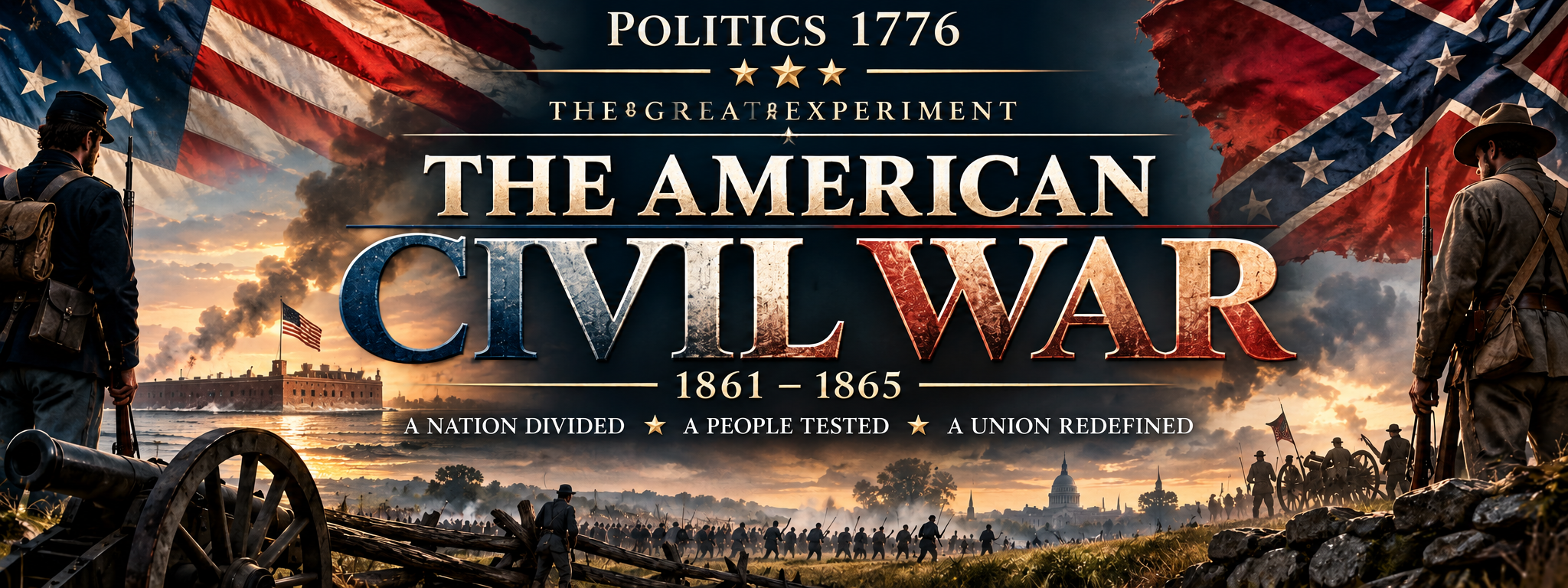
PART V OF V — THE WAR ENDS, THE QUESTIONS REMAIN
The Fall of the Confederacy, the Death of Abraham Lincoln, and the Unfinished Work of Reuniting America
1865
The Final Winter of War
As January 1865 began, the United States was approaching the end of the most destructive conflict in its history.
Nearly four years had passed since Confederate artillery opened fire on Fort Sumter in Charleston Harbor.
What many Americans had initially expected to be a short conflict had become a prolonged struggle involving enormous armies, devastated communities, and hundreds of thousands of deaths.
The Union had achieved major military victories.
Ulysses S. Grant's armies were tightening their hold around Petersburg and Richmond, Virginia.
William Tecumseh Sherman had captured Atlanta and marched across Georgia to Savannah.
The Mississippi River was under federal control.
The Confederate Army of Tennessee had suffered a devastating defeat at Nashville.
The United States Navy continued restricting Confederate commerce.
The Confederacy faced severe shortages of food, military supplies, transportation, and manpower.
Yet the war was not over.
Robert E. Lee's Army of Northern Virginia still defended the approaches to Richmond.
Confederate forces remained active in the Carolinas, the Gulf region, and areas west of the Mississippi River.
President Jefferson Davis continued directing the Confederate government.
For Abraham Lincoln, the military situation was increasingly favorable, but victory remained incomplete.
And even if the armies stopped fighting, the country would face questions that military success alone could not answer.
How would the Southern states return to functioning participation in the Union?
What would freedom mean for millions of formerly enslaved Americans?
Who would control the governments of the former Confederate states?
How would the nation reconcile constitutional authority, civil rights, and the enormous human suffering caused by the war?
The United States was approaching military victory.
But ending the war and rebuilding the nation would prove to be two different challenges.
A Constitutional Change Years in the Making
Before the final Confederate armies surrendered, Congress took an extraordinary step.
The Emancipation Proclamation of January 1, 1863, had declared freedom for enslaved people in designated areas remaining in rebellion against the United States.
It had transformed the Union war effort.
But the proclamation was a wartime measure issued under presidential military authority.
It did not abolish slavery throughout the country.
Slavery remained legal in certain states and areas outside its application.
Lincoln and congressional supporters of abolition recognized the need for a permanent constitutional solution.
The Constitution provided a method for changing the nation's fundamental law.
An amendment could be proposed by the required congressional majorities and become part of the Constitution when ratified by three-fourths of the states.
The Senate had approved a proposed amendment abolishing slavery in April 1864.
The House of Representatives had initially failed to reach the required two-thirds majority.
But the political circumstances changed after Lincoln's reelection and the Union's military victories.
The proposed amendment returned to the House.
January 31, 1865 — Congress Votes to Abolish Slavery
On January 31, the House of Representatives approved the proposed Thirteenth Amendment.
The measure passed with the required two-thirds majority.
It prohibited slavery and involuntary servitude throughout the United States, except as punishment for a crime following conviction.
It also gave Congress authority to enforce the amendment through appropriate legislation.
The congressional vote did not immediately make the amendment part of the Constitution.
Ratification by the states was still required.
But the vote represented a fundamental turning point.
The same constitutional system that had once accommodated slavery was now being used to abolish it.
The transformation had not occurred simply through congressional debate.
It had been driven by decades of abolitionist organizing, the resistance and actions of enslaved people, political conflict, and a devastating civil war.
Black Americans had played an essential role in that history.
They had escaped slavery, assisted Union armies, organized communities, and served as soldiers and sailors.
The amendment offered a means of making abolition permanent throughout the nation.
The final ratification would come in December.
For the moment, the country still had a war to finish.
Sherman Turns North
After capturing Savannah in December 1864, Sherman prepared a new campaign.
His army had marched across Georgia, damaging Confederate transportation and military resources.
Now Sherman intended to move north through the Carolinas.
The campaign would place additional pressure on Confederate forces and threaten the remaining routes connecting the Confederate armies.
In February 1865, Union troops advanced into South Carolina.
The march was difficult.
Heavy rain and flooded rivers complicated movement.
Soldiers built roads and bridges to move equipment through swamps and muddy terrain.
Sherman's forces continued destroying railroad infrastructure and supplies useful to Confederate military operations.
Civilian property also suffered extensive damage.
Some destruction resulted from military orders.
Other damage came from unauthorized acts by soldiers or from the chaos of retreat and occupation.
The campaign brought additional suffering to communities already affected by years of war.
For enslaved people, the arrival of Union forces could offer opportunities to escape bondage.
Thousands sought freedom as federal armies moved through Confederate territory.
But the movement of large numbers of displaced people created urgent questions about shelter, food, transportation, and protection.
The advance through the Carolinas was both a military campaign and part of the larger transformation of Southern society.
Columbia and the Destruction of War
In February, Union forces entered Columbia, South Carolina.
During the occupation, a major fire devastated much of the city.
The origins and responsibility for the destruction have been debated by historians.
Retreating Confederate forces, burning cotton, wind, disorder, and the actions of Union soldiers all formed part of the circumstances surrounding the disaster.
The destruction became one of the war's most controversial episodes.
For residents, however, the immediate consequences were unmistakable.
Homes and businesses were lost.
Families were displaced.
The local economy suffered.
The event demonstrated how destructive the war had become, even when armies were no longer engaged in a conventional battle.
Sherman's army continued into North Carolina.
Confederate forces under General Joseph E. Johnston attempted to resist.
In March, the armies fought at Bentonville.
Johnston's troops launched attacks against part of Sherman's force but could not defeat the larger Union army.
The Confederates withdrew.
Sherman continued advancing.
The Confederacy's military position was deteriorating across multiple fronts.
Lincoln's Second Inauguration
On March 4, 1865, Abraham Lincoln stood at the United States Capitol to begin his second presidential term.
Four years earlier, he had taken office as the country approached disunion.
Now the Confederacy was nearing defeat.
But Lincoln did not deliver a speech celebrating victory.
Instead, he reflected on the war's origins, the role of slavery, the suffering endured by both sides, and the difficult work ahead.
He identified slavery as central to the conflict.
He also considered the moral weight of the war and the uncertainty of human judgments about its meaning.
Near the conclusion, Lincoln urged the country to move forward:
“With malice toward none; with charity for all.”
His address called for healing the nation's wounds, caring for those who had suffered in the war, and pursuing a just and lasting peace.
The words expressed an aspiration toward reconciliation.
They did not provide a complete political program for Reconstruction.
Major questions remained unresolved, including the status of formerly enslaved people, the conditions under which Southern governments would be restored, and the protection of civil rights.
But the speech revealed Lincoln's understanding that military victory alone would not repair the damage.
The nation would have to determine how to live together after years of extraordinary violence.
The Final Struggle Around Petersburg
In Virginia, Grant continued pressuring Lee's army.
For months, the Union had extended its lines around Petersburg.
Federal forces attacked railroads and transportation routes that supplied the Confederate defenders.
Lee's army remained experienced and dangerous.
But its position was becoming increasingly difficult.
Food and equipment were scarce.
Desertion weakened the ranks.
Confederate soldiers endured long periods in defensive trenches.
Grant's forces continued receiving supplies and reinforcements.
Lee understood that he could not remain indefinitely in the Petersburg defenses.
He considered ways to break the Union hold and restore freedom of movement.
On March 25, Confederate troops launched an attack against Fort Stedman, a Union position east of Petersburg.
The attack initially gained ground.
But Union forces counterattacked and restored their lines.
The Confederates suffered heavy losses.
The attempt had failed.
The Union continued preparing for a final offensive.
Five Forks — April 1, 1865
The military situation reached a critical point at Five Forks, southwest of Petersburg.
The location was important because of its relationship to Confederate transportation and supply routes.
Union forces under Major General Philip Sheridan attacked Confederate troops commanded by Major General George E. Pickett.
On April 1, Union infantry and cavalry defeated the Confederate position.
The victory threatened the remaining railroad connections supporting Petersburg.
Grant recognized the opportunity.
He ordered a major assault against the Confederate defensive lines.
On April 2, Union forces broke through important sections of the Petersburg defenses.
The Confederate position could no longer be maintained.
Lee informed Jefferson Davis that Richmond and Petersburg would have to be evacuated.
The government that had directed the Confederacy from Richmond for nearly four years was preparing to leave.
Richmond Falls
During the night of April 2, Confederate officials and troops began evacuating Richmond.
Fires spread through parts of the city as Confederate forces destroyed military supplies and facilities to prevent their capture.
The flames caused extensive damage.
On April 3, Union troops entered Richmond.
The Confederate capital had fallen.
For the United States, the event carried enormous military and symbolic importance.
Richmond had been the center of Confederate government throughout most of the war.
Its capture demonstrated the collapse of Confederate defenses in Virginia.
But the city also held another significance.
Thousands of enslaved people had lived and worked in Richmond.
For many, the arrival of Union troops meant the immediate realization of freedom.
African Americans celebrated the collapse of Confederate authority.
Families began confronting the possibilities and uncertainties of life after slavery.
The city was damaged.
Its population had endured shortages, fear, and years of wartime hardship.
But the political order that had sustained slavery there was ending.
Lincoln Walks Through Richmond
On April 4, President Lincoln visited Richmond.
Only days earlier, the city had been the Confederate capital.
Now Lincoln walked through streets that had been under the authority of a government fighting for independence from the United States.
He visited the former Confederate executive mansion.
Crowds gathered as news of his presence spread.
Black residents were particularly enthusiastic.
For people who had lived under slavery, Lincoln had become associated with the federal government's commitment to emancipation.
His visit represented the extraordinary reversal that had taken place.
The president of the United States was walking through the capital of the defeated rebellion.
But the experience also revealed how much work remained.
Richmond was no longer under Confederate control.
That did not mean its economic and social institutions could be rebuilt overnight.
Freedom had to become a lived reality.
Civil government had to be restored.
And the country had to determine how former Confederates and formerly enslaved Americans would participate in the reunited nation.
Lee's Final Retreat
As Richmond and Petersburg fell, Lee led the remaining Army of Northern Virginia westward.
His objective was to reach supplies and possibly join other Confederate forces.
But the army was exhausted.
Many soldiers were hungry.
Equipment and transportation were inadequate.
Union forces pursued the retreating Confederates.
Federal cavalry and infantry moved to block roads and railroad connections.
On April 6, Union forces attacked Confederate troops at Sailor's Creek.
The Confederates suffered a major defeat.
Thousands were captured, including senior officers.
Lee's army continued retreating, but its situation was increasingly desperate.
Grant sent messages encouraging surrender.
Lee initially hoped to escape.
But Union forces continued closing the routes ahead.
By April 8, federal troops had captured supplies near Appomattox Station.
Lee's army was nearly surrounded.
On the morning of April 9, Confederate troops attempted one final breakthrough.
The effort failed.
Lee now faced the reality that his army could no longer continue effective resistance.
APPOMATTOX — APRIL 9, 1865
Two Generals Meet
On April 9, 1865, Robert E. Lee and Ulysses S. Grant met in the home of Wilmer McLean at Appomattox Court House, Virginia.
The two commanders had known one another from earlier military service.
Now they represented armies that had fought each other through years of devastating conflict.
Lee arrived wearing a formal uniform.
Grant wore a comparatively plain and travel-worn uniform.
The meeting was brief.
They discussed terms for the surrender of the Army of Northern Virginia.
Grant offered conditions intended to end the fighting without unnecessarily humiliating the defeated soldiers.
Confederate officers and men would be paroled after surrendering their arms and military property.
They would be permitted to return home, provided they observed their paroles and the laws in force where they lived.
Officers could retain their sidearms and personal horses.
Grant also allowed soldiers who owned horses or mules to take them home, recognizing their importance for farming.
The terms did not resolve the political future of the former Confederate states.
Nor did they settle the legal responsibility of every person who had supported the rebellion.
They were military surrender terms for Lee's army.
But they helped establish a model for subsequent Confederate surrenders.
After the agreement was completed, Lee departed.
The Army of Northern Virginia, the Confederacy's most prominent military force, had surrendered.
The Meaning of Appomattox
The surrender at Appomattox is often remembered as the end of the Civil War.
Its symbolic importance is undeniable.
Lee's army had been the Confederacy's principal force in Virginia.
Its surrender made continued Confederate resistance much more difficult.
But Appomattox did not technically end the entire war.
Other Confederate armies remained in the field.
Jefferson Davis had not yet abandoned the hope of continuing resistance.
Fighting and military operations continued elsewhere.
The war ended through a series of surrenders and the collapse of organized Confederate military power.
Nevertheless, April 9 became one of the defining dates in American history.
The Union had achieved a victory of enormous importance.
And the military defeat of the Confederacy was opening the way for the abolition of slavery throughout the country.
For thousands of enslaved people in the region around Appomattox, the arrival of Union forces brought immediate changes in their lives.
Black soldiers serving with the Union armies participated in the final campaign.
Their presence was especially significant.
Men who had been excluded from equal rights under American law were helping defeat a rebellion whose leaders had sought to preserve slavery.
The end of Lee's army was therefore more than a military event.
It formed part of a profound transformation in the nation's political and social order.
A Moment of Celebration — And Uncertainty
News of Lee's surrender spread across the North.
Communities celebrated.
Bells rang.
Flags appeared in streets and public squares.
For families that had spent years fearing the loss of loved ones, the news offered hope that the fighting might finally end.
But celebration existed alongside grief.
The war had taken an enormous toll.
Thousands of families had lost relatives.
Veterans carried permanent injuries.
Communities had been devastated.
The Confederate South faced destroyed infrastructure, disrupted agriculture, and severe economic hardship.
Millions of formerly enslaved people faced the challenges of establishing independent lives after generations of bondage.
Even as Americans celebrated, questions remained.
What would happen to Confederate soldiers returning home?
How would the federal government restore civilian authority?
Would formerly enslaved people receive legal protections and political rights?
How would the nation prevent the return of systems resembling slavery?
The armies could stop fighting.
The deeper work of rebuilding the country was just beginning.
Lincoln's Final Public Address
On April 11, Lincoln spoke publicly from the White House.
The war in Virginia was effectively ending.
His remarks focused partly on the difficult question of restoring government in Louisiana.
He discussed the complexities of Reconstruction and the disagreement over how Southern states should resume their place within the Union.
He also expressed support for extending voting rights to some Black men, particularly those who were educated and those who had served in the Union military.
This was a significant public position.
Lincoln's views on race and political rights had developed over time, and his remarks did not call for universal Black male suffrage.
But they pointed toward a broader understanding of citizenship than the nation had previously recognized.
The speech revealed that the political struggle after the war was already beginning.
The future of the South would not be determined solely by military surrender.
It would be shaped by debates over freedom, voting, government authority, and constitutional rights.
Lincoln would not live to guide those debates.
THE ASSASSINATION OF ABRAHAM LINCOLN
April 14, 1865
On the evening of April 14, President Lincoln attended a performance of Our American Cousin at Ford's Theatre in Washington, D.C.
He was accompanied by his wife, Mary Todd Lincoln, and guests.
During the performance, actor and Confederate sympathizer John Wilkes Booth entered the presidential box.
Booth shot Lincoln.
The president was carried to a boardinghouse across the street, where physicians attempted to care for him.
He never regained consciousness.
Early the following morning, April 15, 1865, Abraham Lincoln died.
He was fifty-six years old.
The country had lost the president who had led the Union through four years of civil war.
The assassination came only six days after Lee's surrender at Appomattox.
The nation had scarcely begun celebrating the approaching end of the war when it was confronted with another national tragedy.
A Wider Conspiracy
Lincoln's assassination was part of a larger conspiracy.
Booth and his associates planned attacks against other senior federal officials.
Secretary of State William H. Seward was seriously wounded in an attack at his home.
Vice President Andrew Johnson was also targeted, but the assigned conspirator did not carry out the attack.
The plot was intended to strike the leadership of the federal government at a moment of enormous national uncertainty.
Booth fled Washington after shooting Lincoln.
Federal authorities pursued him.
On April 26, he was located at a farm in Virginia and fatally shot during an attempt to capture him.
Other conspirators were arrested and prosecuted.
The assassination deepened the nation's grief and anger.
It also changed the political leadership of the United States at the very moment when Reconstruction was beginning.
Andrew Johnson Becomes President
Following Lincoln's death, Vice President Andrew Johnson took the presidential oath.
Johnson was a Tennessee Democrat who had remained loyal to the Union.
He had joined Lincoln's National Union ticket in 1864.
Now he became president.
The transition demonstrated that the constitutional system of presidential succession continued functioning even amid the aftermath of civil war.
But Johnson inherited an extraordinary challenge.
The Confederate armies were surrendering.
The Southern states needed functioning civilian governments.
Millions of formerly enslaved people were seeking security, education, employment, and legal protection.
Congress and the president would have to determine how federal authority should be exercised during Reconstruction.
Johnson's approach would soon generate major disagreements with congressional Republicans.
The conflict between the executive and legislative branches would become one of the defining political struggles of the postwar era.
For the moment, the country was still mourning Lincoln and completing the military defeat of the Confederacy.
The Remaining Confederate Armies Surrender
After Appomattox, Confederate commanders elsewhere faced increasingly difficult choices.
General Joseph E. Johnston commanded a large Confederate force in the Carolinas.
Sherman's army remained nearby.
On April 26, Johnston surrendered his forces to Sherman at Bennett Place near Durham, North Carolina, after earlier proposed terms were rejected by federal authorities.
Other Confederate commands surrendered in the following weeks.
In Alabama and Mississippi, Lieutenant General Richard Taylor surrendered his department in May.
Confederate forces west of the Mississippi also began laying down their arms.
General Edmund Kirby Smith's Trans-Mississippi command collapsed and surrendered during late May and early June.
Not every soldier stopped fighting at the same moment.
Communications were uneven.
Some Confederate units were scattered or isolated.
The last significant land battle of the war occurred at Palmito Ranch in Texas on May 12–13, after Lee's surrender.
Confederate forces won that engagement, but the result did not alter the collapse of the Confederacy.
In Indian Territory, Confederate-allied Cherokee leader Stand Watie surrendered his command in June.
By the summer of 1865, organized Confederate resistance had effectively ended.
The Confederate government no longer functioned as an independent wartime authority.
Jefferson Davis had been captured in Georgia on May 10.
The Confederate States of America's attempt to establish independence had failed.
The United States remained one nation.
The War's Final Casualties
The Civil War had produced human suffering on a scale unlike any previous American conflict.
Modern historical estimates generally place military deaths at approximately 620,000 to 750,000 or more, depending on the methods and records used.
The precise total remains uncertain.
Many records were incomplete.
Deaths from disease were especially difficult to document.
The suffering of civilians, enslaved people, and displaced communities was not fully captured in military casualty statistics.
The war left large numbers of widows, orphans, disabled veterans, and grieving families.
Southern cities and transportation systems had been damaged.
Railroads, bridges, farms, and commercial networks required reconstruction.
The Confederate economy, built in large part around enslaved labor, had been fundamentally disrupted.
The federal government had accumulated substantial debt and expanded its administrative responsibilities.
The conflict had changed the country's economic and political institutions.
But its most profound consequence involved slavery and the future of freedom.
Juneteenth — Freedom Reaches Texas
Although the Emancipation Proclamation had taken effect on January 1, 1863, its enforcement depended on the advance of Union authority.
In parts of the Confederacy, slavery continued long after the proclamation was issued.
Texas was one of those places.
The state remained distant from many of the Union's major military campaigns.
On June 19, 1865, Union Major General Gordon Granger arrived in Galveston and issued General Order No. 3, announcing freedom for enslaved people in Texas.
The date became associated with Juneteenth.
The announcement was a major milestone in the practical enforcement of emancipation.
But the end of slavery was not experienced everywhere on a single day.
Some enslaved people had gained freedom earlier through escape, military occupation, or other circumstances.
Others remained in bondage or faced unlawful coercion even after emancipation policies were announced.
The Thirteenth Amendment would provide the nationwide constitutional prohibition.
Juneteenth became an enduring commemoration of emancipation and the struggle for freedom.
It also reminds us that a change in law or policy does not automatically reach every community at the same moment.
What Freedom Meant in Everyday Life
For formerly enslaved Americans, the end of the Civil War opened possibilities that had been denied for generations.
Families searched for relatives who had been sold or separated.
Couples sought legal recognition of marriages.
Parents worked to reunite households and protect their children.
Communities established schools and churches.
Black Americans pursued opportunities to own property, earn wages, and exercise greater control over their lives.
Education became an especially important priority.
Formerly enslaved people and free Black communities had long valued literacy and learning, often pursuing education despite laws and restrictions intended to deny it.
After the war, they established schools and worked with teachers, religious organizations, and federal agencies.
But freedom also brought enormous challenges.
Many families lacked land or financial resources.
Employment opportunities were limited.
Former enslavers sought to retain control over agricultural labor.
Violence and intimidation threatened Black communities.
Disputes over wages, contracts, movement, and family rights became common.
The legal abolition of slavery was essential.
But the larger question remained: what rights and protections would accompany freedom?
The Freedmen's Bureau
In March 1865, Congress established the Bureau of Refugees, Freedmen, and Abandoned Lands, commonly known as the Freedmen's Bureau.
The agency operated within the War Department.
Its responsibilities included providing assistance to formerly enslaved people and certain refugees affected by the war.
The bureau helped distribute food and supplies.
It supported educational efforts.
It assisted with labor arrangements and legal disputes.
It also became involved in questions surrounding abandoned and confiscated property.
The bureau faced enormous difficulties.
Its resources were limited.
Its responsibilities were vast.
Federal officials sometimes encountered resistance from local authorities and former Confederates.
The agency also operated amid disagreements over land ownership, labor, and the future of Southern society.
The Freedmen's Bureau did not solve every problem confronting the postwar South.
But it represented an important expansion of federal responsibility.
The national government was becoming directly involved in helping formerly enslaved people make the transition from slavery to freedom.
That involvement would become one of the defining features of Reconstruction.
The Question of Land
For many formerly enslaved families, land ownership represented independence.
Generations of enslaved people had labored on plantations and farms without owning the land they worked.
After emancipation, many hoped to obtain farms of their own.
Some federal wartime policies temporarily allowed formerly enslaved families to settle on abandoned or confiscated lands.
In January 1865, Sherman issued Special Field Orders No. 15, setting aside certain coastal lands in South Carolina, Georgia, and Florida for settlement by formerly enslaved people.
But the policy was limited and did not create a nationwide program of land redistribution.
Later federal decisions restored much of the affected land to former owners.
The reversal disappointed and displaced many Black families who had begun building independent communities.
Without widespread access to land, many formerly enslaved people entered labor arrangements with landowners.
Sharecropping and tenant farming would become important features of the postwar Southern economy.
These systems varied, but debt, unequal bargaining power, and discriminatory practices frequently restricted economic independence.
The question of land revealed a central challenge of emancipation.
Ending legal ownership of human beings did not automatically provide the economic resources needed for independence.
December 6, 1865 — The Thirteenth Amendment Is Ratified
Throughout 1865, states considered the proposed Thirteenth Amendment.
On December 6, the required number of states had ratified it.
The amendment became part of the Constitution, with formal certification following later that month.
Its first section prohibited slavery and involuntary servitude throughout the United States, except as punishment for a crime following conviction.
Its second section empowered Congress to enforce the prohibition through legislation.
The ratification represented one of the most important constitutional transformations in American history.
Slavery, which had existed in North America for centuries and had been protected under American law, was now constitutionally prohibited throughout the United States.
The amendment did not establish full political or social equality.
It did not automatically grant citizenship or voting rights to formerly enslaved people.
It did not eliminate racial discrimination.
Those questions would require further constitutional amendments, federal legislation, and political struggle.
But the Thirteenth Amendment established a fundamental change in the nation's law.
The Constitution would no longer permit slavery as a lawful system of labor and property, subject to the amendment's punishment exception.
The United States had emerged from the Civil War with a transformed constitutional foundation.
WHAT THE CIVIL WAR CHANGED
The consequences of the Civil War extended far beyond the surrender of Confederate armies.
The Union Survived
The Confederate states had attempted to establish an independent government.
The United States defeated that rebellion.
The Union remained intact.
The outcome established, through the war's result, that unilateral secession would not be accepted as a means of dissolving the United States.
The constitutional understanding of the nation had been profoundly shaped by the conflict.
Slavery Was Abolished
The Emancipation Proclamation had transformed federal wartime policy.
Enslaved people had actively pursued freedom.
Black soldiers and sailors had contributed to the Union victory.
The Thirteenth Amendment made abolition a permanent constitutional rule throughout the country.
The legal institution of slavery had been destroyed.
Federal Authority Expanded
The war required the national government to organize enormous armies, raise revenue, issue currency, regulate wartime commerce, and administer military operations across vast regions.
Federal institutions emerged from the conflict with greater administrative capacity and authority.
Debates over the proper limits of that power would continue.
The Economy Changed
Railroads, factories, agriculture, and financial institutions had been transformed by the demands of war.
The destruction of slavery forced the Southern economy to reorganize.
Federal policies enacted during the war helped shape western settlement, transportation, education, and national finance.
The consequences would influence the country's industrial development.
Citizenship Became a Central Question
Abolition did not settle the status of formerly enslaved people.
Could Black Americans vote?
Would they receive equal protection under the law?
How would citizenship be defined?
What obligations did the federal government have to protect individual rights against state and local discrimination?
These questions would become central during Reconstruction.
THE FOUNDERS' EXPERIMENT SURVIVES ITS GREATEST CRISIS
The American founding had established a republic based on representative government, constitutional authority, and the consent of the governed.
Its founders had created institutions intended to manage disagreements through law, elections, and a division of powers.
But they had also left slavery embedded in the nation's political and economic order.
The Constitution contained compromises involving slavery, and the contradiction between slavery and the Declaration of Independence's principles of equality remained unresolved.
Over the following decades, the nation expanded.
Its population grew.
Its economy developed.
Its political parties changed.
And disputes over slavery became increasingly difficult to contain.
By 1861, the constitutional system had reached a crisis.
Eleven states attempted to leave the Union.
Two governments claimed authority.
Americans fought Americans.
The war lasted four years.
Its consequences reached nearly every part of the country.
In 1865, the Union survived.
Slavery was abolished through constitutional amendment.
But survival did not mean that the country's work was finished.
The Civil War had answered the military question of whether the Confederacy could establish its independence.
It had not fully answered how the reunited nation would protect freedom, define citizenship, or ensure equality before the law.
The founders' constitutional system had endured a devastating conflict.
Now it would face another test.
Could the United States rebuild itself while extending the promises of liberty to people who had long been denied them?
THE WAR ENDS — THE QUESTIONS REMAIN
The American Civil War ended the Confederacy's attempt at independence and destroyed the legal institution of slavery.
But it left a country deeply divided.
The South faced damaged infrastructure, economic disruption, and the collapse of a labor system that had depended on human bondage.
The North faced the costs of war, the return of large numbers of veterans, and debates over the future role of federal authority.
Millions of formerly enslaved Americans faced the challenge of building lives in freedom.
The federal government had to determine how former Confederate states would be governed and how constitutional rights would be enforced.
Lincoln had called for reconciliation and a lasting peace.
But he had been assassinated before he could guide the nation through the postwar period.
Andrew Johnson now occupied the presidency.
Congress would soon challenge his Reconstruction policies.
Former Confederates would seek to regain political power.
Black Americans would organize for education, employment, citizenship, and voting rights.
The struggle over the meaning of freedom would continue.
The Civil War had preserved the United States. Reconstruction would determine how that nation would begin again.
THE STORY CONTINUES
RECONSTRUCTION — REBUILDING THE UNION (1865–1877)
The next chapter in our historical journey begins where the Civil War ends.
The country must now confront the enormous task of restoring the former Confederate states to functioning participation in the Union.
The Thirteenth Amendment has abolished slavery.
But the questions of citizenship, voting rights, economic independence, and equal protection remain unresolved.
President Andrew Johnson and Congress will clash over Reconstruction policy.
The Freedmen's Bureau will attempt to assist formerly enslaved people and war refugees.
Southern legislatures will enact Black Codes that restrict the freedom of African Americans.
Congress will respond with new civil rights legislation.
The Fourteenth and Fifteenth Amendments will reshape the Constitution.
Black Americans will participate in political life in ways previously denied to them.
And the country will confront violent resistance, federal intervention, and disputes over the future of the South.
The fighting between the Union and Confederate armies has ended.
But the work of building a more inclusive constitutional republic has only begun.
The next story: Reconstruction — Rebuilding the Union.
Our Money Matters. Our Choices Matter. Our Voice Matters.
The People. The Voice. The Future.
Politics 1776