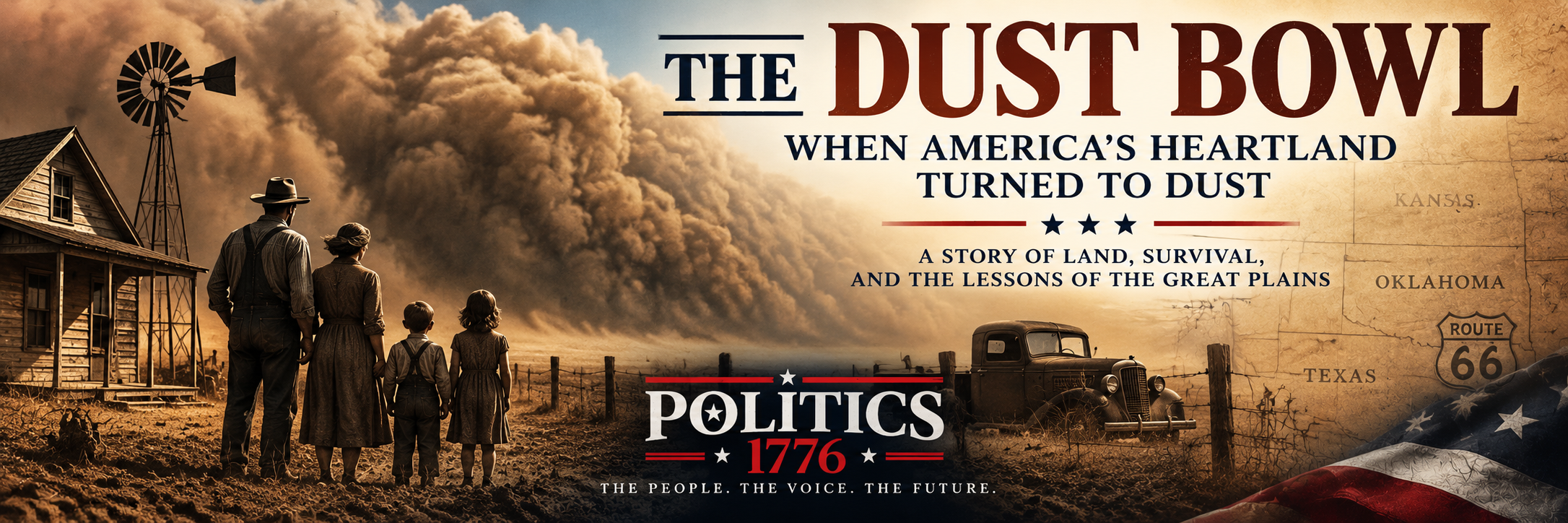
THE DUST BOWL
When America's Heartland Turned to Dust
A Story of Land, Survival, and the Lessons of the Great Plains
The sky began to darken.
At first, it might have looked like an approaching thunderstorm.
But there was no rain.
Instead, enormous clouds of dust rolled across the Great Plains, swallowing fields, roads, houses, and entire communities.
The wind carried away the very soil that farmers depended upon to survive.
Families sealed their windows.
They placed wet cloth around doors.
They covered their faces.
And still, the dust found its way inside.
For some, the choice became painfully simple.
Stay and hope the land recovered.
Or leave behind everything they had worked to build.
This was the Dust Bowl.
And it became one of the most devastating environmental and agricultural disasters in American history.
But the Dust Bowl was more than a drought.
It was a story about westward expansion, agriculture, economics, the Great Depression, government policy, and the consequences of how Americans used the land.
It was also a story about ordinary people trying to survive.
Before the Dust — The Great Plains
Long before the Dust Bowl, the Great Plains stretched across the center of North America.
These enormous grasslands had supported Indigenous communities and vast populations of grazing animals for generations.
Native grasses covered much of the landscape.
Their extensive root systems helped hold the soil in place.
The region experienced naturally recurring droughts, strong winds, and wide variations in rainfall.
Those conditions were part of the environment.
The land could be productive.
But it could also be unforgiving.
As American settlement expanded westward during the nineteenth century, the Great Plains became an increasingly important agricultural region.
The Homestead Act of 1862 encouraged settlement by offering eligible settlers opportunities to acquire federal land.
Railroads expanded.
Towns appeared.
Farms spread across the prairie.
And over time, millions of acres of native grassland were converted to agricultural use.
The landscape was changing.
Wheat, Opportunity, and Expansion
During the early twentieth century, demand for wheat encouraged farmers to expand production.
World War I increased demand for American agricultural products.
High prices made wheat farming attractive.
New machinery allowed farmers to cultivate larger areas.
Tractors made it possible to plow land faster than earlier generations could have imagined.
During the relatively favorable growing conditions of parts of the 1920s, additional grasslands were converted into cropland.
For many farmers, expansion seemed reasonable.
They were responding to markets, technology, and the opportunity to earn a living.
But beneath that prosperity was a growing vulnerability.
Much of the region's natural vegetation had been removed.
When the rains stopped, the soil would have less protection from the wind.
Then the Rain Stopped
Beginning around 1930, severe drought spread across much of the Great Plains.
Crops failed.
Fields dried.
Vegetation disappeared.
The exposed soil became vulnerable to the region's powerful winds.
And those winds began carrying it away.
The worst conditions developed across parts of Oklahoma, Texas, Kansas, Colorado, and New Mexico, although drought and dust storms affected a much larger area.
The disaster was not caused by one factor.
Severe drought created the immediate environmental crisis.
Extensive cultivation, overgrazing, and inadequate soil-conservation practices made parts of the landscape far more vulnerable.
Nature and human decisions combined with devastating consequences.
When the Soil Began to Fly
Dust storms became increasingly common.
Some were enormous.
Walls of dust moved across the prairie, reducing visibility and turning daylight into darkness.
Fine soil entered homes even when windows and doors were closed.
Dust collected on furniture.
It settled in food.
It covered bedding.
It accumulated against fences and buildings.
Fields that had once produced crops became barren.
In some places, drifting soil buried equipment and fences.
Farmers watched the topsoil that had taken generations to develop disappear into the wind.
And the storms did not always remain on the Great Plains.
In 1934, dust traveled eastward across the country, reaching Washington, D.C., and beyond.
America's agricultural crisis was becoming visible far outside the region where it began.
Black Sunday — April 14, 1935
One of the most infamous days of the Dust Bowl came on Sunday, April 14, 1935.
A massive dust storm swept across the southern Great Plains.
The sky turned black.
Visibility collapsed.
People caught outside struggled to find shelter.
Communities across the region experienced terrifying conditions.
The storm became known as Black Sunday.
It also helped give the disaster its enduring name.
The Dust Bowl.
For Americans living through it, this was not simply an event to be remembered in a history book.
It was the world outside their front doors.
Oklahoma at the Center
Oklahoma became one of the places most closely associated with the Dust Bowl.
The state's Panhandle was especially hard hit.
Communities such as Boise City experienced severe drought, dust storms, crop failures, and economic hardship.
Farmers who had built their lives around the land faced enormous uncertainty.
But the Dust Bowl did not affect every part of Oklahoma equally.
The most severe dust erosion was concentrated in the southern High Plains, including the Oklahoma and Texas Panhandles and neighboring areas.
The disaster's economic and social effects, however, reached much farther.
Oklahoma became central to the national memory of the crisis, particularly because so many displaced families later traveled west seeking work.
The Great Depression Made Everything Worse
The Dust Bowl unfolded during the Great Depression.
That timing mattered enormously.
Farm prices had collapsed.
Banks were failing.
Credit was difficult to obtain.
Unemployment was widespread.
Families already struggling financially faced another disaster when crops failed.
Some farmers could not pay their debts.
Some lost their land.
Tenant farmers and sharecroppers were especially vulnerable because they often had little property or financial security to fall back on.
The Depression and the Dust Bowl reinforced one another.
Farmers needed income to survive.
But the land was producing less.
Prices were low.
And the dust kept blowing.
For many families, there was no easy way out.
The Human Cost
The Dust Bowl was not only an agricultural disaster.
It was a public-health crisis.
Dust filled the air people breathed.
Respiratory illnesses became serious concerns.
Some residents developed what was commonly called dust pneumonia.
Children and older adults were particularly vulnerable.
Families struggled to keep homes clean and food protected.
Livestock suffered.
Crops failed.
Financial insecurity created additional stress.
The damage reached into nearly every part of daily life.
And yet many families remained.
They continued farming when possible.
They adapted their routines.
They helped neighbors.
They hoped for rain.
Their persistence is as much a part of Dust Bowl history as the families who eventually left.
The Road West
For others, staying became impossible.
Families loaded their belongings into cars and trucks.
They left farms, towns, and communities behind.
Many traveled toward California, hoping to find agricultural work.
Route 66 became one of the most recognizable paths west.
The migration became closely associated with Oklahoma, and migrants were often called “Okies.”
But not everyone who received that label came from Oklahoma.
Families also left Texas, Arkansas, Kansas, and other states.
And not every migrant was escaping the worst dust storms.
The Depression, mechanization, farm foreclosures, and the collapse of rural employment also drove people west.
California offered the possibility of work.
But arrival did not guarantee a better life.
California Was Not Always the Promised Land
Many migrants discovered that agricultural jobs were seasonal, wages were low, and housing was scarce.
Families lived in temporary camps.
Some slept in vehicles or makeshift shelters.
Others moved repeatedly in search of employment.
They faced poverty and discrimination.
Longtime residents sometimes resented the newcomers.
The term “Okie” was frequently used as an insult, regardless of a migrant's actual home state.
The migration revealed another side of the American economy.
People willing to work could still struggle to find stable employment, decent housing, and financial security.
Their hardship became part of the national story of the Great Depression.
The Photographs That Showed America
Much of what Americans remember about the Dust Bowl comes from photographs.
Photographers working for New Deal agencies documented farms, families, migrants, and the conditions of the 1930s.
Among them was Dorothea Lange.
Her photographs helped bring the experiences of struggling families to national attention.
Other photographers, including Arthur Rothstein, documented the eroded landscapes and dust storms of the Great Plains.
These images remain powerful because they show the human side of an enormous historical event.
A damaged farm.
An abandoned home.
A family beside a vehicle.
A mother worried about her children.
The Dust Bowl was not just a collection of statistics.
It happened to real people.
The Government Responds
President Franklin D. Roosevelt entered office in 1933, as the Great Depression and Dust Bowl were already devastating parts of the country.
His administration introduced numerous programs under the New Deal.
Some addressed agricultural prices and production.
Others provided employment, relief, or assistance to displaced families.
Soil conservation became an increasingly important federal priority.
The government supported research and demonstration projects intended to reduce erosion and improve land management.
But these efforts also raised familiar American questions.
What responsibilities belonged to individual landowners?
What role should state governments play?
When did environmental damage become a national concern?
And how much federal involvement was appropriate?
The Dust Bowl brought those questions into sharp focus.
Hugh Hammond Bennett and the Soil
One of the central figures in America's response was Hugh Hammond Bennett.
Bennett had studied soil erosion long before the Dust Bowl.
He argued that losing productive soil threatened agriculture and the nation's long-term economic well-being.
In 1935, Congress created the Soil Conservation Service within the Department of Agriculture.
Bennett became its first chief.
The agency worked to demonstrate and encourage improved farming practices.
These included contour plowing, strip cropping, maintaining protective vegetation, and other methods intended to reduce erosion.
The response also involved cooperation with farmers, agricultural experts, and eventually locally organized conservation districts.
The objective was straightforward.
Keep the soil where it belongs.
Planting a Different Future
The government and farmers also worked to reduce wind erosion through tree planting and changes in agricultural practices.
The Prairie States Forestry Project, often associated with the Great Plains Shelterbelt, supported planting trees in windbreaks across portions of the Plains.
The effort was ambitious.
But trees alone could not solve the problem.
Successful conservation required understanding local soils, rainfall, vegetation, farming methods, and the limitations of the land.
Farmers increasingly adopted practices intended to protect topsoil.
Scientific knowledge became more closely connected to everyday agricultural decisions.
The Dust Bowl had demonstrated what could happen when soil conservation was neglected.
The response helped establish a lasting American commitment to studying and protecting agricultural land.
Did the Government End the Dust Bowl?
Not by itself.
This distinction matters.
Conservation programs improved land-management practices and helped reduce vulnerability to erosion.
But the return of more favorable rainfall was also essential.
The severe drought eventually eased.
Agricultural conditions improved.
The land began recovering in many places.
The Dust Bowl did not end because of one law, one agency, one farming technique, or one president.
It ended through a combination of changing weather conditions, conservation efforts, agricultural adaptation, and broader economic developments.
That is an important historical lesson.
Large problems rarely have only one cause, and they rarely have only one solution.
The Dust Bowl Changed America
The consequences reached far beyond the Great Plains.
The disaster changed American agriculture.
It strengthened interest in soil science and conservation.
It contributed to major internal migration.
It influenced federal agricultural and environmental policy.
It became part of the cultural memory of the Great Depression.
Writers, photographers, musicians, and historians documented the experiences of the people who lived through it.
And the Dust Bowl reminded Americans that the nation's economic prosperity depended partly upon the health of its natural resources.
Land was not simply something to occupy.
It was something upon which communities depended.
What Can We Learn?
The Dust Bowl offers several lessons.
First, natural resources have limits.
The Great Plains could support agriculture, but not every farming practice was equally suited to its climate and soil.
Second, economic incentives can have unintended consequences.
Farmers expanded production in response to real opportunities. But widespread cultivation of vulnerable land increased the region's exposure to drought and erosion.
Third, environmental disasters become more destructive when combined with economic hardship.
The Dust Bowl was especially devastating because it occurred during the Great Depression.
Fourth, local knowledge, scientific research, and cooperation matter.
Farmers, researchers, conservationists, communities, and government institutions all contributed to changing agricultural practices.
And finally:
History becomes more useful when we understand the decisions that produced its consequences rather than simply assigning blame.
The People Behind the Dust
It is easy to look backward and see what went wrong.
The farmers of the Great Plains did not have the benefit of knowing how the 1930s would unfold.
Many were ordinary Americans trying to make a living.
They followed opportunities.
They invested in land.
They raised families.
They built communities.
They worked.
And when conditions changed, they faced decisions no one would have wanted to make.
Some stayed.
Some left.
Some recovered.
Others never regained what they had lost.
Their stories remind us that history is not only made in Washington, in Congress, or in the White House.
It is also made on farms.
In small towns.
Along highways.
And around kitchen tables where families decide what to do next.
WHEN THE DUST SETTLED
The Dust Bowl was one of the great environmental disasters of the twentieth century.
But it was also a turning point.
It changed the way Americans thought about farming, conservation, migration, and the relationship between people and the land.
It showed how environmental conditions and economic decisions could combine to threaten entire communities.
And it showed how Americans responded—with persistence, adaptation, scientific research, cooperation, and sometimes difficult choices about the future.
The Dust Bowl is not simply a story about a drought that happened long ago.
It is a reminder that decisions made today can shape the opportunities and challenges inherited by future generations.
The land mattered.
The choices mattered.
And the people who lived through it mattered.
Their story remains part of the American experiment.
THE GREAT EXPERIMENT CONTINUES.
Learn the history.
Understand the decisions.
Examine the consequences.
Ask questions.
Use your voice.
Our Money Matters.
Our Choices Matter.
Our Voice Matters.
The People. The Voice. The Future.
Politics 1776