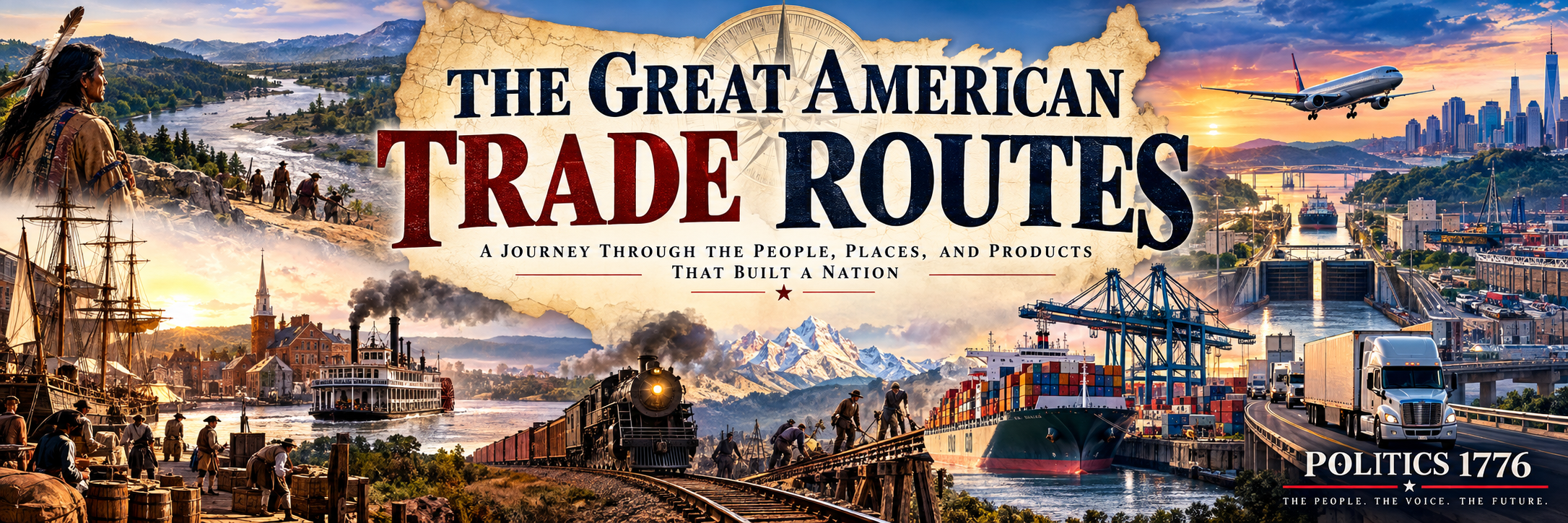
THE GREAT AMERICAN TRADE ROUTES
PART V — ACROSS THE OCEANS: AMERICA ENTERS GLOBAL COMMERCE
From Industrial Exports and the Panama Canal to a Changing World Economy
Imagine standing on the docks of New York Harbor in the early twentieth century.
A great steamship is preparing to depart.
Workers move cargo from warehouses toward the vessel.
Crates of machinery.
Barrels of petroleum products.
Agricultural goods.
Manufactured equipment.
And merchandise destined for customers thousands of miles away.
Nearby, other ships are arriving.
Some carry raw materials.
Others bring manufactured products, food, and goods that Americans cannot easily produce at home.
Sailors move between vessels.
Merchants examine shipping documents.
Customs officials inspect cargo.
Banks arrange payments.
Insurance companies assess the risks of another ocean voyage.
And somewhere across the Atlantic, a factory owner is waiting for a shipment of American machinery.
Across the Pacific, another merchant is searching for customers.
The United States has become part of an enormous international commercial system.
But this did not happen overnight.
For generations, American trade had developed through rivers, canals, roads, and railroads.
Now the country's growing industrial economy was connecting those domestic routes to markets around the world.
America was no longer simply building the transportation networks needed to connect its own communities. It was becoming an increasingly important participant in global commerce.
And that transformation would change the country.
From Colonial Commerce to Industrial Power
In Part II, we explored how colonial America became connected to the Atlantic economy.
Ships carried tobacco, rice, timber, fish, and other products between the colonies and overseas markets.
Manufactured goods arrived from Europe.
The Atlantic slave trade and enslaved labor formed central parts of that commercial system.
After independence, the United States developed its own commercial policies and international relationships.
But much of its early export economy still depended upon agriculture and raw materials.
Cotton became especially important.
American cotton supplied textile manufacturers in Britain and elsewhere.
Grain, tobacco, timber, and other commodities also entered international markets.
By the late nineteenth century, however, the American economy was changing.
Factories expanded.
Steel production increased.
Petroleum became a major industry.
Railroads carried raw materials and finished products across the country.
Industrial companies developed the ability to produce enormous quantities of merchandise.
American exports increasingly included manufactured goods as well as agricultural commodities.
The United States was becoming one of the world's leading industrial economies.
And its businesses were looking beyond the nation's borders.
The Industrial Revolution Reaches the Oceans
The Industrial Revolution transformed the production and transportation of goods.
Steam engines powered factories.
Railroads moved freight inland.
Steamships changed ocean transportation.
Steel increasingly replaced wood and iron in major industrial applications.
Improved communications allowed merchants to exchange information across enormous distances.
The result was a commercial world that operated at a scale earlier generations could scarcely have imagined.
Steamships offered advantages over vessels dependent primarily upon wind.
They could maintain more predictable schedules on many routes.
Improvements in hull design, engines, and fuel efficiency gradually made ocean shipping more practical for larger volumes of freight.
Refrigeration opened new possibilities for transporting perishable products.
And the development of international telegraph cables allowed information to cross oceans far more quickly than ships.
A merchant no longer had to wait weeks for every message to arrive by sea.
Prices, orders, and financial information could travel across the Atlantic in minutes.
Goods still required ships. But information could move almost instantly by the standards of the time.
That combination transformed international commerce.
The American Port Becomes a Global Gateway
As industrial production increased, American ports grew in importance.
New York remained a major center of international commerce.
Its harbor, financial institutions, warehouses, and railroad connections helped make it a powerful gateway to overseas markets.
Boston, Philadelphia, and Baltimore continued serving important commercial roles.
New Orleans connected the Mississippi River system with the Gulf of Mexico and international shipping.
Along the Gulf Coast, ports such as Galveston handled agricultural and other exports.
On the Pacific Coast, San Francisco became an important center of commerce with Asia and the Pacific.
Other ports developed as railroad connections, industries, and regional economies expanded.
A port was no longer simply a place where a ship unloaded cargo.
It was part of a larger transportation system.
Railroads brought goods from inland farms and factories.
Warehouses stored merchandise.
Banks financed transactions.
Shipping companies arranged voyages.
And oceangoing vessels carried products to distant markets.
The country's internal transportation network was becoming connected to the world's oceans.
What Was America Selling to the World?
By the late nineteenth and early twentieth centuries, American exports reflected the country's changing economy.
Agricultural products remained important.
Cotton.
Wheat.
Flour.
Meat.
Tobacco.
And other commodities continued reaching overseas buyers.
But manufactured products became increasingly significant.
Machinery.
Steel products.
Industrial equipment.
Petroleum products.
Agricultural machinery.
And eventually automobiles and electrical equipment.
The ability to produce goods on a large scale helped American companies compete in international markets.
But exporting was not always simple.
Different countries maintained different tariff systems.
Shipping costs affected prices.
Currency exchange rates influenced transactions.
Political instability could interrupt commerce.
And businesses faced competition from manufacturers in other industrial countries.
International trade offered opportunities.
But it also introduced new risks.
Tariffs — A Debate as Old as the Republic
One of the most persistent debates in American economic history concerns tariffs.
A tariff is a tax imposed on imported goods.
The United States had used tariffs since the earliest years of the federal government.
They served different purposes.
Tariffs could generate revenue for the government.
They could also raise the cost of imported products, providing domestic producers with some protection from foreign competition.
Supporters of protective tariffs argued that American industries needed opportunities to develop without being overwhelmed by established foreign manufacturers.
They also emphasized domestic production, employment, and economic independence.
Opponents argued that tariffs could increase costs for consumers and businesses.
They warned that protection could reduce competition and encourage other countries to restrict American exports.
Different industries and regions often had different interests.
Manufacturers competing with imports might favor protection.
Exporters could worry about retaliation.
Businesses dependent upon imported materials might oppose higher duties.
Consumers could face higher prices.
The debate was not simply about whether Americans supported commerce.
It concerned how the benefits and costs of international trade should be distributed.
And it would remain central to American politics for generations.
The Age of the Trusts and International Competition
As American industry expanded, large corporations became increasingly influential.
Steel.
Oil.
Railroads.
Manufacturing.
Finance.
And other industries developed companies capable of operating on an enormous scale.
Some American businesses competed internationally.
Others controlled important domestic markets.
This was the period explored in our earlier article, The Age of the Trusts.
The growth of large corporations raised questions about competition and economic power.
But international commerce added another dimension.
American manufacturers faced competitors overseas.
Foreign producers sought access to American consumers.
Governments used tariffs and other policies to influence trade.
And industrial companies increasingly operated across national boundaries.
The relationship between domestic competition and international trade became more complicated.
A company might be a powerful producer within the United States while also facing competition from foreign firms.
Government officials had to consider how domestic economic policy interacted with global markets.
The Pacific Ocean Opens New Commercial Possibilities
The Atlantic had long been central to American overseas trade.
But the Pacific became increasingly important during the nineteenth century.
American merchants had traded with China and other Asian markets since the early years of the republic.
The ship Empress of China departed New York in 1784 and reached Canton, now Guangzhou, helping establish direct American commercial relations with China.
As the United States expanded westward, Pacific ports became more accessible.
California's admission to the Union in 1850 strengthened the country's Pacific presence.
The transcontinental railroad later connected the Pacific Coast more closely with the eastern states.
Goods could move between American factories, western ports, and overseas markets.
Commercial relationships with China, Japan, and other Pacific regions became increasingly important.
But these relationships existed within a world shaped by imperial competition, unequal treaties, military power, and differing national interests.
International commerce was never entirely separate from diplomacy.
The Open Door Policy
By the late nineteenth century, several foreign powers had established spheres of influence in China.
American officials worried that exclusive commercial arrangements could restrict American access to Chinese markets.
In 1899 and 1900, Secretary of State John Hay issued diplomatic notes associated with the Open Door Policy.
The policy sought equal commercial opportunity among foreign powers operating in China and expressed support for China's territorial and administrative integrity.
The notes did not establish a binding international agreement.
Nor did they end foreign domination or competition in China.
But they reflected an important American objective.
The United States wanted access to international markets without being excluded by the exclusive privileges of competing powers.
The policy also revealed the complicated relationship between commerce and foreign affairs.
Trade was no longer simply a matter of merchants finding buyers.
It was becoming an important part of American diplomacy.
A Geographic Problem Between Two Oceans
By the beginning of the twentieth century, the United States had major commercial interests on both the Atlantic and Pacific coasts.
But moving ships between those oceans presented a serious challenge.
Before the Panama Canal, a vessel traveling by sea between the eastern and western coasts of the United States generally had to sail around South America.
The journey was long.
It required substantial fuel, supplies, and time.
Storms and difficult conditions near Cape Horn could make travel dangerous.
Alternative routes involving overland transfers across Central America existed, but they required unloading and transferring cargo.
A direct water passage through Central America had attracted interest for generations.
If such a canal could be constructed, it would dramatically shorten many ocean voyages.
The idea was extraordinary.
But building it would prove even more difficult than many anticipated.
The Dream of the Panama Canal
The narrow land connection between North and South America had long attracted attention from explorers, merchants, and governments.
A canal through the isthmus could connect the Atlantic and Pacific oceans.
During the nineteenth century, several routes were considered.
French interests attempted to construct a canal in Panama beginning in the 1880s.
The project was associated with Ferdinand de Lesseps, who had played a leading role in the successful construction of the Suez Canal.
But Panama presented enormous difficulties.
Heavy rainfall.
Tropical terrain.
Landslides.
Engineering challenges.
And deadly diseases.
The French effort failed financially after years of construction.
Thousands of workers died during the undertaking, many from disease.
The dream remained unfinished.
But the commercial and strategic value of the canal was too great for the idea to disappear.
Theodore Roosevelt and the Canal
President Theodore Roosevelt strongly supported construction of a canal through Central America.
He viewed the project as important to American commerce and naval mobility.
At the time, Panama was part of Colombia.
Negotiations between the United States and Colombia failed to produce an agreement acceptable to both governments.
In 1903, Panama declared independence from Colombia.
The United States supported the separation and quickly recognized the new republic.
American naval involvement and diplomatic actions surrounding Panamanian independence remain important and controversial parts of the canal's history.
The United States subsequently negotiated a treaty with Panama granting extensive rights to construct and administer a canal zone.
Construction proceeded under American direction.
The project combined engineering ambition, public investment, international diplomacy, and questions about sovereignty.
It would become one of the most consequential infrastructure projects of the twentieth century.
Building the Canal
Constructing the Panama Canal required an enormous workforce.
Workers came from many countries, including large numbers from the Caribbean.
Laborers excavated earth and rock.
Engineers constructed locks, dams, and channels.
Railroads moved excavated material.
Heavy machinery operated in difficult tropical conditions.
Disease had been one of the greatest obstacles during the earlier French effort.
American authorities undertook extensive mosquito-control and sanitation campaigns, building upon medical discoveries concerning the transmission of yellow fever and malaria.
These efforts significantly reduced some of the most devastating health risks.
But construction remained dangerous.
Accidents and disease continued to claim lives.
Workers also experienced unequal treatment.
The canal labor system developed racial and occupational divisions, including the distinction between the higher-paid Gold Roll and lower-paid Silver Roll.
The achievement depended upon the labor of thousands of people whose experiences were very different from those of the political leaders and engineers often featured in historical accounts.
August 15, 1914 — The Panama Canal Opens
On August 15, 1914, the Panama Canal officially opened to commercial traffic.
The steamship SS Ancon made the ceremonial first official transit.
The canal connected the Atlantic and Pacific oceans through a system of channels, artificial lakes, and locks.
Instead of sailing around the southern tip of South America, ships could cross the isthmus.
For many voyages, the savings in distance and time were substantial.
The canal transformed global shipping routes.
It strengthened connections between America's Atlantic and Pacific ports.
It influenced international trade patterns.
And it became strategically important to the United States and other maritime powers.
But its significance extended beyond American commerce.
Ships from many nations could use the route.
The canal became part of the infrastructure of international trade.
A narrow passage through Central America had changed the geography of global shipping.
A Canal Opens as the World Goes to War
There was a remarkable historical coincidence.
The Panama Canal opened in August 1914.
That same month, Europe was entering the opening stages of World War I.
The war would profoundly disrupt international commerce.
Naval blockades affected shipping.
Submarine warfare threatened merchant vessels.
Governments redirected industrial production toward military needs.
Trade routes became strategically important.
Neutral countries faced difficult commercial decisions.
The United States initially remained neutral.
American businesses continued trading with overseas markets, although wartime conditions changed the nature and direction of commerce.
The war created demand for agricultural products, industrial materials, and manufactured goods.
But it also brought shipping risks, diplomatic disputes, and financial uncertainty.
In 1917, the United States entered the war.
American factories, farms, railroads, and ports became part of a vast wartime supply effort.
International trade was no longer merely a question of commercial opportunity.
It had become inseparable from global conflict.
World War I and American Industry
The war demonstrated the enormous productive capacity of the United States.
American farms supplied food.
Factories produced equipment and materials.
Railroads transported freight toward ports.
Ships carried supplies across the Atlantic.
The federal government became deeply involved in coordinating economic activity for the war effort.
American industry expanded in important sectors.
The war also changed international financial relationships.
European governments borrowed heavily.
The United States emerged from the conflict with a stronger position as an international creditor.
But the transition back to peacetime was difficult.
Businesses had to adjust production.
Farmers faced changing demand.
International debts and reparations complicated financial relationships.
And the world economy remained unstable.
The commercial consequences of the war would continue shaping the decades that followed.
The 1920s — An Interconnected but Uneven Economy
During the 1920s, American industry continued developing.
Automobiles became increasingly important.
Electrical equipment and consumer products expanded.
Mass-production methods transformed manufacturing.
International trade remained significant.
American businesses invested abroad.
Financial relationships connected the United States with Europe and other regions.
But the economy was not equally prosperous everywhere.
Agriculture experienced serious difficulties during much of the decade.
International debts and monetary problems created instability.
Trade barriers remained important.
And economic growth depended upon financial arrangements that could become vulnerable during a crisis.
The United States was deeply connected to the international economy.
That connection created opportunities.
But it also meant that economic problems could spread across borders.
The Great Depression and World Trade
In 1929, the American stock market crashed.
The crash was not the sole cause of the Great Depression, but it became part of a much larger economic collapse.
Banks failed.
Businesses closed.
Unemployment rose dramatically.
Investment declined.
Consumer spending weakened.
The crisis spread internationally through banking, trade, debt, and monetary relationships.
Countries responded in different ways.
Some raised tariffs.
Others imposed restrictions on imports or international payments.
Governments attempted to protect domestic economies during a period of extraordinary uncertainty.
But when many countries restricted trade at the same time, international commerce became even more difficult.
The global trading system contracted sharply.
The Smoot-Hawley Tariff
In 1930, President Herbert Hoover signed the Smoot-Hawley Tariff Act.
The legislation increased tariffs on many imported goods.
Supporters hoped to protect American producers from foreign competition during difficult economic conditions.
Critics warned that higher tariffs could increase costs and encourage retaliation by other countries.
Foreign governments responded with various trade restrictions, and international commercial tensions intensified.
But historians and economists distinguish between several related questions.
The Great Depression had multiple causes.
The Smoot-Hawley Tariff did not cause the entire economic collapse.
International trade was already under pressure from falling demand, financial crises, and monetary instability.
Scholars continue to examine the extent to which tariffs and retaliation deepened the downturn.
What is clear is that international trade declined dramatically during the early 1930s.
And the experience influenced later debates about trade policy.
A Different Approach — The Reciprocal Trade Agreements Act
In 1934, President Franklin D. Roosevelt signed the Reciprocal Trade Agreements Act.
The legislation represented an important change in American trade policy.
Rather than relying only upon unilateral tariff decisions, the federal government could negotiate reciprocal tariff reductions with other countries under authority granted by Congress.
The idea was that countries could lower certain trade barriers in exchange for comparable concessions.
Supporters believed this approach could expand export markets and encourage international commerce.
The legislation did not eliminate tariffs.
Nor did it create unrestricted trade.
But it established a framework for negotiated trade agreements.
That approach would become increasingly important after World War II.
The United States was beginning to move toward a different model of international commercial relations.
World War II — Industry Becomes a Global Supply Network
In 1939, war again broke out in Europe.
The conflict expanded into World War II.
American industrial production became increasingly important to the Allied war effort.
Even before the United States formally entered the war, American factories supplied materials to countries fighting the Axis powers.
In 1941, Congress passed the Lend-Lease Act.
The program allowed the United States to provide military equipment, supplies, and other assistance to Allied nations under specified arrangements.
After the attack on Pearl Harbor in December 1941, the United States entered the war directly.
American production expanded on an extraordinary scale.
Factories manufactured aircraft, ships, vehicles, weapons, and machinery.
Railroads moved materials.
Ports handled enormous shipments.
Merchant mariners carried supplies across dangerous oceans.
Shipyards constructed vessels at remarkable rates.
Workers from many backgrounds entered wartime industries.
Women became increasingly visible in industrial employment.
The wartime economy demonstrated how manufacturing, transportation, government coordination, and international logistics could operate together on a vast scale.
But wartime shipping came at a heavy human cost.
Merchant vessels faced submarine attacks.
Military operations disrupted civilian commerce.
And global trade was reorganized around the demands of war.
The Merchant Marine
The American Merchant Marine played an essential role in wartime transportation.
Merchant ships carried food, fuel, vehicles, ammunition, machinery, and other supplies.
Their crews faced dangerous voyages across the Atlantic, Pacific, and other waters.
German submarines attacked Allied shipping.
Japanese forces threatened routes in the Pacific.
Merchant mariners worked under conditions that could be extremely hazardous.
Without ocean transportation, industrial production alone could not sustain distant military operations.
A tank manufactured in an American factory had little immediate value overseas unless it could reach the people who needed it.
The same was true of food, fuel, aircraft components, and countless other supplies.
The war demonstrated an enduring principle of commerce and logistics.
Producing goods is only part of an economic system. Moving them to their destination is equally important.
Bretton Woods — Planning the Postwar Economy
As World War II continued, Allied officials began planning for the economic challenges that would follow the conflict.
The instability of the interwar years had left a powerful impression.
Currency problems.
Financial crises.
Trade restrictions.
And international economic competition had contributed to a difficult global environment.
In July 1944, representatives of 44 Allied nations met at Bretton Woods, New Hampshire.
The conference helped establish plans for a new international monetary and financial framework.
Two important institutions emerged from these arrangements.
The International Monetary Fund, or IMF.
And the institution that became the World Bank.
The IMF was intended to support international monetary cooperation and help address balance-of-payments problems.
The World Bank initially focused on reconstruction and development financing.
The broader objective was to create conditions that could support greater international economic stability.
These institutions did not eliminate economic crises or disagreements.
But they represented a major effort to establish rules and institutions for the postwar international economy.
The Dollar's Growing International Role
The postwar monetary system strengthened the international role of the American dollar.
Under the Bretton Woods arrangements, participating countries generally maintained exchange rates tied to the dollar, while the United States committed to exchanging dollars for gold with foreign monetary authorities at a fixed official rate.
This system reflected the economic position of the United States after World War II.
American industry had emerged with enormous productive capacity.
Much of Europe and Asia faced the immense task of reconstruction.
The United States possessed substantial financial resources and became central to international monetary arrangements.
The system would later experience growing strains.
In 1971, President Richard Nixon suspended the dollar's convertibility into gold for foreign monetary authorities.
The fixed-exchange-rate framework subsequently gave way to a different international monetary system.
But the dollar remained an important currency in global trade and finance.
The history of commerce was now connected not only to ships and railroads, but also to international monetary institutions.
Rebuilding International Trade
After World War II, governments sought ways to reduce certain barriers to international commerce.
The General Agreement on Tariffs and Trade, commonly called GATT, was signed in 1947.
It established a framework for negotiating tariff reductions and applying agreed rules to international trade.
The original agreement involved 23 countries.
Over time, additional countries participated.
Negotiations addressed tariffs and other commercial issues.
The system evolved over several decades.
GATT did not eliminate all restrictions.
Countries continued to protect particular industries and pursue different economic policies.
But it provided an organized process for negotiating trade rules.
In 1995, the World Trade Organization, or WTO, was established, incorporating and expanding upon the earlier GATT framework.
These developments would become central to the modern international trading system.
The Marshall Plan and European Recovery
The United States also played an important role in European reconstruction after World War II.
In 1948, the European Recovery Program, commonly known as the Marshall Plan, began.
The program provided economic assistance to participating European countries.
Its objectives included supporting recovery, rebuilding productive capacity, and encouraging economic stability.
The program also reflected American strategic concerns during the emerging Cold War.
European recovery helped restore commercial relationships and industrial production.
As economies recovered, international trade expanded.
American businesses participated in a world where reconstruction, political alliances, and commercial relationships increasingly overlapped.
The distinction between economic policy and foreign policy was becoming harder to separate.
Commerce and the Cold War
After World War II, international commerce developed within a world divided by competing political and economic systems.
The United States and the Soviet Union emerged as rival superpowers.
Their differences shaped trade relationships.
Some countries developed market-oriented economies with substantial private enterprise.
Others adopted centrally planned economic systems.
Trade restrictions, export controls, and strategic concerns affected the movement of goods and technology.
The United States maintained close commercial relationships with many allies.
But it also restricted certain transactions with countries viewed as strategic adversaries.
International commerce was not simply expanding without limits.
It was being shaped by political alliances, security concerns, and competing economic institutions.
The Cold War demonstrated that global trade could be influenced by more than price and consumer demand.
Governments could restrict access to products, technologies, and markets for strategic reasons.
The Oceans Had Become Economic Highways
By the middle of the twentieth century, the United States had undergone an extraordinary transformation.
The country that once depended heavily upon coastal sailing ships and river flatboats now possessed an enormous industrial and transportation system.
Railroads connected inland producers with ports.
Factories supplied domestic and international markets.
Merchant ships carried goods across the oceans.
The Panama Canal shortened important shipping routes.
Financial institutions supported international transactions.
Governments negotiated trade agreements.
And the United States played a central role in the development of postwar international economic institutions.
The country was deeply connected to the global economy.
But another transformation was approaching.
One that would change how almost every manufactured product traveled across the world.
It would not begin with a new ocean.
Or a new canal.
Or even a faster ship.
It would begin with a deceptively simple idea.
Put the cargo in a standardized metal box.
The Coming Container Revolution
For generations, loading and unloading cargo had been labor-intensive.
Goods arrived at ports in barrels, crates, sacks, and other packages.
Workers moved individual shipments between warehouses, docks, ships, trucks, and railroad cars.
The process required time and labor.
Cargo could be damaged.
Theft was a concern.
Delays were common.
Standardized shipping containers offered a different approach.
Goods could be packed into large metal containers.
Those containers could be transferred between trucks, trains, and ships without unloading every individual item.
The idea was not entirely new.
Earlier forms of container transport had existed.
But during the 1950s, American trucking entrepreneur Malcom McLean became a central figure in developing modern container shipping.
In 1956, his company launched an important containerized shipping operation between Newark, New Jersey, and Houston, Texas.
Over the following decades, containerization would transform international freight transportation.
Ports would be redesigned.
Ships would become larger.
Cargo handling would change.
And businesses would develop increasingly complex international supply chains.
The modern era of global commerce was beginning.
WHEN AMERICA'S TRADE ROUTES REACHED THE WORLD
For centuries, the development of American commerce had been shaped by geography.
Rivers connected communities.
Canals shortened journeys.
Railroads linked distant regions.
Ports connected the interior to the oceans.
And the Panama Canal transformed important international shipping routes.
But by the twentieth century, American trade had become more than a story of transportation.
It was also a story of international finance.
Industrial production.
Government policy.
Tariffs.
Diplomacy.
War.
Reconstruction.
And the growing economic relationships between nations.
The United States had become deeply connected to a global marketplace.
That connection created opportunities for American businesses, workers, farmers, and consumers.
It also introduced new risks.
Economic crises could spread across borders.
Wars could interrupt shipping.
Trade restrictions could affect distant industries.
Changes in foreign markets could influence American employment and production.
And decisions made by governments thousands of miles away could affect the prices and availability of goods at home.
The history of global commerce reveals something important.
As trade networks expand, economies become more connected—and the consequences of events in one part of the world can reach far beyond their borders.
The United States had helped build an international commercial system.
And that system was about to enter an entirely new age.
NEXT — PART VI
THE WORLD AT AMERICA'S DOORSTEP — THE MODERN TRADE NETWORK
From Shipping Containers and Interstate Highways to the Global Supply Chains of Today
The rivers had connected early America.
The canals and railroads had built a national marketplace.
The oceans had connected American commerce to the world.
Now the movement of goods would undergo another revolution.
Standardized shipping containers would transform ports and international transportation.
The Interstate Highway System would connect American communities through a vast road network.
Commercial aviation would make it possible to move certain goods across oceans in hours.
Computers would transform inventory management and shipping coordination.
International supply chains would connect factories, suppliers, warehouses, and consumers across multiple continents.
And e-commerce would make it possible for customers to purchase goods from distant businesses without leaving home.
But these developments would also raise new questions.
What happens when a critical shipping route closes?
How dependent should a country become upon distant suppliers?
How do transportation costs influence consumer prices?
What happens to workers and communities when industries relocate?
And how do governments, businesses, and consumers respond when global supply chains are disrupted?
The final chapter follows the development of the modern trade network—and brings the entire story together.
Because the history of American commerce is not simply about how goods move.
It is about how those movements have helped shape the country, its communities, and the lives of the people who call it home.
THE GREAT AMERICAN TRADE ROUTES CONTINUES.
Our Money Matters.
Our Choices Matter.
Our Voice Matters.
The People. The Voice. The Future.
Politics 1776