

THE GREAT EXPERIMENT: SOUTH AFRICA
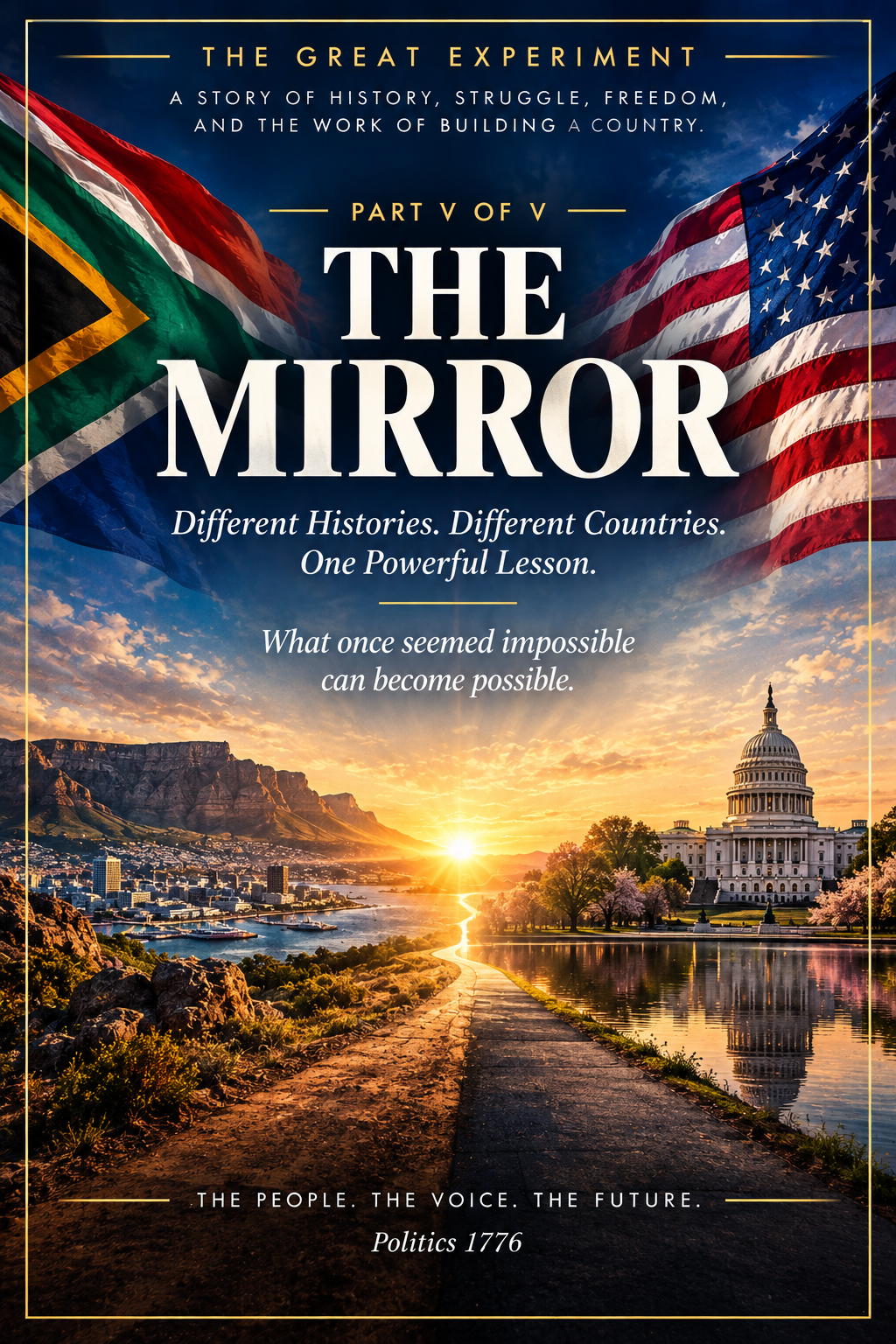
A Story of History, Struggle, Freedom, and the Work of Building a Country
PART V OF V
THE MIRROR
Different Histories. Different Countries. One Powerful Lesson.
For four parts, we stayed in South Africa.
We began with the country that existed before Nelson Mandela.
We watched segregation develop into apartheid.
We followed Mandela from a young man into a revolutionary and prisoner.
We watched him walk out of prison.
And we watched South Africa attempt something that, for much of its history, could have seemed almost impossible:
to move from apartheid toward a democratic constitutional order.
Now the story turns toward America.
But before we make that turn, one thing must be made absolutely clear.
South Africa and America are not the same.
Their histories are different.
Their founding circumstances are different.
Their political institutions are different.
Their conflicts are different.
Their cultures are different.
Their paths through history are different.
We should not erase those differences just to create a convenient comparison.
The purpose of this final chapter is not to say that the two countries experienced the same things.
They did not.
The purpose is to look at something deeper.
Possibility.
Because both countries have faced moments when the problems before them appeared enormous.
At times, the divisions seemed permanent.
At times, the conflicts seemed impossible to resolve.
At times, the future seemed almost impossible to imagine.
And yet history moved.
WHEN IMPOSSIBLE LOOKS PERMANENT
Imagine living in South Africa under apartheid.
The political system was not simply a disagreement between political parties.
It was a system established and enforced through law.
Race affected political rights, residence, education, movement, employment, and many other aspects of life.
Then imagine being told that one day the system would end.
That South Africans who had been separated by law would participate in a common democratic political system.
That Nelson Mandela, who had spent 27 years in prison, would become president.
That South Africa would adopt a new constitutional order.
At many points along the way, that future would have been difficult to imagine.
Yet it happened.
The first democratic elections were held on April 27, 1994, and Mandela was inaugurated as president on May 10. South Africa then built a new constitutional order, with the 1996 Constitution establishing principles including universal adult suffrage, regular elections, a multiparty system, human dignity, equality, and the rule of law.
That does not mean South Africa suddenly became perfect.
It did not.
The country still faced enormous economic and social challenges.
But something that once seemed impossible had become reality.
That is what makes the story worth remembering.
AMERICA HAD ITS OWN IMPOSSIBLE MOMENTS
America's history is different.
But America also experienced moments when the problems confronting the country appeared extraordinarily difficult to overcome.
The United States was founded around ideas of liberty and self-government.
Yet slavery existed within the new republic.
That contradiction became one of the deepest conflicts in American history.
Eventually, the country went to war with itself.
The Civil War cost hundreds of thousands of lives.
And the constitutional order changed.
The 13th Amendment abolished slavery.
The 14th established national citizenship and constitutional protections including due process and equal protection.
The 15th prohibited denying the right to vote on the basis of race, color, or previous condition of servitude.
Those changes were enormous.
But they did not instantly solve everything.
And that is important.
Changing the law did not instantly change the country.
THE FIRST ATTEMPT WAS NOT THE END
The Reconstruction Amendments represented extraordinary constitutional change.
But the story did not simply move forward in a straight line.
Black Americans gained new constitutional rights.
Black Americans voted.
Black Americans held public office.
New institutions and schools were established.
But political violence, discrimination, and resistance undermined many of the gains of Reconstruction.
Jim Crow segregation later became entrenched across much of the South.
Voting restrictions made political participation extraordinarily difficult for many Black Americans.
The promise of the constitutional amendments remained.
But the reality did not always match the promise.
The United States had changed its Constitution.
Yet the country still had more work to do.
That is another important lesson:
One victory does not guarantee the next one.
ANOTHER GENERATION KEPT MOVING
Decades later, another generation confronted the problem.
The civil rights movement challenged racial segregation and discrimination through litigation, organizing, protests, boycotts, political action, and other forms of civic participation.
In 1954, the Supreme Court decided Brown v. Board of Education, ruling that racial segregation in public schools was unconstitutional.
In 1964, Congress passed the Civil Rights Act, prohibiting discrimination in several major areas.
In 1965, Congress passed the Voting Rights Act, targeting discriminatory voting practices including literacy tests and creating additional federal protections for voting rights.
Again, the country had changed.
Again, it had taken generations.
And again, the work did not suddenly end.
THIS IS WHERE THE MIRROR MATTERS
South Africa's history and America's history are not interchangeable.
But they reveal something that is bigger than either country.
Countries can change.
Political systems can change.
Laws can change.
Institutions can change.
Ideas can change.
And sometimes the people living through the hardest moments cannot see what the next generation will eventually accomplish.
That does not mean every problem has a solution.
It does not mean every attempt succeeds.
It does not mean progress is guaranteed.
It means something simpler:
The future is not always as limited as the present makes it appear.
THE IMPOSSIBLE CAN BECOME POSSIBLE
For generations of South Africans, apartheid was the political reality they knew.
Then the system began to change.
For generations of Americans, slavery was part of the nation's legal and economic system.
Then slavery was abolished.
For generations after that, racial segregation and voting restrictions remained powerful realities.
Then laws and constitutional protections changed again.
These histories are not the same.
The people involved were not the same.
The political systems were not the same.
The solutions were not the same.
But there is a common human experience:
People living inside a problem often cannot know exactly how history will eventually change it.
They can only decide what they are going to do.
NO ONE PERSON DID IT
This is another reason the Mandela story matters.
It would be easy to turn everything into a story about one extraordinary man.
Mandela was enormously important.
But South Africa's transformation was larger than Mandela.
Millions of people participated in the country's political struggle.
Negotiators worked.
Communities endured.
Political organizations organized.
Government officials changed course.
Citizens voted.
Institutions were created.
A constitution was written.
And an entire country had to participate in what came next.
America's history tells us the same thing.
The Civil War was not caused or ended by one person alone.
Reconstruction was not the work of one person.
The civil rights movement was not the work of one person.
The changes that followed involved generations of citizens, organizations, courts, legislatures, presidents, lawyers, activists, workers, students, voters, and communities.
History is made by people.
THE PEOPLE WHO COME AFTER US
This may be the most important lesson of the entire series.
The people who changed history did not always live to see everything their work would produce.
Some planted seeds they would never see grow.
Some fought battles that would not be settled during their lifetime.
Some created institutions that later generations would strengthen.
Some made mistakes that later generations would correct.
That is how countries develop.
One generation builds something.
The next generation inherits it.
Then it decides what to do with it.
WE INHERIT THE PAST
Every country inherits something.
South Africa inherited its Indigenous history.
Its colonial history.
Its conflicts.
Its segregation.
Its apartheid system.
Its liberation struggle.
Its transition.
Its Constitution.
America inherited its founding documents.
Its constitutional system.
Its Revolution.
Its expansion.
Its history of slavery.
Its Civil War.
Its Reconstruction.
Its civil rights struggles.
Its institutions.
Its successes.
Its failures.
None of us chose the starting point.
But we do participate in what happens next.
That is the responsibility of citizenship.
HISTORY SHOULD INFORM US — NOT PARALYZE US
There are two ways to misuse history.
One is to pretend it never happened.
The other is to believe that because something happened in the past, it must permanently define the future.
Neither is necessary.
We should remember.
We should study.
We should tell the truth.
We should understand how institutions were created and how they changed.
We should understand the consequences of decisions made by previous generations.
But we should also recognize that history contains change.
That matters.
Because if history only demonstrated that nothing can ever change, there would be little reason to study it.
Instead, history repeatedly demonstrates something else:
People change things.
Sometimes slowly.
Sometimes painfully.
Sometimes imperfectly.
Sometimes after enormous sacrifice.
But they can change them.
THE GREAT EXPERIMENT IS NOT A PROMISE OF PERFECTION
This is what the phrase The Great Experiment really means.
It does not mean that America is perfect.
It does not mean South Africa is perfect.
It does not mean democracy guarantees perfect outcomes.
It does not mean governments always make the right decision.
It does not mean every political movement succeeds.
It means that people are capable of creating institutions, testing ideas, changing laws, correcting mistakes, and building something that did not previously exist.
An experiment can fail.
It can be changed.
It can be improved.
It can produce unexpected results.
And it can continue.
WHAT SOUTH AFRICA SHOWS US
South Africa's story gives us a remarkable example of political transformation.
A country with a deeply divided past entered a difficult period of negotiation.
The old system ended.
An election took place.
A new government was formed.
A new constitutional order followed.
And the country continued.
The story did not become perfect.
The work did not become easy.
But the impossible had become possible.
WHAT AMERICA'S HISTORY SHOWS US
America's history provides a different example.
The country began with ideals of liberty and self-government while also containing slavery and other exclusions.
The contradiction eventually produced a devastating civil war.
The constitutional order changed.
Slavery ended.
Citizenship and voting rights were constitutionally expanded.
Those changes were followed by setbacks.
Then generations later, constitutional principles and federal laws were used again to challenge segregation and barriers to voting.
The American story was not one straight line.
It was a series of struggles, changes, setbacks, and new efforts.
That is precisely why it belongs in this conversation.
DIFFERENT STORIES. THE SAME HUMAN POSSIBILITY.
This is the point.
Not that South Africa is America.
Not that America is South Africa.
Not that their histories should be merged.
They should not.
The point is that both histories demonstrate the capacity for change.
When people look at a problem that has existed for generations, it can be tempting to assume:
“This is simply how things are.”
History tells us to be careful with that assumption.
Apartheid was once how South Africa was governed.
It ended.
Slavery was once legal throughout much of the United States.
It ended.
Segregation was once enforced by law across much of the American South.
Its legal structure was dismantled.
None of those changes happened easily.
None happened overnight.
And none solved every problem that came afterward.
But they happened.
SO WHAT DO WE DO WITH THAT LESSON?
We don't use history to pretend the future will be easy.
We use history to understand that difficult does not necessarily mean impossible.
We don't look at Mandela and conclude that one great leader can fix everything.
We look at his story and see what happens when people continue working through circumstances that seem impossible.
We don't look at America's history and conclude that every problem will eventually solve itself.
We look at it and see that constitutional government has mechanisms for change—and that citizens and institutions have repeatedly used them.
The lesson is not optimism without evidence.
The lesson is possibility grounded in history.
THE NEXT GENERATION IS WATCHING
One day, the people reading this article will be part of history themselves.
Maybe not famous history.
Maybe not the history written in textbooks.
But history nonetheless.
Every election.
Every business opened.
Every child educated.
Every law passed.
Every community built.
Every problem solved.
Every institution strengthened.
Every citizen who decides to participate.
It all becomes part of the country the next generation inherits.
That is why citizenship matters.
Not because one person can fix everything.
But because millions of people making decisions over generations can change the direction of a country.
A COUNTRY IS BUILT EVERY DAY
That brings us back to the lesson at the heart of this entire series.
A country isn't built in a day.
South Africa wasn't.
America wasn't.
And neither will ever truly be finished.
A country is built through generations.
Through decisions.
Through institutions.
Through work.
Through disagreement.
Through compromise.
Through courage.
Through mistakes.
Through correction.
Through ordinary people deciding that the future is worth building.
Sometimes the first step is simply believing that change is possible.
WHAT ONCE SEEMED IMPOSSIBLE
There is something powerful about looking backward.
We know how the story turned out.
The people living through the hardest moments did not.
They could not see the future.
They could only see the problem in front of them.
And sometimes that problem must have seemed impossible.
Yet history moved.
Not because everything suddenly became easy.
Not because everyone agreed.
Not because one person had all the answers.
But because people kept working.
They kept negotiating.
They kept organizing.
They kept voting.
They kept building.
They kept trying.
And eventually, things changed.
What once seemed impossible became possible.
That is not a promise that every impossible problem will be solved.
It is something more grounded than that.
It is a reminder that we should be careful before declaring that change can never happen.
THE GREAT EXPERIMENT CONTINUES
South Africa's story ends here.
But the lesson does not.
America's story continues.
South Africa's story continues.
And the story of every country continues through the people who live there.
We inherit the work of those who came before us.
Then we add our own chapter.
Maybe we solve something.
Maybe we make a mistake.
Maybe we build something that lasts.
Maybe the next generation improves what we started.
That is how history works.
No generation gets to finish everything.
But every generation gets a chance to build something.
So learn the history.
Know where you came from.
Understand what previous generations faced.
Respect the people who carried the burden before you.
Learn from their successes.
Learn from their failures.
And then look forward.
Because the future has not been written yet.
The past is history.
The future is work.
And the work belongs to all of us.
A COUNTRY ISN'T BUILT IN A DAY.
IT IS BUILT EVERY DAY.
WHAT ONCE SEEMED IMPOSSIBLE CAN BECOME POSSIBLE.
THE GREAT EXPERIMENT CONTINUES.
THE PEOPLE. THE VOICE. THE FUTURE.
Politics 1776