THE MAYFLOWER PART 3 - A NEW BEGINNING
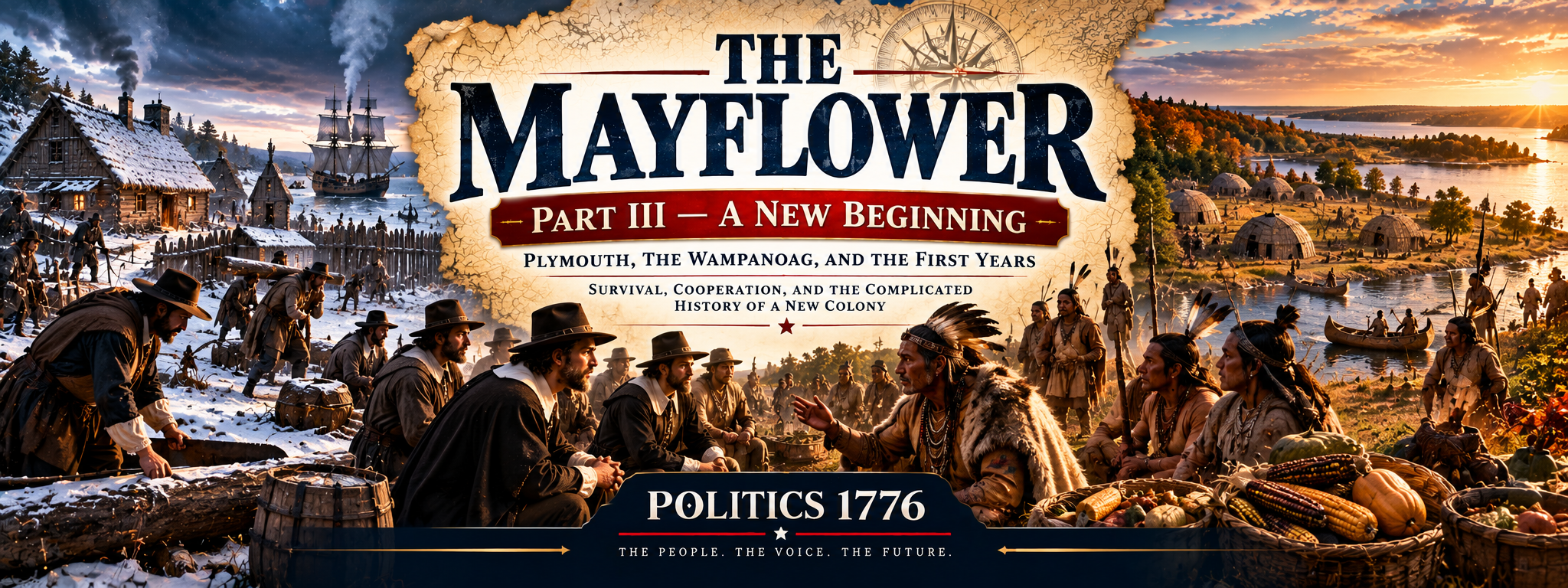
A NEW BEGINNING
Plymouth, the Wampanoag, and the First Years
Survival, Cooperation, and the Complicated History of a New Colony
Imagine standing on the shore of New England in December 1620.
The air is cold.
The wind moves across the water.
Trees rise beyond the coastline.
And offshore, a wooden merchant ship rests at anchor.
The people aboard have spent more than two months crossing the Atlantic Ocean.
They are exhausted.
Some are sick.
Their supplies are limited.
And winter has already arrived.
They have no houses waiting for them.
No established farms.
No roads leading to a friendly English settlement.
No reliable means of obtaining additional supplies from home.
Everything they need must either be carried from the ship, constructed by hand, obtained through trade, or gathered from the surrounding environment.
But the coastline is not an empty wilderness.
For thousands of years, Indigenous peoples have lived throughout the region.
They have established communities.
Cultivated crops.
Traveled waterways.
Maintained political relationships.
And developed extensive knowledge of the land and its resources.
The newcomers are entering a world that already has a history.
And that history will become inseparable from their own.
The Mayflower had carried its passengers across the ocean. Now the challenge was surviving on the other side.
The Land Before Plymouth
Long before English settlers established Plymouth Colony, southeastern New England was home to Indigenous nations and communities with established ways of life.
Among them were the Wampanoag, whose homeland encompassed much of present-day southeastern Massachusetts and parts of Rhode Island, including Martha's Vineyard and Nantucket.
Wampanoag communities were connected through family relationships, diplomacy, trade, and political leadership.
They cultivated crops, fished, hunted, gathered seasonal resources, and traveled along established routes.
Their lives were shaped by the changing seasons.
Corn, beans, and squash were important agricultural crops.
Coastal waters provided fish and shellfish.
Forests supplied wood, game, and other resources.
Communities maintained their own traditions and relationships with neighboring peoples.
The Wampanoag were not a single village under one simple political structure.
They included multiple communities with their own local leadership and relationships.
An important regional leader in 1620 was Ousamequin, widely known in English historical accounts as Massasoit.
His decisions would become central to the survival of the English settlement.
But before we reach those decisions, we need to understand what had happened in the region before the Mayflower arrived.
The Epidemic Before the Mayflower
Between approximately 1616 and 1619, a devastating epidemic swept through portions of coastal New England.
The disease caused severe population losses in several Indigenous communities.
Its precise cause remains uncertain.
Historians and medical researchers have proposed different explanations, but the surviving evidence does not establish a definitive diagnosis.
What is clear is that the epidemic had profound consequences.
Communities lost family members.
Local populations declined.
Political and economic relationships were disrupted.
Some settlements were devastated.
One of the places severely affected was Patuxet, a Wampanoag community located near what would become Plymouth.
By the time the Mayflower passengers arrived, Patuxet had experienced catastrophic population loss.
This history is essential.
The English settlers did not discover an unoccupied continent.
They arrived in a region where Indigenous societies had existed for generations and where European contact had already caused enormous harm.
The epidemic also influenced the political circumstances the newcomers encountered.
Ousamequin and neighboring Indigenous leaders faced a changing regional balance of power.
Their decisions about the English settlement would be shaped by those realities.
Patuxet — A Place With a History
The English settlers eventually chose the site of Patuxet for their colony.
They called the settlement Plymouth.
The location offered practical advantages.
There was access to freshwater.
The harbor provided a connection to the coast.
Some land had already been cleared through Indigenous occupation and agriculture.
The surrounding region offered potential resources for fishing, farming, and building.
But those advantages existed partly because people had lived and worked there before the English arrived.
The landscape was not untouched.
It had been shaped by Indigenous communities.
The settlers' choice of location therefore connected the beginning of Plymouth Colony with the history of Patuxet.
For the English passengers, it appeared to be a place where they might establish a settlement.
For the Wampanoag, it was part of a homeland with existing relationships, memories, and claims.
The same place could carry very different meanings for different people.
Building a Settlement in Winter
The English colonists faced an immediate problem.
They needed shelter.
Construction began under difficult conditions.
Trees had to be cut.
Timber had to be prepared.
Materials had to be moved.
Buildings had to be assembled.
And the work had to continue despite cold weather, illness, and exhaustion.
Many passengers remained aboard the Mayflower while construction proceeded.
Travel between the ship and shore could be difficult.
The settlers also needed to organize food supplies and protect what little equipment they possessed.
The community had limited experience establishing a settlement under these particular conditions.
Some passengers had worked as farmers or craftsmen.
Others came from different occupations.
But even experienced workers faced the challenge of building a community in an unfamiliar environment during winter.
Progress was slow.
And the health of the passengers began to deteriorate.
The First Winter
The winter of 1620–1621 was devastating.
Disease and exposure spread through the settlement and among those still aboard the Mayflower.
The precise causes of individual deaths cannot always be determined from the surviving evidence.
Contemporary accounts describe severe illness, weakness, and the extraordinary burden placed upon the few who remained healthy enough to care for others.
Food and shelter were inadequate.
The colonists had arrived too late in the year to establish a substantial harvest.
Their supplies had to last until they could begin producing food or obtaining it through other means.
By the spring of 1621, roughly half of the Mayflower passengers had died.
The losses included men, women, and children.
Families were shattered.
Some children lost parents.
Some adults lost spouses.
And the small community was left with fewer people capable of carrying out the work necessary for survival.
The Mayflower had completed its voyage with relatively few passenger deaths.
But the first winter on land proved far more deadly.
The People Who Kept the Colony Alive
William Bradford later described the extraordinary efforts of those who cared for the sick.
In Of Plymouth Plantation, he recalled that during the worst period, only a small number of people remained healthy enough to perform essential duties.
They gathered fuel.
Prepared food.
Cared for the ill.
Maintained fires.
And continued the work necessary to keep the settlement functioning.
Bradford particularly praised William Brewster and Miles Standish for their service during the crisis.
His account reflects the perspective of a participant and later governor.
But it provides a powerful description of the community's suffering.
The settlers' survival was not guaranteed.
Every death reduced the number of people available to work.
Every illness increased the burden on those who remained healthy.
The colony's future depended upon a shrinking group of survivors.
And as spring approached, they still faced enormous uncertainty.
John Carver and the First Government
The Mayflower Compact had established an agreement among its signers to organize civil government.
John Carver had been selected as the colony's first governor.
Carver had already played an important role in organizing the expedition and negotiating its arrangements.
Now he faced a different responsibility.
The settlement needed leadership during an emergency.
Decisions had to be made about construction, supplies, exploration, defense, and relationships with neighboring Indigenous communities.
The Compact provided a political foundation, but it did not eliminate disagreements or practical difficulties.
The colonists had to develop institutions through experience.
They also had to balance their own community's needs with the requirements and expectations of the investors who had helped finance the voyage.
The political and economic future of Plymouth remained uncertain.
And before long, the colony would lose its first governor.
March 1621 — An Unexpected Visitor
On March 16, 1621, according to the English calendar, a remarkable encounter took place.
An Indigenous man entered the English settlement.
His name was Samoset.
He was an Abenaki sagamore from farther north along the coast, in the region of present-day Maine.
To the colonists' surprise, he greeted them in English.
Samoset had learned some of the language through contact with English fishermen and traders.
His arrival demonstrated something the settlers were only beginning to understand.
Indigenous communities had already developed relationships with Europeans.
Information traveled along coastal routes.
People moved between communities.
And the English settlement was not isolated from the wider region.
Samoset helped establish communication between the colonists and local Indigenous leaders.
His visit would become an important step toward a more formal relationship.
Tisquantum — The Man Known as Squanto
Soon another Indigenous man became central to the story.
His name was Tisquantum, commonly known in English accounts as Squanto.
He was from Patuxet.
His life before the Mayflower's arrival had been extraordinary and deeply traumatic.
In 1614, the English captain Thomas Hunt kidnapped Tisquantum and other Indigenous men from the New England coast.
They were taken across the Atlantic and intended for sale into slavery.
Tisquantum eventually reached England.
Over time, he learned English and became familiar with aspects of European society.
He later returned to North America, reaching his homeland in 1619.
But when he returned to Patuxet, he found that the epidemic had devastated his community.
The world he had known had been transformed.
Tisquantum's ability to speak English made him valuable as an interpreter and intermediary.
But his story was not simply one of a helpful guide.
He was a man who had survived kidnapping, displacement, and the destruction of much of his home community.
His experiences shaped the role he would play in the early years of Plymouth Colony.
Ousamequin — The Wampanoag Leader
Another central figure was Ousamequin, often called Massasoit in historical accounts.
He was an important leader among the Pokanoket and within the broader Wampanoag political world.
His position required him to consider the security and interests of his people.
The epidemic had weakened some Wampanoag communities.
Relations with neighboring Indigenous nations, including the Narragansett, were important political considerations.
European traders and settlers introduced additional uncertainties.
The English newcomers were few in number.
They had suffered terrible losses.
But they possessed firearms and connections to the expanding English Atlantic world.
Ousamequin had to decide how to respond to their presence.
He could treat them as a threat.
Avoid them.
Or attempt to establish a relationship that might serve Wampanoag interests.
He chose to negotiate.
That decision would influence the future of both communities.
The Agreement of March 1621
On March 22, 1621, according to the English calendar, Ousamequin and Plymouth's leaders reached an agreement.
The arrangement is often described as a peace treaty or alliance.
Its terms were recorded in English sources.
They included commitments intended to reduce violence, address wrongdoing, and provide mutual assistance in certain circumstances.
The agreement also concerned the handling of weapons during visits and the maintenance of peaceful relations.
For the English colonists, the arrangement offered an opportunity to improve their security.
For Ousamequin, it may have provided strategic advantages within a changing regional political environment.
Historians examine his decision in light of Wampanoag interests, the epidemic, and relations with neighboring nations.
It should not be understood simply as an act of generosity toward helpless newcomers.
Ousamequin was a political leader making decisions for his people.
The agreement reflected diplomacy between communities with different interests.
And for a time, it helped establish a working relationship.
Cooperation Was Not the Same as Equality
The alliance is an important part of Plymouth's early history.
But it should not be romanticized.
The English settlers and the Wampanoag did not possess identical goals.
They had different understandings of land, political authority, and community relationships.
The English intended to establish a permanent colony.
The Wampanoag sought to protect their people and maintain their position within the region.
The agreement created opportunities for cooperation.
It did not eliminate every source of tension.
Nor did it resolve the long-term consequences of English settlement.
Those consequences would become more serious as colonial populations expanded and demands for land increased.
But in 1621, the immediate circumstances encouraged diplomacy.
Both sides had reasons to maintain a workable relationship.
Learning to Live in a New Environment
The English settlers needed to develop a reliable food supply.
Their first winter had demonstrated the danger of depending entirely upon imported provisions.
They needed to cultivate crops.
Fish.
Gather resources.
And learn how to use the surrounding environment.
Tisquantum helped the settlers communicate with Indigenous communities and understand aspects of local agriculture and geography.
Historical accounts credit him with providing guidance about planting corn and obtaining food.
He also served as an interpreter during diplomatic and trading activities.
Some popular retellings describe him as single-handedly teaching the colonists everything they needed to survive.
That simplifies the history.
The settlers possessed agricultural and practical knowledge of their own.
They also depended upon multiple people, changing circumstances, and relationships with Indigenous communities.
But Tisquantum's contributions were important.
His knowledge and language skills helped the colony navigate a world unfamiliar to many of its residents.
Corn and the First Growing Season
Corn was one of the most important crops cultivated by Indigenous communities in the region.
It had been developed and cultivated in the Americas long before European colonization.
By 1621, the English settlers recognized its importance to their food supply.
They planted crops during the spring.
They also continued exploring opportunities for fishing, hunting, and gathering.
The growing season required patience.
A successful harvest could not be guaranteed.
Weather conditions mattered.
Labor was limited.
And the colony was still recovering from the devastating winter.
But as spring turned to summer, the survivors began establishing a more sustainable pattern of life.
Their prospects were improving.
William Bradford Becomes Governor
In April 1621, John Carver died.
His death was another serious loss for the colony.
The settlers selected William Bradford as governor.
Bradford would become one of the most influential leaders in Plymouth's history.
He served numerous terms as governor over the following decades.
His later writing preserved much of what historians know about the colony's early years.
But in 1621, Bradford was not yet the historical figure remembered today.
He was a young leader facing enormous practical responsibilities.
The colony remained small.
Its economic future was uncertain.
And its relationship with neighboring Indigenous communities required careful management.
Bradford's leadership would help shape Plymouth's development.
But the colony's survival depended upon many people.
The Mayflower Returns to England
In April 1621, the Mayflower departed Plymouth Colony and returned to England.
The ship had remained in New England through the winter.
Its crew had also suffered illness and losses.
But by spring, the vessel was ready to sail home.
For the surviving colonists, the departure was significant.
The ship represented their last direct connection to the expedition that had brought them across the Atlantic.
Once it departed, they were left to continue establishing the settlement.
The Mayflower was a merchant vessel.
Its crew had commercial responsibilities beyond the colony.
The ship would not remain permanently at Plymouth.
The settlers now had to depend upon their own work, their developing relationships, and the possibility of future supply voyages.
The famous ship had completed its role in the founding expedition.
But Plymouth's story was only beginning.
Summer 1621 — Building Relationships
During the spring and summer, Plymouth's leaders worked to strengthen their relationships with neighboring Indigenous communities.
Diplomatic visits and exchanges helped establish communication.
Edward Winslow and Stephen Hopkins traveled to meet Ousamequin.
Tisquantum served as an interpreter and intermediary.
These interactions involved more than simple friendship.
They concerned political relationships, trade, security, and mutual expectations.
The English needed information about the region.
They hoped to develop economic opportunities.
They also wanted to understand the intentions of neighboring communities.
Indigenous leaders had their own reasons for communicating with the colonists.
The settlement had become a new factor in regional politics.
And its future would depend partly upon how those relationships developed.
Tisquantum's Complicated Position
Tisquantum occupied an unusual position.
He could communicate with the English.
He understood aspects of their society.
He knew the region and its Indigenous communities.
That made him influential.
But his interests were not necessarily identical to those of Ousamequin or the English colonists.
Historical accounts suggest that Tisquantum sometimes attempted to use his position as an intermediary to increase his own influence.
This created tensions.
At times, Plymouth's leaders and Wampanoag authorities disagreed over his conduct.
His story reminds us that historical figures cannot always be reduced to simple categories.
Tisquantum was neither merely a helpful guide nor a figure whose every decision can be explained through loyalty to one side.
He was navigating an extraordinarily difficult political and personal situation.
His actions reflected the complicated circumstances of early colonial encounters.
Autumn 1621 — A Harvest
By autumn, Plymouth's settlers had experienced their first growing season.
The harvest provided an important opportunity to replenish food supplies.
The colony had survived its first winter.
Its population remained small.
Many families had suffered losses.
But the survivors had begun building homes, cultivating land, and developing a working relationship with Ousamequin's people.
At some point during the autumn of 1621, the colonists held a gathering that included feasting and recreation.
A group of Wampanoag men, including Ousamequin, participated.
The event would later become famous as the First Thanksgiving.
But the historical gathering was different from the familiar holiday images that developed centuries afterward.
What Actually Happened in 1621?
One of the principal surviving descriptions comes from Edward Winslow, writing in a letter later published in Mourt's Relation.
Winslow described the colonists gathering to celebrate their harvest.
He reported that Ousamequin arrived with approximately ninety men.
The Wampanoag visitors remained for three days.
Winslow also recorded that the Wampanoag contributed five deer.
The English engaged in fowling, and the gathering included food and recreation.
The surviving account is brief.
It does not provide a complete menu.
It does not describe every activity.
And it does not record the event as the beginning of an annual national holiday.
The gathering took place within the context of the diplomatic relationship established earlier that year.
It involved people from two communities whose future relationship remained uncertain.
Was It Really the First Thanksgiving?
The phrase First Thanksgiving is familiar to Americans.
But it can be misleading if interpreted literally.
Indigenous peoples had long maintained traditions of giving thanks, including ceremonies and practices connected to harvests and the natural world.
Europeans also observed religious days of thanksgiving before 1621.
Other thanksgiving observances occurred in North America before the Plymouth harvest gathering.
The 1621 event was not the first occasion on which people in North America expressed gratitude or celebrated a harvest.
Nor did it immediately establish the modern American Thanksgiving holiday.
The connection between Plymouth's 1621 gathering and the national holiday developed much later.
Thanksgiving became an official annual national observance through a long historical process, including President Abraham Lincoln's 1863 proclamation and subsequent federal legislation.
The 1621 gathering is historically significant.
But its meaning changed as later generations incorporated it into American national memory.
The Familiar Thanksgiving Image
Many Americans grew up seeing paintings and illustrations of Pilgrims and Indigenous people seated together at a long table.
The images often show familiar modern holiday foods.
Turkey.
Pumpkin pie.
Cranberry sauce.
And other dishes associated with Thanksgiving today.
But the surviving sources do not establish that this was the meal served in 1621.
Wildfowl and venison are supported by the historical record.
Other foods may have been available, including corn and regional resources.
But historians must distinguish between documented evidence and later assumptions.
The event also should not be presented as proof that relations between English settlers and Indigenous communities remained permanently peaceful.
The alliance of 1621 was real.
So were the tensions and conflicts that developed in later decades.
The historical story is more complicated than the familiar holiday illustration.
And understanding that complexity does not diminish the importance of cooperation.
It places cooperation within the circumstances in which it occurred.
The Arrival of the Fortune
In November 1621, another English ship arrived at Plymouth.
Its name was the Fortune.
The ship brought approximately thirty-five new settlers.
For the colony, the arrival was both encouraging and challenging.
Additional people meant more potential labor.
More families and workers could help expand the settlement.
But the newcomers also required food and shelter.
The Fortune brought limited provisions for the additional population.
The colony's resources were already stretched.
Its first harvest had helped improve conditions, but the settlement was not yet prosperous.
The arrival demonstrated that Plymouth was becoming part of an ongoing migration and commercial network.
The colony was no longer simply the group that had arrived aboard the Mayflower.
Its population was beginning to grow.
And that growth would create new demands.
The Investors Still Expected Returns
The commercial arrangements discussed in Part I did not disappear when the Mayflower reached North America.
The investors who helped finance the expedition expected the colony to produce economic value.
The settlers were supposed to develop resources and send goods back to England.
Potential products included furs, timber, and other commodities.
But the colony's first year had been dominated by survival.
Nearly half of the original passengers had died.
Construction was incomplete.
Agriculture was only beginning.
And the settlers had limited resources available for export.
The Fortune carried a shipment of goods from the colony intended for the investors.
But the ship was captured by a French privateer on its return voyage.
The loss created another financial setback.
The colony's economic challenges were far from over.
The Search for a Sustainable Economy
Plymouth's settlers had to establish a way to support themselves over the long term.
Agriculture was essential.
But farming alone did not immediately satisfy the expectations of the investors.
The colony also explored trade.
Furs became particularly important.
Indigenous communities possessed established trading relationships and knowledge of regional resources.
European demand for furs created commercial opportunities.
The settlers sought to participate in these networks.
But trade involved negotiation, competition, and relationships with Indigenous peoples.
The colony's economic future depended partly upon its ability to maintain those relationships.
This connects Plymouth's story directly to the larger history of American commerce.
The settlement was not isolated from the Atlantic economy.
It was an attempt to establish a new community within it.
1622 — New Challenges
The second year brought additional difficulties.
Food supplies remained uncertain.
The colony's population was growing.
The settlers faced pressure to expand agriculture and trade.
Relations with neighboring Indigenous communities also became more complicated.
Tisquantum continued serving as an interpreter, but his political position generated tensions.
He died in late 1622 during a trading expedition.
The exact cause of his death remains uncertain.
His loss deprived Plymouth of an important intermediary.
It also marked the end of an extraordinary life shaped by kidnapping, transatlantic travel, the devastation of Patuxet, and the difficult politics of early English settlement.
Tisquantum's role in Plymouth's survival was significant.
But his life deserves to be remembered as more than a footnote to the English colonists' story.
1623 — The Colony Adjusts
By 1623, Plymouth's leaders were confronting the weaknesses of their early economic arrangements.
The colony had initially operated under a system in which substantial agricultural labor and production were organized for the common enterprise.
Bradford later described difficulties with this arrangement.
He believed it discouraged some individual effort and created disputes about labor and responsibility.
The colony began allocating land for household cultivation while maintaining certain obligations to the broader community.
Bradford presented the change as an improvement in productivity and motivation.
His account has often been used in later political and economic arguments.
But historians should distinguish between Bradford's interpretation and the broader historical circumstances.
The colony's agricultural difficulties had multiple causes.
The settlers had arrived late in the year.
They had suffered severe mortality.
They lacked adequate supplies.
They were adjusting to unfamiliar growing conditions.
And their original financial arrangements were complicated.
The shift toward household cultivation was an important development.
But it should not be reduced to a simple modern political lesson.
It was a practical change made by a struggling seventeenth-century settlement.
The Colony Begins to Take Root
Despite its difficulties, Plymouth survived.
Additional settlers arrived.
Agriculture expanded.
Trade developed.
Houses and other structures were built.
The colony established more regular patterns of government.
But survival did not mean that every problem had been solved.
The settlement remained small.
Its finances were uncertain.
And its relationship with Indigenous communities required continued diplomacy.
The English population would grow over time.
That growth would increase demand for land and resources.
It would also alter the political relationships that had helped the colony survive its earliest years.
The story of Plymouth was entering a new phase.
The Alliance and Its Limits
The agreement between Ousamequin and Plymouth's leaders helped maintain a relationship that endured for decades, though not without tensions.
Both sides had reasons to preserve cooperation.
But their interests were not identical.
The English wanted a permanent and expanding settlement.
Wampanoag communities sought to protect their lands, political relationships, and independence.
As more English settlers arrived in New England, disputes over land and authority became increasingly important.
Different Indigenous communities responded to colonial expansion in different ways.
Some negotiated.
Some traded.
Some resisted.
And alliances shifted as circumstances changed.
The early cooperation at Plymouth was genuine.
But it existed within a larger history of colonization that would bring profound consequences.
A New Colony in an Older World
By the end of Plymouth's first several years, the settlement had become more stable than it had been during the terrible winter of 1620–1621.
The colonists had established a government.
Developed agriculture.
Participated in trade.
And maintained important diplomatic relationships.
But the colony's survival had depended upon far more than the passengers' determination.
The site they occupied had been shaped by Indigenous habitation.
Their first diplomatic relationships involved Indigenous leaders pursuing their own interests.
Tisquantum and others provided essential language skills, knowledge, and assistance.
And the region's existing political circumstances influenced the choices available to everyone involved.
The history of Plymouth cannot be understood solely through the Mayflower passengers.
It must also include the people whose homeland they entered.
Plymouth Colony survived through a combination of labor, adaptation, diplomacy, Indigenous knowledge, and circumstances that neither community fully controlled.
THE FIRST YEARS — WHAT THEY REALLY TELL US
The familiar story of Plymouth often focuses on a few recognizable images.
A ship crossing the Atlantic.
A group of settlers arriving on shore.
A written agreement.
A difficult winter.
And a harvest gathering shared with Indigenous neighbors.
All of these have historical foundations.
But the complete story is much larger.
It includes the devastating epidemic that struck Indigenous communities before the Mayflower arrived.
The destruction of Patuxet.
The political leadership of Ousamequin.
The extraordinary and painful life of Tisquantum.
The losses suffered by the English settlers.
The diplomatic agreement of 1621.
The challenges of farming and trade.
And the gradual development of a colony whose future was far from guaranteed.
It also reveals that cooperation and conflict are not mutually exclusive parts of history.
Communities can form alliances while pursuing different interests.
They can help one another while disagreeing about land, authority, and the future.
And relationships that appear stable in one generation can change dramatically in another.
The early years of Plymouth offer an important example.
For a time, diplomacy and cooperation helped two communities navigate a difficult situation.
But the long-term consequences of English settlement would extend far beyond the survival of the first colonists.
THE MAYFLOWER'S STORY WAS NEVER JUST ABOUT THE MAYFLOWER
The ship had crossed the Atlantic.
The passengers had survived their first year.
The colony had begun to establish itself.
But the Mayflower itself was already gone.
It had returned to England in April 1621.
The settlement that remained was shaped by people and decisions on both sides of the Atlantic.
English investors continued expecting commercial returns.
Colonial leaders worked to establish government and economic stability.
Indigenous leaders evaluated the growing English presence.
Families struggled to build lives in a changing environment.
And the future remained uncertain.
The story of Plymouth would continue through the following decades.
The colony would develop institutions.
Its economy would change.
Its population would grow.
And its relationship with neighboring Indigenous nations would become increasingly complicated.
Eventually, the Mayflower voyage would become a powerful symbol in American historical memory.
But that symbolic legacy would emerge long after the first winter, the alliance of 1621, and the difficult work of establishing the colony.
To understand the Mayflower's place in American history, we must examine both the colony that developed and the story later generations chose to remember.
That brings us to the final chapter.
NEXT — PART IV
THE LEGACY — SELF-GOVERNMENT, COMMERCE, AND THE MAKING OF AN AMERICAN STORY
How Plymouth Developed, How Relationships Changed, and Why the Mayflower Became a National Symbol
The Mayflower has returned to England.
Plymouth Colony has survived its earliest years.
But its story is far from complete.
The final chapter follows the colony's development through the decades that followed.
We will explore its changing economy, the role of private property and commercial investment, and the institutions that developed from the Mayflower Compact.
We will examine how English settlement expanded and how relationships with Indigenous nations changed over time.
We will also explore the events that culminated in King Philip's War and the profound consequences of that conflict.
Finally, we will examine how the Mayflower became a national symbol, how the familiar Thanksgiving narrative developed, and what the historical record actually tells us.
Because the Mayflower's importance lies not simply in the voyage of 1620.
It lies in the history that followed—and in how Americans have remembered that history ever since.
THE MAYFLOWER CONTINUES.
Our Money Matters.
Our Choices Matter.
Our Voice Matters.
The People. The Voice. The Future.
Politics 1776