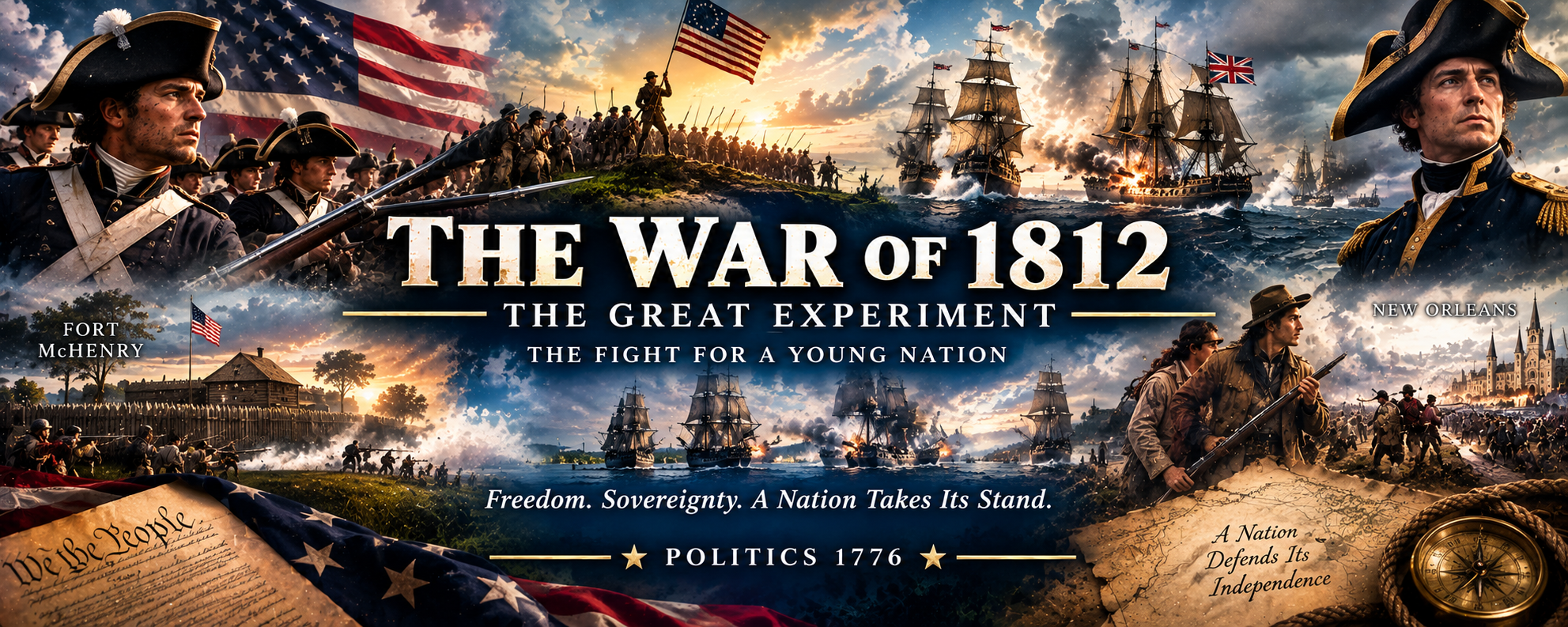
THE WAR OF 1812
PART II OF II
SIX STORIES THAT BECAME AMERICAN SYMBOLS
Dolley Madison. USS Constitution. Tecumseh. Fort McHenry. The Star-Spangled Banner. The Battle of New Orleans.
The first part of the War of 1812 story explained why the war began, how the young United States entered it, and how the conflict finally ended.
But wars are not remembered only through declarations, campaigns, and treaties.
They are remembered through people.
Through ships.
Through places.
Through flags.
Through songs.
And sometimes through a single night that becomes part of a country's memory.
The War of 1812 left America with some of its most recognizable stories.
This is the story behind six of them.
1. DOLLEY MADISON
The Night Washington Burned
By the summer of 1814, the war had entered a dangerous new phase.
British forces had defeated Napoleon in Europe, freeing troops and resources for operations against the United States.
Washington was vulnerable.
On August 24, 1814, American forces were defeated at the Battle of Bladensburg, Maryland.
The road to the capital was open.
British troops entered Washington that evening.
The Capitol was burned.
The President's House was burned.
Other public buildings were damaged or destroyed.
James Madison and his government fled the city.
But inside the President's House, another story was unfolding.
Dolley Madison, the president's wife, was preparing to leave.
Among the objects inside was a famous full-length portrait of George Washington painted by Gilbert Stuart.
The portrait was large and mounted to the wall.
There was no time to carefully remove it.
According to the National Park Service, Dolley instructed Paul Jennings, a 15-year-old enslaved African American who worked in the White House, to save the portrait if possible. The frame was broken apart so the canvas could be removed and carried to safety.
The story is often remembered simply as Dolley Madison saving Washington's portrait.
But the fuller story matters.
Dolley was not alone.
An enslaved young man named Paul Jennings helped save it.
History is often remembered through famous names.
Sometimes the people who actually carried history through the door were people whose names were barely remembered at all.
The portrait survived.
The White House did not.
But the government would rebuild.
And the portrait of the nation's first president would remain.
2. USS CONSTITUTION
“OLD IRONSIDES”
Before the War of 1812, the United States was still a young maritime nation.
Its navy was small.
Britain's Royal Navy was enormous.
The USS Constitution had been launched in Boston in 1797 as one of six frigates authorized by Congress in the Naval Act of 1794.
By 1812, Constitution was ready for war.
On August 19, 1812, she encountered HMS Guerriere off the coast of Nova Scotia.
The battle lasted roughly half an hour.
British cannon fire struck Constitution's thick oak hull.
Some of the shot appeared to bounce off.
An American sailor reportedly exclaimed:
“Huzzah! Her sides are made of iron!”
And a legend was born.
Old Ironsides.
Constitution defeated Guerriere.
She later defeated HMS Java in December 1812 and HMS Cyane and HMS Levant in February 1815.
These victories did not determine the outcome of the entire war.
The U.S. Navy was far smaller than Britain's, and Constitution's victories had limited direct strategic effect on the overall conflict.
But something else happened.
Americans saw a young nation's ship defeat vessels belonging to the world's dominant naval power.
Morale mattered.
Confidence mattered.
The United States had entered the war as a young republic uncertain of its military strength.
Old Ironsides gave Americans something they could point to.
A ship.
A crew.
A victory.
A reminder that the young country could stand on its own.
3. TECUMSEH
The Nation That Never Came to Be
The War of 1812 was not simply a conflict between Americans and British.
Native nations had their own interests, their own territories, their own political goals, and their own reasons for entering the conflict.
Few people illustrate that better than Tecumseh, the Shawnee leader.
Tecumseh believed Native peoples faced an existential threat from continued American expansion.
He and his brother Tenskwatawa, known as the Prophet, worked to build an alliance among Native nations.
Their goal was not simply to choose between America and Britain.
Tecumseh envisioned a unified Native homeland capable of resisting further American expansion.
In 1811, while Tecumseh was away seeking allies, William Henry Harrison's forces attacked Prophetstown, the center of the confederacy.
The settlement was destroyed.
Tecumseh concluded that peaceful resistance was becoming increasingly difficult and eventually allied with the British during the War of 1812.
The alliance achieved important victories.
But the western theater began to turn after American naval forces won the Battle of Lake Erie in September 1813.
British forces retreated.
Tecumseh remained behind.
On October 5, 1813, American forces under William Henry Harrison fought British and Native forces at the Battle of the Thames.
Tecumseh was killed.
His confederacy did not survive him.
His vision of a unified Native homeland was never realized.
And that is an important part of the War of 1812 story.
The war helped strengthen the United States.
But it also had enormous consequences for Native nations.
American victories in the West opened the way for further American expansion, while Native nations lost land and political leverage.
The American story cannot be understood only from the American side of the battlefield.
Tecumseh reminds us that there were other peoples living on this continent with their own visions of what the future should look like.
4. FORT McHENRY
The Night the Flag Survived
September 1814.
Baltimore.
After burning Washington, British forces turned toward another important American city.
Their target was Baltimore.
But Baltimore was defended.
At the entrance to the harbor stood Fort McHenry.
The British began their bombardment on September 13.
For approximately 25 hours, British ships fired on the fort.
Inside were American defenders.
Outside were British warships.
And watching from a vessel in the harbor was an American lawyer named Francis Scott Key.
Key had been involved in negotiations surrounding the release of an American prisoner.
He was aboard a ship when the British attack began.
Throughout the night, he watched the bombardment.
The question was whether the fort would survive.
Then morning came.
Through the smoke, Key saw the American flag still flying over Fort McHenry.
The fort had held.
Key began writing words inspired by what he had seen.
Those words would eventually become the national anthem of the United States.
But the story began with a flag.
A large American flag.
The garrison flag flying over Fort McHenry measured approximately 30 by 42 feet.
It had survived the night.
And for Key, that sight became the beginning of a song.
5. THE STAR-SPANGLED BANNER
How a Flag Became a National Symbol
The flag and the song are often treated as if they were always inseparable.
They weren't.
The flag existed first.
The song came afterward.
Francis Scott Key's poem was originally titled “Defence of Fort M'Henry.”
It was written after he saw the American flag flying over the fort following the British bombardment.
The words were later set to the tune of a popular English drinking song called “To Anacreon in Heaven.”
The song spread.
But it did not immediately become the national anthem.
That took more than a century.
In 1916, President Woodrow Wilson ordered that “The Star-Spangled Banner” be played at military and other official occasions.
In 1931, Congress passed legislation making it the official national anthem, and President Herbert Hoover signed it into law.
The song had traveled a long way.
From a lawyer watching a battle.
To a poem.
To a song.
To a national symbol.
The National Park Service describes both the flag and anthem as lasting legacies of the War of 1812.
And there is something remarkable about that.
A military attack created a moment.
A person witnessed it.
A person wrote about it.
Generations gave it meaning.
That is how symbols are made.
6. THE BATTLE OF NEW ORLEANS
The Battle That Happened After the Treaty Was Signed
And now we arrive at one of the strangest moments of the entire war.
By December 1814, American and British diplomats were negotiating peace in Ghent, Belgium.
On December 24, 1814, they signed the Treaty of Ghent.
But the war was not over yet.
The treaty still had to be ratified.
And news traveled by ship.
The armies fighting in North America did not immediately know what had been agreed upon thousands of miles away.
That meant the fighting continued.
British forces moved toward New Orleans.
American forces gathered under Major General Andrew Jackson.
On January 8, 1815, the two armies met.
Jackson's American forces won a decisive victory.
The British suffered heavy casualties.
And then came the strange part.
The Treaty of Ghent had already been signed.
The battle happened afterward.
But the war had not legally ended because the treaty had not yet been fully ratified.
The Battle of New Orleans therefore became one of the final major battles of the War of 1812.
And because news traveled slowly, soldiers were still fighting a war diplomats had already agreed to end.
The American victory became legendary.
Andrew Jackson became a national hero.
But the battle did not win the war in the conventional sense.
The treaty had already established the terms of peace.
Instead, New Orleans became something else:
A powerful final image of the young republic standing its ground.
SIX STORIES
Look at these six stories together.
They tell us something the timeline alone cannot.
Dolley Madison shows a capital under attack.
Paul Jennings reminds us that people whose names disappeared from the headlines were still part of the story.
USS Constitution shows a young navy challenging a powerful opponent.
Tecumseh reminds us that the United States was not the only nation or people with a vision for the future of this continent.
Fort McHenry gives us the night behind the song.
The Star-Spangled Banner shows how an event can become a symbol.
And New Orleans shows just how different the world was when information traveled at the speed of a ship.
These stories also reveal something important about the American Experiment.
America was still young.
Its government was still young.
Its military was still developing.
Its institutions were still being tested.
And the country was far from united on every question.
The War of 1812 did not magically solve those problems.
But it became another test.
Could this young republic survive another major war?
Could it defend its independence?
Could it rebuild after its capital was burned?
Could it grow stronger while confronting the consequences of its own expansion?
Those questions did not disappear when the Treaty of Ghent was ratified.
They became part of the next chapter.
WHAT THE WAR LEFT BEHIND
The War of 1812 is sometimes remembered as a collection of famous stories:
Old Ironsides.
The flag over Fort McHenry.
The burning of Washington.
Dolley Madison.
Tecumseh.
Andrew Jackson.
The Star-Spangled Banner.
But underneath those stories was a much larger transformation.
The war reinforced American independence.
It encouraged domestic manufacturing.
It strengthened American nationalism and confidence.
It exposed weaknesses in the country's military and financial systems.
It accelerated conflict and displacement involving Native nations.
And it left Americans with a stronger sense that the young republic had survived another enormous test.
The National Park Service describes the conflict as much more complicated than the familiar American icons suggest, involving multiple nations and dozens of Native nations.
That complexity is worth remembering.
History is not just the story of the people who won.
It is the story of everyone who lived through it.
THE GREAT EXPERIMENT
The American Revolution had asked a fundamental question:
Could a people govern themselves?
The War of 1812 asked another:
Could the young republic defend the independence it had claimed?
The answer was not simple.
The United States suffered serious defeats.
Washington burned.
American invasions of Canada failed.
The economy struggled.
Native nations suffered devastating losses.
The country ended the war without gaining the territorial concessions it had sought.
And yet the republic survived.
Its government survived.
Its Constitution survived.
Its capital was rebuilt.
Its institutions continued.
And the country moved into a new chapter of its history.
That is the larger story.
Not perfection.
Not victory without cost.
Not a country without contradictions.
A country still being built.
A COUNTRY ISN'T BUILT IN A DAY.
IT IS BUILT EVERY DAY.
The War of 1812 left behind more than battlefields.
It left behind stories.
Stories that Americans would carry for generations.
A portrait.
A ship.
A leader.
A fort.
A flag.
A song.
And a battle fought while peace was already crossing the ocean.
THE GREAT EXPERIMENT CONTINUES.
THE PEOPLE. THE VOICE. THE FUTURE.
Politics 1776