

WHY AMERICA DECLARED INDEPENDENCE PART 1
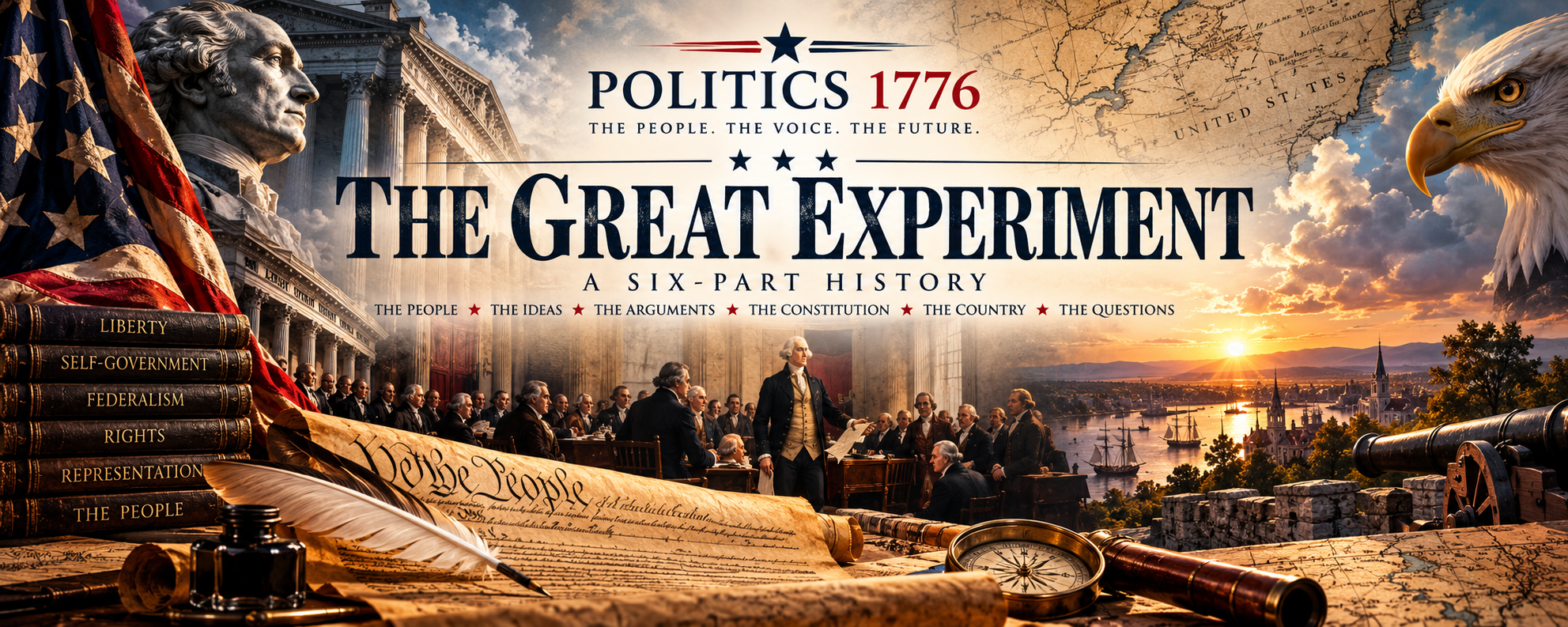
THE GREAT EXPERIMENT
Part I: The Founders Were Never One Voice
The People Who Built the American Experiment
Before there was a Constitution, before there was a President of the United States, and before there were the political parties Americans recognize today, there was a question.
Could people govern themselves?
The Americans who declared independence in 1776 had already made an extraordinary claim.
Government did not simply possess authority because a king, parliament, army, or tradition said that it did.
The Declaration of Independence argued that legitimate government derived its power from “the consent of the governed.”
That was an enormous idea.
But declaring it was one thing.
Building a country around it would prove much more difficult.
The men we now collectively call the Founders did not gather around a table with one political philosophy, one economic vision, or one answer for how America should work.
They disagreed about power.
They disagreed about representation.
They disagreed about taxation.
They disagreed about commerce.
They disagreed about banking.
They disagreed about agriculture and manufacturing.
They disagreed about the relationship between the states and the national government.
They disagreed about how strictly the powers of the new government should be interpreted.
They even disagreed about the Constitution itself.
Some would help write it.
Some would defend it.
Some would oppose it.
Some would demand that it be changed before they were willing to trust it.
And several of the most important figures of the American founding were not even in the room when the Constitution was written.
The Founders were anything but one voice.
That may be one of the most important things to understand about the country they created.
Independence Was Only the Beginning
On July 4, 1776, the colonies declared themselves independent.
The Declaration announced principles that would become inseparable from the American story: equality, rights, liberty, the pursuit of happiness, government by consent, and the right of people to change a government that became destructive of those purposes.
But the Declaration was not a detailed plan of government.
America still had to figure out how self-government would actually work.
How much power should a national government possess?
How much should remain with the states?
Who could impose taxes?
Who could regulate trade?
Who would defend the country?
How should states with very different populations be represented?
How could the government protect liberty while still possessing enough power to govern?
And perhaps most difficult of all:
What happens when free people simply do not agree?
Those questions would occupy Americans for years.
In many ways, they still do.
America's First Attempt
The Constitution was not America's first national framework.
That distinction belongs to the Articles of Confederation.
The Articles created what they called a “league of friendship” among thirteen states. Each state retained substantial sovereignty and power, and each state received one vote in Congress regardless of population.
That arrangement reflected understandable fears.
Americans had just fought a revolution against a distant government they believed had abused its authority. Creating another powerful central government was hardly an obvious next step.
So the first American system left considerable power with the states.
But independence exposed another problem:
A government can be too weak as well as too powerful.
Under the Articles, Congress could not directly levy taxes. It depended heavily on the states for revenue.
The national government lacked sufficient authority to regulate interstate commerce.
It struggled with debt and finances left by the Revolutionary War.
States quarreled over trade, territory, taxation, and other matters.
The government responsible for the interests of the whole Union often lacked the power to address problems affecting the whole Union.
To men such as George Washington, James Madison, Alexander Hamilton, and John Jay, that was increasingly dangerous.
But strengthening the national government created an equally important question:
How do you give government more power without eventually giving it too much?
That tension would sit near the center of the American experiment.
They Did Not Arrive With One Vision
It is tempting, more than two centuries later, to speak of “what the Founders believed.”
Sometimes that is appropriate. There were principles around which many of them could rally.
But it can also hide the most interesting part of the story.
They were different people.
They came from different states.
They represented different constituencies and economic interests.
They had different experiences.
And they frequently reached different conclusions.
Consider just a few of them.
George Washington — Union and a Government That Could Function
Washington had seen firsthand what weakness in the national government could mean.
He had commanded the Continental Army through a war in which money, supplies, troops, and coordination were recurring problems.
By the 1780s, Washington had become deeply concerned about the condition of the Confederation.
He supported the effort that led to the Constitutional Convention and was unanimously chosen to preside over it.
His presence gave the gathering enormous credibility.
Washington was not the principal architect of every provision debated in Philadelphia. His role at the Convention was often restrained.
But the larger problem mattered greatly to him:
Could thirteen states remain united under a government capable of acting for the nation?
For Washington, independence had to become something more than thirteen states loosely connected by their revolutionary history.
The Union had to work.
James Madison — Designing a Republic Around Human Nature
Madison approached the problem differently.
He spent considerable time studying earlier governments and confederacies and thinking about why republics failed.
One problem particularly concerned him:
faction.
People naturally form groups around different interests, beliefs, occupations, property, wealth, geography, and political ideas.
Madison did not believe those differences could simply be wished away.
Later, in Federalist No. 10, he would make a striking observation: differences in property and economic interests naturally produce different groups within society.
Landowners might have one interest.
Merchants another.
Manufacturers another.
Creditors and debtors might see the same question very differently.
Government therefore had to operate in a society where disagreement was normal.
Madison's solution was not to eliminate those differences.
It was to design institutions capable of managing their effects while preserving republican government.
That distinction would become enormously important.
Alexander Hamilton — A Nation Strong Enough to Act
Hamilton looked at the weakness of the Confederation and saw danger.
He favored a considerably stronger national government than many of his contemporaries were comfortable accepting.
Hamilton believed national strength mattered economically as well as politically.
Public credit mattered.
Commerce mattered.
Revenue mattered.
National defense mattered.
The government's ability to fulfill its obligations mattered.
In the years after the Constitution was ratified, Hamilton's vision would extend into some of the most consequential economic debates of the new republic, including federal finances and the creation of a national bank.
His interpretation of federal power would clash sharply with Thomas Jefferson's.
That disagreement was not a minor personality dispute.
It represented two substantially different ideas about how the new American system should develop.
Thomas Jefferson — Liberty, Agriculture, and Suspicion of Concentrated Power
Jefferson was not at the Constitutional Convention.
He was serving as America's minister to France.
Yet his ideas were enormously important to the founding era and to what happened after ratification.
Jefferson was deeply associated with an agrarian vision of America and placed great importance on individual independence.
He was also wary of concentrated governmental and financial power.
Where Hamilton would later defend a broader interpretation of national authority in support of a national bank, Jefferson argued for a narrower reading of the Constitution.
That disagreement would help define some of America's earliest political divisions.
Both men had participated in the Revolution.
Both served in Washington's administration.
Both wanted the United States to succeed.
They simply did not agree on what success should look like or how much power the national government should exercise to achieve it.
Washington eventually found himself trying to manage the growing conflict between them.
The American political system was already discovering something that would become permanent:
People could share a country without sharing a political philosophy.
Benjamin Franklin — Experience and Compromise
Benjamin Franklin was the oldest delegate at the Constitutional Convention.
By 1787, he had lived through colonial government, revolution, diplomacy, independence, and the first American attempt at union.
Franklin brought something particularly valuable to Philadelphia:
a willingness to compromise.
That did not mean he believed every proposal was perfect.
Quite the opposite.
Near the end of the Convention, Franklin acknowledged that there were portions of the Constitution he did not approve of.
Yet he also recognized something fundamental about building a government among people who disagree:
No individual was likely to get everything he wanted.
The Constitution would ultimately require compromise—not because everyone suddenly discovered that they agreed, but because they did not.
George Mason — Liberty Required More Protection
George Mason attended the Constitutional Convention and contributed to its debates.
But when the finished document was presented, he refused to sign it.
Among his objections was the absence of a declaration of rights.
Mason was not alone in worrying that the proposed national government could become too powerful.
Near the end of the Convention, Mason and Elbridge Gerry proposed adding a bill of rights. The Convention rejected the proposal.
The issue did not disappear.
It followed the Constitution into the ratification debates and became one of the most significant criticisms raised against the new framework.
Eventually, pressure for explicit protections of individual rights helped produce the first ten amendments to the Constitution.
The disagreement had changed the system.
Patrick Henry — What If the New Government Became the Problem?
Patrick Henry was another major voice of the founding generation who was not at the Constitutional Convention.
He declined to participate and later became one of Virginia's most forceful opponents of ratification.
Henry feared that the proposed Constitution placed too much authority in the national government.
That concern represented a broader Anti-Federalist argument.
Supporters of the Constitution saw the failures of the Confederation and asked:
How can a nation survive if its government is too weak to act?
Opponents could look at the proposed Constitution and ask the opposite:
What happens to liberty if the new government becomes too powerful?
Both questions mattered.
The Constitution would ultimately be shaped by the tension between them.
John Jay — Union, Security, and the Nation Abroad
John Jay brought another perspective.
He had served in the Continental Congress, worked in diplomacy, and participated in negotiating the peace that ended the Revolutionary War.
Jay strongly supported the Constitution and joined Hamilton and Madison in writing essays defending it—the writings we now know as The Federalist Papers.
For Jay, union also had an international dimension.
The United States existed in a world of powerful nations.
Foreign relations, treaties, security, trade, and war could not simply be ignored because Americans preferred local government.
The country had to determine whether thirteen states could act effectively as one nation when dealing with the rest of the world.
John Adams — A Republic Needed Structure
John Adams was also absent from the Constitutional Convention because he was serving abroad.
But he had spent years thinking and writing about republican government.
Adams believed liberty required more than good intentions.
Government needed structure.
Power had to be balanced.
Institutions mattered.
The passions and ambitions of human beings had to be considered when designing those institutions.
This broader concern—that liberty depended not merely upon choosing good leaders but upon constructing government carefully—ran throughout the founding era.
Roger Sherman — The Problem of Representation
Roger Sherman of Connecticut confronted one of the Convention's most dangerous disputes.
Large states and small states had very different ideas about representation.
Virginia's proposal favored proportional representation, giving more populous states greater influence.
The New Jersey Plan protected the political position of smaller states by preserving equal state voting.
Neither side considered the question trivial.
Representation meant political power.
The eventual compromise created a Congress with two chambers:
A House of Representatives, where representation would be based on population, and a Senate, where each state would have equal representation.
It was not the system either side had originally demanded.
It was a compromise necessary to keep the Convention—and potentially the Union—from breaking apart.
And There Were Many More
Washington, Madison, Hamilton, Jefferson, Franklin, Mason, Henry, Jay, Adams, and Sherman do not represent every voice of the founding.
There were Gouverneur Morris, James Wilson, John Dickinson, Edmund Randolph, Elbridge Gerry, Charles and Charles Cotesworth Pinckney, William Paterson, John Rutledge, and many others.
Some changed their positions.
Some supported portions of the proposed system while objecting to others.
Some signed the Constitution.
Some refused.
Some weren't delegates at all but shaped the national debate outside the Convention.
And beyond the famous political leaders were countless Americans whose lives were affected by decisions in which they had little or no political voice.
That matters too.
The Great Contradiction
Any serious examination of the American founding also has to confront its greatest contradiction.
A generation that proclaimed liberty lived in a society in which hundreds of thousands of people were enslaved.
Many prominent Founders themselves enslaved people.
The Constitutional Convention did not abolish slavery.
Instead, delegates made compromises involving slavery as they attempted to hold together states with profoundly different interests.
The Constitution included provisions connected to slavery, including the notorious three-fifths formula for representation and direct taxation, while allowing Congress to prohibit the international slave trade only after 1808.
Those compromises helped make agreement on a Constitution possible.
They also left an enormous injustice unresolved.
The consequences would follow the United States for generations and eventually contribute to a Civil War.
That history cannot be separated from the Great Experiment.
A country founded while declaring principles of liberty began its existence without extending those principles equally to everyone.
The ideals were larger than the reality that existed in 1787.
The struggle over that distance between American principles and American practice would become part of the country's history as well.
Philadelphia, 1787
By May 1787, delegates began arriving in Philadelphia.
Officially, they had been sent to address the problems of the Articles of Confederation.
They soon went much further.
They began designing an entirely new framework of government.
And almost immediately, disagreement emerged.
How should representation work?
Should population determine political power?
Should states remain equal?
How powerful should Congress become?
What authority should the executive possess?
How should judges be selected?
Could the national government tax individuals directly?
Could it regulate commerce?
What powers should remain with the states?
How should slavery affect representation?
How could a republic govern an enormous territory?
And behind nearly every debate was the same fundamental problem:
How could they create a government strong enough to govern without creating one powerful enough to threaten liberty?
There was no obvious answer.
The Convention Nearly Broke Apart
One of the fiercest disputes concerned representation.
Large states generally wanted representation connected to population.
Smaller states feared that such a system would allow the largest states to dominate the new government.
The Virginia Plan and New Jersey Plan represented substantially different approaches.
The disagreement became so serious that the Convention itself was in danger.
Eventually, compromise prevailed.
The House would represent population.
The Senate would represent states equally.
It was one of several compromises that made the Constitution possible.
But compromise should not be confused with unanimity.
The delegates did not leave Philadelphia believing they had created a perfect document.
Of the 55 delegates who attended the Convention at some point, only 39 signed the Constitution.
The document then had to survive another enormous argument:
Would the American people accept it?
Federalists and Anti-Federalists
The debate moved from Philadelphia into the states.
Supporters of the Constitution became known as Federalists.
Opponents became known as Anti-Federalists.
Hamilton, Madison, and Jay wrote essays defending the Constitution that became The Federalist Papers.
Their opponents produced arguments of their own.
The debate involved questions that would remain familiar throughout American history:
How much power should the federal government possess?
Could a large republic truly represent ordinary citizens?
Would distant national officials understand local concerns?
Could the states protect liberty better?
Was the national government strong enough?
Was it becoming too strong?
Did the Constitution sufficiently protect individual rights?
The Constitution survived that debate.
But the Anti-Federalists did not simply disappear from American history.
One of their most important concerns helped produce something Americans now consider fundamental:
the Bill of Rights.
Disagreement had once again become part of the construction process.
They Didn't Solve Disagreement
Perhaps the most remarkable thing about the founding generation is not that these people eventually agreed.
They didn't.
Their disagreements continued after the Constitution was ratified.
Hamilton and Jefferson would battle over economic policy and constitutional interpretation.
Madison, who had played a central role in designing and defending the Constitution, would later join Jefferson in opposing important elements of Hamilton's program.
Political factions emerged.
Arguments over federal and state power continued.
Arguments over taxes continued.
Arguments over banking continued.
Arguments over foreign policy continued.
Arguments over individual liberty continued.
And slavery—the issue the founding generation failed to resolve—grew increasingly destructive.
The Constitution did not end political disagreement.
It gave political disagreement a structure.
That may be one of the most important achievements of the American founding.
A Government Built for People Who Disagree
In Federalist No. 10, Madison confronted something extraordinarily practical.
People have different interests.
Different amounts and forms of property.
Different occupations.
Different beliefs.
Different priorities.
Those differences create factions.
Madison did not propose eliminating them.
Instead, the constitutional system attempted to prevent any single interest from easily controlling everything.
Representation.
Different branches.
Different chambers of Congress.
Federal and state governments.
Regular elections.
Checks and balances.
An independent judiciary.
Constitutional limitations.
And eventually explicit protections for individual rights.
None guaranteed perfect government.
None guaranteed wise decisions.
None guaranteed agreement.
That wasn't really the point.
The system assumed that disagreement would continue.
That Was the Experiment
Alexander Hamilton opened Federalist No. 1 by describing the decision facing Americans in unusually large terms.
Could people establish good government through “reflection and choice” rather than having political systems determined by accident or force?
That question captures something important about the founding.
America was not created because a collection of men discovered the same answer to every political question.
They didn't.
It was created through argument.
Debate.
Competing interests.
Different philosophies.
Failures.
Compromise.
And eventually a framework.
The Founders didn't eliminate the struggle between national power and local authority.
They created federalism.
They didn't eliminate competing interests.
They created representative institutions through which those interests could contend.
They didn't assume government officials would always use power wisely.
They divided governmental power.
They didn't create a Constitution that could never change.
They created an amendment process.
And when Americans argued that the original Constitution did not sufficiently protect individual liberties, the country added a Bill of Rights.
The Founders did not build America because they agreed with one another.
They built a system because they didn't.
And Their Story Was Just Beginning
The Constitution was signed on September 17, 1787.
But the Great Experiment had barely begun.
The words written on parchment still had to become a functioning government.
And some of the greatest disagreements were waiting just ahead.
What should Americans be allowed to own?
What did property mean to liberty and independence?
Should the country's economic future rest primarily with farmers, merchants, manufacturers—or some combination of them?
How should government raise money?
How much should citizens be taxed?
Who should regulate commerce?
Who should build the roads and infrastructure connecting a growing country?
How powerful should the national government become?
How much authority should remain close to the people in their states and communities?
Hamilton would have answers.
Jefferson would have answers.
Madison would have answers.
Adams would have answers.
Washington would make choices between competing answers.
And Americans outside government would have answers of their own.
They would not always agree.
That is exactly where our story goes next.
NEXT — PART II
WHY BUILD A NEW GOVERNMENT?
From Revolution to Constitution
Before we can understand the Constitution, we have to understand why Americans decided their first system of government was not working.
We will go back inside the problems facing the young United States: debt, taxation, commerce, interstate disputes, national defense, representation, and the difficult question at the heart of the Constitutional Convention:
How do you give a government enough power to work without giving it enough power to take over?
THE GREAT EXPERIMENT CONTINUES.
The People. The Voice. The Future.
Politics 1776