THE GREAT EXPERIMENT — WORLD WAR II
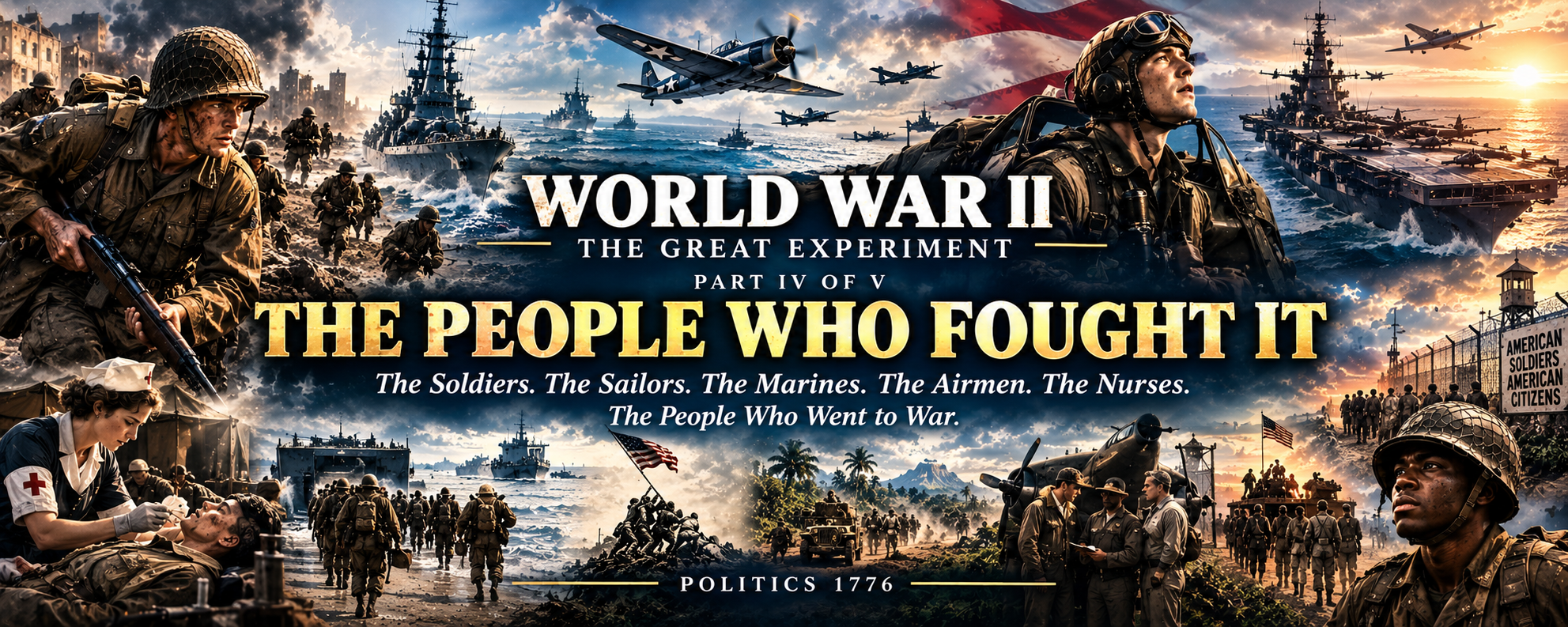
PART IV OF V
THE PEOPLE WHO FOUGHT IT
The Soldiers. The Sailors. The Marines. The Airmen. The Nurses. The People Who Went to War.
When we talk about World War II, it is easy to talk about armies.
Millions of men.
Thousands of ships.
Tens of thousands of aircraft.
Battles with names that became famous.
D-Day.
Midway.
Guadalcanal.
Iwo Jima.
Okinawa.
Normandy.
The Battle of the Bulge.
But wars are not fought by numbers.
They are fought by people.
Nearly 16 million Americans served in uniform during World War II.
They came from cities and farms, small towns and large industrial centers. They came from different backgrounds, different states, different families, and different walks of life.
Some were career military men.
Many were not.
Some had never traveled far from home.
Then suddenly they were crossing oceans and fighting on beaches, in forests, across deserts, in cities, and on islands thousands of miles away.
They were young men and women who had parents waiting at home.
They had brothers and sisters.
They had wives and husbands.
They had children.
They had jobs they left behind.
They had favorite songs.
They had hometowns.
They had plans for what they would do when the war was over.
And some never got the chance to return.
BEFORE THEY WERE SOLDIERS, THEY WERE PEOPLE
One of the easiest things to forget about World War II is that the people who fought it did not begin as soldiers.
They began as Americans.
A farmer.
A mechanic.
A factory worker.
A student.
A railroad worker.
A clerk.
A construction worker.
A teenager who had just graduated from high school.
A young man who had never seen the ocean.
A young woman who had never imagined herself serving in uniform.
Then came Pearl Harbor.
And everything changed.
The United States had entered a war unlike anything most Americans had ever experienced.
For many, military service meant leaving home for the first time.
Basic training taught them how to march, shoot, maintain equipment, follow orders, work as a unit, and survive under conditions they had never experienced as civilians.
But training could not fully prepare anyone for combat.
Combat was something else.
THE BOND BETWEEN BUDDIES
Soldiers often talked about their units differently than civilians talked about the war.
To a civilian, a division might be a number.
To a soldier, it was the people around him.
The man in the foxhole.
The man carrying ammunition.
The mechanic keeping the truck running.
The medic who came forward when everyone else was trying to get out of the way.
The pilot who depended on the crew beside him.
The sailor who stood watch through the night.
The Marine who landed on the beach beside him.
War created an extraordinary dependence on other people.
Your life could depend on the person standing next to you.
And his life could depend on you.
That bond became one of the defining experiences of military service.
The Army's own wartime medical histories later described how the shared danger of combat could create extraordinarily powerful bonds between soldiers.
They were not fighting alone.
They were fighting together.
THE SOLDIER
The infantryman carried much of the war on his back.
Rifle.
Ammunition.
Helmet.
Uniform.
Food.
Water.
Tools.
Equipment.
Sometimes a pack that seemed impossibly heavy after miles of marching.
Then came the terrain.
Mud.
Snow.
Mountains.
Hedgerows.
Forests.
Deserts.
Rivers.
Ruined cities.
And sometimes there was no road at all.
The infantryman walked.
He dug.
He carried.
He slept wherever he could.
He waited.
He moved when ordered.
And when the shooting started, there was nowhere to hide from the reality of what was happening.
The famous battles of World War II were experienced at ground level by individual men who often knew very little about the larger picture.
A soldier might know that his unit had to take a hill.
He might not know why that hill mattered to a general hundreds of miles away.
He knew only that the hill was in front of him.
And that someone was shooting at him from it.
THE SAILOR
The war at sea was different.
A sailor could spend days or weeks surrounded by nothing but ocean.
Then, without warning, the horizon could erupt.
Aircraft.
Bombs.
Torpedoes.
Gunfire.
Smoke.
Fire.
Ships disappearing beneath the water.
Aboard an aircraft carrier, battleship, cruiser, destroyer, submarine, transport, or landing craft, survival depended on thousands of individual tasks being performed correctly.
A sailor might never see the enemy face-to-face.
But the danger was no less real.
Submarines hunted merchant ships.
Destroyers hunted submarines.
Aircraft attacked fleets.
Carriers launched aircraft while their crews worked around enormous machinery, fuel, ammunition, and moving aircraft.
And thousands of sailors served aboard ships whose names have become part of American history.
But behind every ship was a crew.
People who ate together.
Worked together.
Slept together.
And sometimes died together.
THE MARINE
For many Marines, the war meant amphibious warfare.
Landing craft approaching shore.
Heavy equipment moving through surf.
Enemy fire coming from the beach.
Men trying to get off the boats.
Then moving forward.
Guadalcanal.
Tarawa.
Saipan.
Guam.
Peleliu.
Iwo Jima.
Okinawa.
The Pacific demanded a different kind of fighting.
Heat.
Jungle.
Disease.
Mud.
Mountains.
Coral.
Long distances.
And an enemy defending islands where retreat was often impossible.
The Marines became associated with some of the most recognizable battles and images of the Pacific War.
But the photograph does not show everything.
Behind every famous image were thousands of men who carried the equipment, dug the positions, treated the wounded, repaired vehicles, moved ammunition, maintained aircraft, operated radios, and kept the fighting force moving.
THE AIRMAN
Then there were the men who fought the war from the sky.
Pilots.
Bombardiers.
Navigators.
Gunners.
Radio operators.
Mechanics.
Ground crews.
Men who flew thousands of feet above the earth and men who kept the aircraft operating from the ground.
A bomber crew could take off knowing that enemy fighters and anti-aircraft guns were waiting somewhere ahead.
A fighter pilot could be engaged by an enemy aircraft within seconds.
A damaged aircraft might have to make it hundreds of miles back to safety.
And the men on the ground had to repair the machines and prepare them to fly again.
Aircraft were machines.
But machines did not fly themselves.
People did.
THE MEDICS AND NURSES
Some of the people who went closest to the battlefield did not carry rifles.
They carried medical supplies.
Medics and corpsmen moved toward wounded men while others were moving away from danger.
They treated wounds.
Stopped bleeding.
Carried casualties.
Worked in field hospitals.
Performed surgery.
And tried to keep people alive under conditions that were often chaotic and terrifying.
Army nurses served in hospitals around the world, including close to combat zones.
On D-Day, Army nurses arrived in France within days of the invasion. Field hospitals began treating casualties while the battle for Normandy was still underway.
They did not simply watch the war.
They experienced it.
Some nurses were captured.
Some became prisoners of war.
Some died.
The Army Nurse Corps would become an essential part of the American military medical system.
And the work was not finished when the shooting stopped.
For every wounded soldier who survived, there was a long road home.
WOMEN SERVED TOO
World War II dramatically expanded the role of American women in military and aviation service.
Women served as nurses.
They joined the Women's Army Corps.
They served in the Navy's WAVES.
They performed administrative, communications, technical, and medical work.
And some took to the skies.
The Women Airforce Service Pilots—WASP— were civilian women who flew military aircraft in non-combat roles.
More than 1,000 women eventually served as WASP.
They ferried aircraft.
Towed targets.
Transported personnel and equipment.
Performed flight testing.
And carried out other flying duties.
Their work freed male pilots for combat assignments.
They flew more than 60 million miles.
Thirty-eight WASP died in service during the war.
Yet they were civilians rather than members of the military, and their fight for official military recognition would continue long after the war ended.
They were finally granted military status retroactively in 1977.
The war had changed what Americans had seen women capable of doing.
AFRICAN AMERICANS SERVED IN A SEGREGATED MILITARY
World War II also exposed one of America's deepest contradictions.
The United States was fighting regimes that claimed racial superiority while maintaining racial segregation within its own armed forces.
More than 1.2 million African Americans served in the U.S. military during World War II.
They served in every theater.
But many served in segregated units and faced discrimination in assignments, training, promotion, and daily military life.
Still, they served.
The Tuskegee Airmen became one of the most famous examples.
The 99th Fighter Squadron and 332nd Fighter Group became symbols of African American military aviation.
Other African American units fought on the ground.
The 761st Tank Battalion—the "Black Panthers"—became the first African American tankers to fight in the American Army.
African American sailors also broke barriers.
In 1944, the Navy commissioned its first African American officers.
They became known as the Golden Thirteen.
The war did not eliminate segregation.
But the service and performance of African Americans challenged assumptions that had been used to justify it.
The war helped expose a contradiction that the nation would continue confronting after 1945.
NATIVE AMERICANS SERVED
Native Americans also served in large numbers.
One of the most famous examples was the Navajo Code Talkers.
Navajo Marines developed a communications system based on the Navajo language and specially created military terminology.
The code was used to transmit sensitive battlefield communications in the Pacific.
The Japanese never broke the code.
The Code Talkers were not simply symbols.
They were Marines doing an important military job.
Their language became part of the American war effort.
And their contribution would become an enduring part of World War II history.
JAPANESE AMERICANS: FIGHTING FOR A COUNTRY THAT HAD IMPRISONED THEIR FAMILIES
Perhaps nowhere was the contradiction more painful than among Japanese Americans.
After Pearl Harbor, the United States forcibly removed and incarcerated roughly 120,000 people of Japanese ancestry, most of them American citizens.
Families lost homes.
Businesses were abandoned.
Lives were disrupted.
People were confined behind barbed wire.
Yet Japanese Americans still served.
The 100th Infantry Battalion.
The 442nd Regimental Combat Team.
The Military Intelligence Service.
Japanese American soldiers fought in Europe.
Japanese American linguists served in the Pacific.
The 442nd became one of the most highly decorated units in American military history for its size and length of service.
These soldiers faced the enemy overseas while their families could be living behind barbed wire at home.
That contradiction should never be removed from the story.
It is part of the story.
And it is part of what makes their service so remarkable.
In 1946, President Harry Truman told members of the 442nd:
“You fought not only the enemy, but you fought prejudice, and you have won.”
The history is complicated.
The service was real.
The injustice was real.
Both belong in the same story.
THE PRISONERS OF WAR
Not everyone who went to war came home freely.
Thousands of Americans became prisoners of war.
In Europe, nearly 94,000 Americans were imprisoned.
In the Pacific, nearly 30,000 Americans were held by the Japanese.
Their experiences could be horrific.
American prisoners captured after the fall of the Philippines endured forced marches, starvation, disease, forced labor, and brutal treatment.
The Bataan Death March became one of the most infamous examples.
Others were held for years in camps across Europe and Asia.
For a prisoner, the war became something different.
There was no battlefield to advance across.
There was no certainty about tomorrow.
There was waiting.
Hunger.
Cold.
Disease.
Fear.
And the constant question:
Will I ever go home?
For many families, that question was asked for years.
THE PEOPLE WHO DIDN'T COME HOME
Every casualty statistic has a name behind it.
A son.
A daughter.
A husband.
A wife.
A brother.
A sister.
A father.
A friend.
A neighbor.
The National Archives records nearly 16 million Americans who served.
The Department of Veterans Affairs records more than 291,000 U.S. battle deaths during World War II, along with more than 113,000 other deaths while in service.
Those numbers are enormous.
But they are also incomplete as a description of what was lost.
Because numbers cannot tell you who was supposed to come home for Christmas.
They cannot tell you who was engaged.
They cannot tell you who had a little brother waiting for him.
They cannot tell you who had a farm waiting at home.
They cannot tell you what a family felt when a telegram arrived.
History records the numbers.
Families carried the names.
THE FAMILIES WHO WAITED
There was another front that did not appear on any battlefield map.
Home.
Families waited for letters.
They listened to the radio.
They read newspapers.
They studied maps.
They waited for casualty lists.
They bought war bonds.
They planted gardens.
They worked in factories.
They raised children.
They worried.
And they hoped.
A soldier's war was fought thousands of miles away.
But his family fought a different kind of war at home.
The war of uncertainty.
The war of waiting.
The war of wondering whether the next letter would arrive.
THE COST OF WAR
World War II created enormous achievements.
American industry produced ships, aircraft, vehicles, weapons, ammunition, medicine, and equipment on a scale few nations could match.
Military forces crossed oceans and liberated territory.
Allied armies defeated Nazi Germany and Imperial Japan.
But victory did not make the war cheap.
Millions of people around the world were killed.
Cities were destroyed.
Families were shattered.
Entire communities disappeared.
The Holocaust murdered six million Jews and millions of other victims of Nazi persecution.
The Soviet Union suffered catastrophic losses.
China suffered enormous casualties and destruction.
Japan and Germany were devastated.
Across the world, millions of civilians paid the price for a war they did not choose.
World War II was not simply a story of military achievement.
It was also a story of human suffering.
WHAT DID THESE PEOPLE THINK THEY WERE FIGHTING FOR?
This is one of the hardest questions in the entire story.
People fight wars for many reasons.
Duty.
Orders.
Family.
Country.
Survival.
Comrades.
Fear.
Conviction.
Sometimes several at once.
Not every American who served had the same political beliefs.
Not every soldier understood the war in exactly the same way.
Not every person volunteered.
Some were drafted.
Some enlisted.
Some were career servicemembers.
Some simply wanted to go home.
But once they were in uniform, they became part of something much larger than themselves.
Eisenhower understood that.
Before D-Day, he told the soldiers, sailors, and airmen who were about to cross the English Channel:
“The eyes of the world are upon you.”
He also understood something else.
If the invasion failed, thousands of people could die.
He prepared a message accepting responsibility for the decision.
Fortunately, that message was never delivered.
The invasion succeeded.
But the existence of that message tells us something important.
The men going ashore were not numbers on a military chart.
They were people whose lives could end on a beach in Normandy.
THE GREAT EXPERIMENT, AT GROUND LEVEL
The Great Experiment is often discussed in terms of presidents.
Congress.
Constitutions.
Elections.
Wars.
Treaties.
But sometimes the Great Experiment is much simpler.
It is a person being asked:
What will you do when your country needs you?
During World War II, millions of Americans answered that question in different ways.
Some put on uniforms.
Some built airplanes.
Some drove trucks.
Some treated wounded soldiers.
Some decoded messages.
Some flew aircraft.
Some loaded ships.
Some worked farms.
Some raised families.
Some waited.
Some gave their lives.
The war was won by armies.
But armies are made of people.
REMEMBER THE PERSON, NOT JUST THE BATTLE
When we look at photographs from World War II, it is easy to see the machinery.
The tanks.
The bombers.
The ships.
The landing craft.
The aircraft carriers.
The guns.
The uniforms.
But look closer.
There is a person inside every uniform.
Someone who had a home.
Someone who had a story.
Someone who was loved.
Someone who was afraid.
Someone who hoped to see home again.
Some did.
Some didn't.
And many who returned carried the war with them for the rest of their lives.
That is why remembering World War II should never be reduced to dates and battles alone.
The dates matter.
The battles matter.
The strategy matters.
The technology matters.
The politics matter.
But the people matter most.
Because without them, none of it happened.
BEFORE THE FINAL CHAPTER
By the summer of 1945, Germany had surrendered.
But the war was not yet finished.
Japan was still fighting.
American forces were preparing for what could have been an enormous invasion of the Japanese home islands.
The Manhattan Project had produced a weapon unlike anything the world had ever seen.
President Franklin Roosevelt was gone.
Harry Truman was now president.
The Soviet Union had entered the war against Japan.
The Pacific War was approaching its final and most consequential weeks.
And the people who had fought for years were waiting for one thing:
Home.
But before the war could finally end, decisions had to be made that would change the world forever.
The atomic bomb.
Hiroshima.
Nagasaki.
Japan's surrender.
The return of millions of servicemembers.
And the beginning of a completely different world.
That is where the final chapter begins.
PART V
THE END OF THE WAR — AND THE WORLD IT CREATED
The fighting would soon end.
But the consequences would not.
The men and women who survived would come home to a country that had changed.
The world they returned to would never be the same.
And the decisions made in those final days would shape the next century.
THE GREAT EXPERIMENT CONTINUES.
THE PEOPLE. THE VOICE. THE FUTURE.
POLITICS 1776