

THE GREAT EXPERIMENT: SOUTH AFRICA
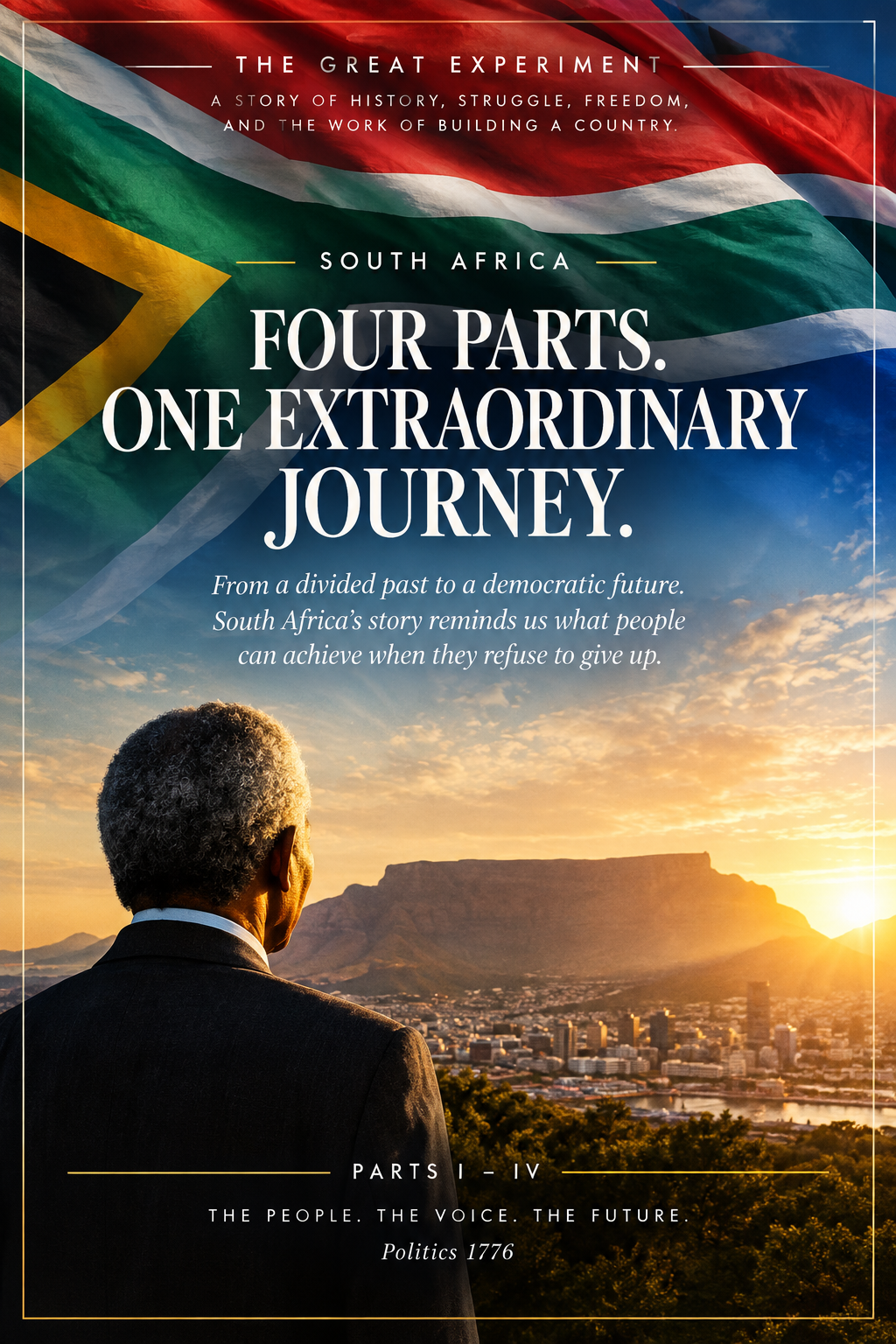
THE GREAT EXPERIMENT: SOUTH AFRICA
A Story of History, Struggle, Freedom, and the Work of Building a Country
PART III OF V
NELSON MANDELA
The Man, the Prisoner, and the Revolutionary
There are people whose names become larger than their own lives.
Nelson Mandela became one of them.
But before he became a president, a prisoner, a Nobel Peace Prize winner, or a symbol recognized around the world, he was simply Rolihlahla Mandela.
He was born in a rural village.
He lost his father.
He went to school.
He studied law.
He fell in love.
He married.
He became a father.
He became angry at injustice.
He made political choices.
Some of those choices would eventually cost him 27 years of his life.
To understand the man the world came to know as Nelson Mandela, we have to understand the man who existed before the legend.
THE BOY FROM MVEZO
Nelson Rolihlahla Mandela was born on July 18, 1918, in Mvezo in South Africa's Eastern Cape.
He was born into the Thembu royal family.
His father, Gadla Henry Mphakanyiswa, was a chief and an important local figure.
When Mandela was still young, his father died.
Mandela was subsequently taken into the household of Jongintaba Dalindyebo, the acting regent of the Thembu people.
He grew up surrounded by traditional leadership, community responsibilities, African customs, and the realities of colonial South Africa.
This part of Mandela's story matters.
He was not born into Johannesburg politics.
He was not born into a revolutionary organization.
He was a child of rural South Africa.
And his understanding of leadership was shaped partly by watching traditional leaders listen to people and deliberate over community disputes.
The future revolutionary was first a boy learning how his community worked.
THE NAME NELSON
His birth name was Rolihlahla.
The name Nelson came later.
One of his teachers gave him the English name "Nelson" when he began school.
It was a common practice in colonial-era mission schools to give African students English names.
The name would eventually become known throughout the world.
But Mandela never stopped being Rolihlahla.
And later in life, he would also become widely known by his clan name:
Madiba.
Names matter because they tell us something about identity.
Mandela would spend much of his life fighting against a political system that attempted to define people according to racial categories.
Yet his own identity was much larger than a government classification.
He was Thembu.
He was African.
He was South African.
He was a lawyer.
He was a husband and father.
He was a political activist.
He was a prisoner.
And eventually, he became a president.
EDUCATION CHANGED HIS WORLD
Mandela attended Methodist mission schools before enrolling at the University College of Fort Hare in 1939.
Fort Hare was one of the most important institutions of higher education available to Black South Africans at the time.
There Mandela encountered students who would later become important figures in African politics.
But university life did not go smoothly.
Mandela became involved in a student protest and was effectively expelled.
He returned home.
Then came another turning point.
An arranged marriage was being planned for him.
Mandela did not want it.
So he left.
He went to Johannesburg.
That decision changed his life.
JOHANNESBURG
Johannesburg was different from the rural world Mandela had known.
It was an industrial city.
Gold mining had transformed the region.
Factories, businesses, mines, workers, poverty, wealth, and racial restrictions existed side by side.
Mandela worked briefly as a mine security guard.
He eventually found work at a law firm.
And there he met a man who would become one of the most important influences in his life:
Walter Sisulu.
Sisulu introduced Mandela to a much broader political world.
Mandela began attending meetings of the African National Congress.
He was seeing firsthand what apartheid and racial discrimination meant in an urban environment.
The political questions were no longer abstract.
They involved real people.
Real families.
Real jobs.
Real homes.
Real opportunities.
And real restrictions.
THE LAWYER
Mandela studied law.
In 1952, he and Oliver Tambo opened Mandela & Tambo, one of the first Black law partnerships in Johannesburg.
The practice represented Black South Africans who faced discrimination and legal problems under the apartheid system.
For Mandela, law became more than a profession.
It became another way to fight.
If the government used law to organize society, then lawyers could use law to challenge what they believed was unjust.
Mandela was learning an important lesson:
Power does not exist only in government offices.
It also exists in courts.
In organizations.
In communities.
In businesses.
And among ordinary people who decide they will no longer accept the status quo.
THE ANC YOUTH LEAGUE
In 1944, Mandela helped establish the African National Congress Youth League with people including Walter Sisulu, Oliver Tambo, Anton Lembede, and others.
The younger activists wanted the ANC to become more aggressive and organized in confronting racial discrimination.
They believed mass participation was necessary.
They wanted boycotts.
Strikes.
Civil disobedience.
Political organization.
They wanted ordinary South Africans involved in the struggle.
Mandela was becoming more militant in his political thinking.
But at this stage, the emphasis remained on political mobilization and mass resistance.
1952: DEFIANCE
The Defiance Campaign brought Mandela into national prominence.
Volunteers deliberately violated apartheid laws.
They entered segregated facilities.
They broke discriminatory regulations.
They accepted arrest.
Mandela became Volunteer-in-Chief.
He was arrested and convicted under the government's laws.
He was also banned from political activity.
But the campaign demonstrated the power of organized civil disobedience.
Thousands of people participated.
The movement was showing that a government could have enormous legal power and still face determined opposition.
Mandela's political career was accelerating.
So was the government's determination to stop him.
THE FREEDOM CHARTER
In 1955, representatives of anti-apartheid organizations gathered at Kliptown for the Congress of the People.
They adopted the Freedom Charter.
Its central declaration was simple:
"The People Shall Govern!"
The document called for a democratic South Africa and addressed political rights, land, labor, housing, education, and economic opportunity.
Mandela was not present openly at the gathering because he was under restrictions.
But he remained deeply connected to the movement.
The government viewed the Freedom Charter as evidence of a revolutionary conspiracy.
In 1956, Mandela and 155 other activists were arrested and charged with treason.
The Treason Trial would last for years.
Ultimately, the defendants were acquitted.
Mandela survived another attempt to remove him from the political battlefield.
But the country was becoming more dangerous.
SHARPEVILLE CHANGED EVERYTHING
Then came Sharpeville.
March 21, 1960.
Police opened fire on protesters demonstrating against the pass laws.
Sixty-nine people were killed.
Hundreds were wounded.
The government declared a state of emergency.
The ANC was banned.
The political environment changed dramatically.
Mandela and other activists were forced to reconsider their strategy.
For years, the movement had emphasized petitions, protests, civil disobedience, strikes, and political organizing.
But what happens when the government responds to those methods with increasing repression?
Mandela came to believe that another path was necessary.
That decision would define the next chapter of his life.
UMKHONTO WE SIZWE
In 1961, Umkhonto we Sizwe, commonly known as MK, was formed as the armed wing of the ANC.
Mandela became its first commander.
This is one of the most important facts about Mandela's life.
It should neither be hidden nor exaggerated.
Mandela was not simply a peaceful protester who was imprisoned for speaking against apartheid.
He became a leader of an armed organization.
The initial strategy of MK emphasized sabotage against government and economic infrastructure, while attempting to avoid loss of life.
But it was still an armed struggle.
Mandela believed peaceful avenues for political change had been closed.
The government considered MK a terrorist organization and treated its activities as a grave threat to the state.
History requires us to acknowledge both realities.
Mandela believed he was fighting an unjust system.
The government believed it was fighting an armed revolutionary movement.
And ordinary South Africans would live with the consequences of that conflict.
LEAVING SOUTH AFRICA
In January 1962, Mandela secretly left South Africa.
He traveled through several African countries and visited England.
He sought political and financial support for the armed struggle and received military training in Morocco and Ethiopia.
When he returned to South Africa, he was arrested on August 5, 1962.
He was charged with leaving the country illegally and inciting workers to strike.
He was convicted and sentenced to five years in prison.
But that would not be the end of his legal troubles.
It was only the beginning.
THE RIVONIA RAID
While Mandela was already imprisoned, police raided Liliesleaf Farm in Rivonia in July 1963.
Several of his colleagues were arrested.
Documents connected to MK were discovered.
Mandela was brought into the case.
The result became known as the Rivonia Trial.
Mandela and his co-defendants were charged with sabotage.
The trial became one of the most consequential political trials in South African history.
The possibility of execution was real.
Mandela understood that he might never leave prison alive.
THE SPEECH
On April 20, 1964, Mandela made his famous statement from the dock.
He explained the political struggle that had brought him there.
He acknowledged the armed struggle.
He described the ideal he believed he was fighting for:
a democratic society in which people could live together with equal opportunity.
Then came the words that would become permanently associated with him.
He said he had fought against both white domination and black domination and that he cherished the ideal of a democratic and free society.
He concluded that it was an ideal for which he was prepared to die.
The statement was not the speech of a man claiming perfection.
It was the statement of a man who had made a political choice and was willing to accept the consequences.
LIFE IMPRISONMENT
On June 12, 1964, Mandela and seven of his co-defendants were sentenced to life imprisonment.
They were sent to Robben Island.
Mandela was 45 years old.
He would not walk free again for more than two decades.
He had entered prison as a political revolutionary.
He would eventually leave it as something else.
But that transformation would take years.
ROBBEN ISLAND
Robben Island became Mandela's world.
For 18 years, he was imprisoned there.
The conditions were harsh.
Prisoners were separated according to racial classifications.
Work was physically demanding.
Food was inadequate.
Political prisoners fought for better treatment.
Even in prison, the struggle continued.
Mandela and his fellow prisoners organized.
They studied.
They debated.
They educated one another.
They challenged prison authorities.
They refused to allow imprisonment to completely control their minds.
Mandela later described prison as a place where he had to learn patience, discipline, and the importance of understanding his opponents.
The prison was intended to remove his political influence.
Instead, over time, it helped transform his understanding of leadership.
THE PRICE OF 27 YEARS
There is another part of Mandela's story that should never be forgotten.
The 27 years in prison were not simply a number.
They were 27 years of life.
His children grew up without him.
His mother died while he was imprisoned.
His eldest son, Thembekile, died in a car accident in 1969.
Mandela was not allowed to attend either funeral.
His marriage to Winnie Mandela deteriorated over time and eventually ended in divorce.
His family paid a price for his political life too.
The prison sentence did not affect only the prisoner.
It affected everyone who loved him.
FROM ROBBEN ISLAND TO POLLSMOOR
In 1982, Mandela was transferred from Robben Island to Pollsmoor Prison.
Later, in 1988, he became seriously ill with tuberculosis.
He was eventually moved to Victor Verster Prison.
By then, something had begun to change.
The apartheid government was under increasing internal and international pressure.
South Africa was facing growing economic, political, and social problems.
The government was beginning to recognize that the conflict could not simply be solved through imprisonment.
And Mandela was no longer merely a prisoner.
He was becoming someone with whom the government would have to negotiate.
THE PRISONER WHO WOULD NOT DISAPPEAR
Mandela had been imprisoned to remove him from politics.
It did not work.
His name became more powerful while he was behind bars.
International pressure grew.
Resistance inside South Africa continued.
The government faced increasing instability.
And Mandela himself had changed.
He had entered prison as a relatively young revolutionary.
He emerged from it as a leader capable of thinking beyond the immediate battle.
That distinction would become critical.
Because eventually the question would no longer be:
How do we defeat the other side?
The question would become:
How do we build a country where both sides can live?
That was a much harder question.
THE MAN BEHIND THE SYMBOL
It is tempting to turn Mandela into a simple symbol.
Hero.
Prisoner.
President.
Nobel Prize winner.
But the real story is more complicated.
Mandela made mistakes.
He changed his mind.
He adopted positions that evolved over time.
He supported armed resistance.
He spent years inside a political movement that included people with very different ideological beliefs.
He experienced personal failures.
He lost people he loved.
He spent decades separated from his family.
And yet he continued.
That is what makes his story worth studying.
Not because he was perfect.
But because he was human.
WHAT CAN WE LEARN FROM MANDELA?
1. People are more complicated than their labels.
"Revolutionary."
"Prisoner."
"Politician."
"President."
None of those words completely explain a person.
2. Political choices have consequences.
Mandela made choices.
Some were peaceful.
Some were revolutionary.
Some involved armed resistance.
He lived with the consequences of those choices for decades.
3. Courage does not mean the absence of fear.
Mandela knew he could be imprisoned or killed.
He continued anyway.
4. Prison did not have to define the rest of his life.
Mandela lost 27 years.
But he did not allow those 27 years to become the rest of his story.
5. Leadership can change.
The man who entered prison was not exactly the same man who left it.
He learned.
He adapted.
He negotiated.
He listened.
And eventually he helped lead a country through one of the most difficult political transitions in modern history.
6. The hardest victory is sometimes learning how to live together.
Winning a political battle is one thing.
Building a country afterward is another.
THE GATES OPEN
On February 11, 1990, Nelson Mandela walked out of Victor Verster Prison.
He had spent 27 years in prison.
The world watched.
The man who had entered prison as a revolutionary walked out as the most recognizable figure in South Africa's struggle against apartheid.
But freedom had not yet been secured.
Apartheid had not disappeared.
The country was still divided.
Political violence continued.
The future remained uncertain.
Mandela was free.
But South Africa was not yet finished with its struggle.
The next challenge would be harder than escaping prison.
It would be building a democracy.
And that would require Mandela to sit across the table from the very government he had spent decades fighting.
His next opponent would not simply be a prison guard or a law.
It would be the question of whether enemies could become negotiating partners.
PART IV
FREEDOM ISN'T THE FINISH LINE
Mandela, de Klerk, and the Long Road to Democracy
The prison gates had opened.
But opening a prison door does not automatically open a country's future.
South Africa still had to answer the hardest question of all:
How do you build one country after generations of division?
Mandela would soon find out.
And the answer would involve another remarkable figure:
F. W. de Klerk.
Two men who represented opposing sides of South Africa's conflict would become partners in an extraordinarily difficult negotiation.
They would face violence.
Distrust.
Political pressure.
Compromise.
And an entire country waiting to see whether democracy was actually possible.
The story was entering its final chapter.
But the Great Experiment was only beginning to reveal what South Africa might become.
A country isn't built in a day.
It is built every day.
THE GREAT EXPERIMENT CONTINUES.
THE PEOPLE. THE VOICE. THE FUTURE.
Politics 1776