THE GREAT EXPERIMENT: SOUTH AFRICA
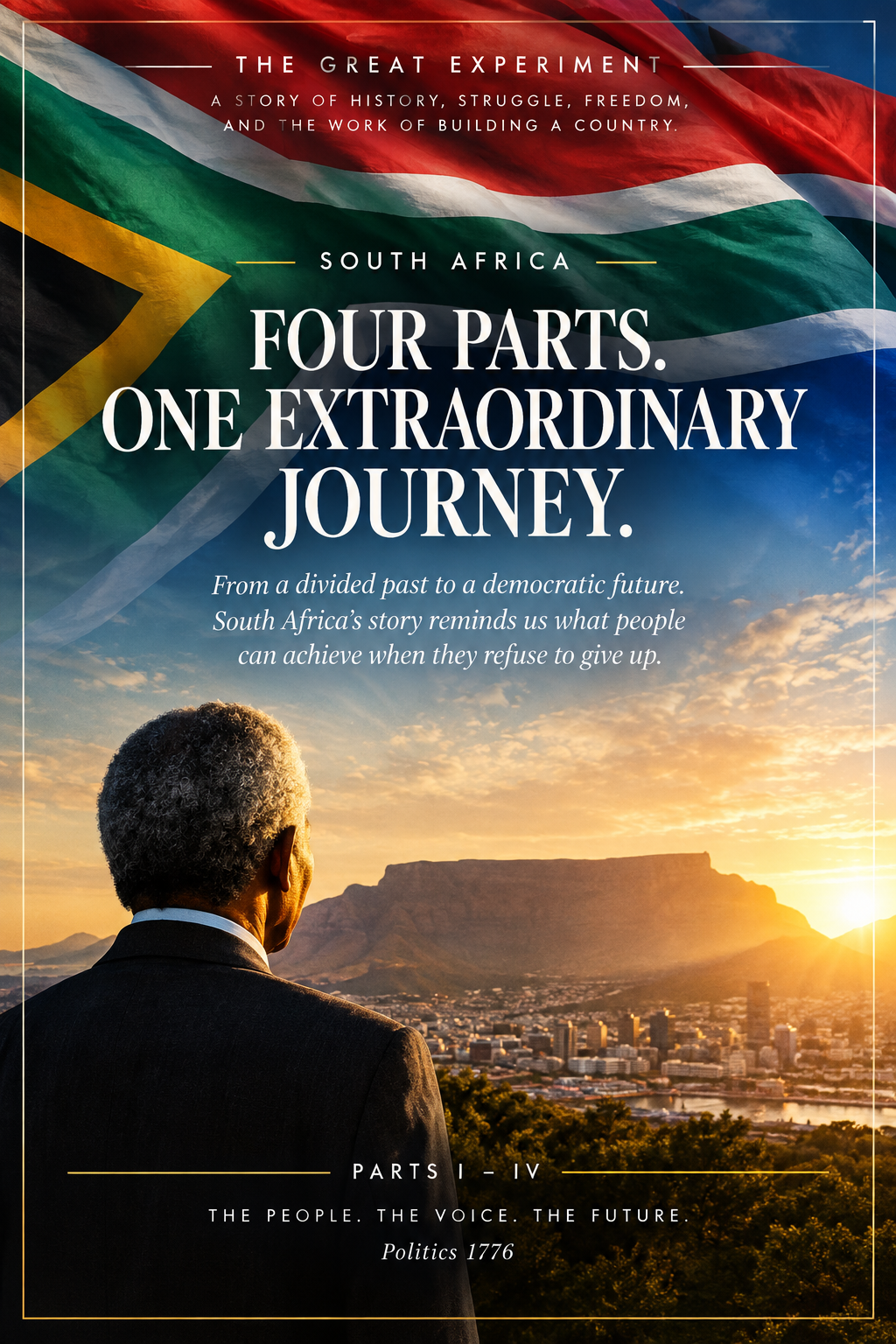
THE GREAT EXPERIMENT: SOUTH AFRICA
A Story of History, Struggle, Freedom, and the Work of Building a Country
PART IV OF V
FREEDOM ISN'T THE FINISH LINE
Mandela, de Klerk, and the Long Road to Democracy
For 27 years, Nelson Mandela was a prisoner.
Then, on February 11, 1990, he walked out of Victor Verster Prison.
The images became some of the most recognizable of the twentieth century.
Mandela was free.
But South Africa was not suddenly at peace.
The country was still deeply divided.
Political violence continued.
Millions of people were still living with the consequences of decades of racial separation, unequal political rights, economic inequality, and distrust.
Mandela had spent decades fighting against the system that had imprisoned him.
Now came an entirely different challenge:
How do you build a country after the system you've been fighting has begun to disappear?
Freedom had opened the door.
But walking through it would require something more than freedom alone.
It would require negotiation.
Institutions.
Compromise.
Elections.
A constitution.
And millions of people willing to live together in a country that had spent generations divided.
TWO SIDES OF A COUNTRY
South Africa's transition did not happen because one side simply defeated the other.
It happened through a long and difficult political process.
On one side was Nelson Mandela and the African National Congress.
On the other was F.W. de Klerk and the government that had governed South Africa under apartheid.
They represented opposing political traditions.
They had spent years on opposite sides of a conflict that had produced imprisonment, violence, political repression, and deep mistrust.
Yet they eventually had to sit across from one another.
And talk.
That is an important part of the story.
The end of apartheid was not simply an announcement.
It was a process.
And processes are rarely clean.
THE GOVERNMENT BEGINS TO CHANGE
Before Mandela was released, President F.W. de Klerk had already announced major changes.
On February 2, 1990, de Klerk announced the unbanning of the ANC and other political organizations and signaled the release of political prisoners.
Nine days later, Mandela walked free.
The government and the ANC then began negotiations about the country's future.
In May 1990, the two sides reached the Groote Schuur Minute, establishing a framework for continued discussions and addressing obstacles to negotiations.
Later that year, the Pretoria Minute followed.
The ANC also announced the suspension of its armed struggle in 1990 as the political process developed.
These steps did not erase decades of conflict.
They were attempts to create a political path forward.
And that distinction matters.
Ending a conflict is not the same thing as instantly solving everything that caused it.
PEACE WAS STILL FRAGILE
The transition was not peaceful in every sense of the word.
Political violence continued.
Communities remained divided.
Thousands of people died in political violence during the transition period.
One of the most notorious episodes was the Boipatong massacre in June 1992, when residents of Boipatong township were attacked and dozens of people were killed.
The violence damaged trust between political organizations and threatened the negotiations.
For a time, the political process nearly collapsed.
Mandela and the ANC accused the government of failing to stop violence.
The government rejected allegations that it was responsible for deliberately destabilizing the country.
The situation was extremely tense.
South Africa was trying to negotiate a new political system while violence was still happening on the ground.
That made the negotiations even harder.
CODESA
In December 1991, political parties and organizations gathered at the Convention for a Democratic South Africa, commonly known as CODESA.
The goal was enormous:
Create a framework for a democratic South Africa.
Representatives from across the political landscape participated.
The negotiations dealt with some of the hardest questions imaginable.
Who would hold political power?
How would elections work?
How would the constitution be created?
How would minorities be protected?
How would the military and security forces fit into the new political order?
How could South Africa avoid a return to widespread violence?
The first round of negotiations produced important agreements.
But the process eventually broke down.
The disagreements were fundamental.
The ANC wanted democratic majority rule.
Other groups wanted different forms of power-sharing and protection.
Trust remained limited.
South Africa had not yet found the formula.
THE POLITICAL PROCESS NEARLY BREAKS
The collapse of negotiations demonstrated something important.
Democracy is not created simply because everyone agrees that democracy sounds good.
People have to agree on rules.
And agreeing on rules can be extremely difficult when the people involved have spent decades fighting one another.
The violence and political tensions of 1992 and 1993 created enormous pressure.
Yet negotiations eventually resumed.
Political leaders continued working toward an agreement.
And gradually, a framework for a democratic election began to take shape.
The goal was no longer simply to change the government.
It was to create a constitutional system that could survive the change.
THE INTERIM CONSTITUTION
In 1993, South Africa adopted an Interim Constitution.
It provided the legal framework for the transition to democratic government.
It established the basis for the country's first democratic national election.
It also set out principles for a constitutional state and a new political order based on democratic participation.
This was a crucial moment.
South Africa was moving from the question:
How do we end apartheid?
toward the much harder question:
How do we govern the country after apartheid?
Those are two different questions.
The first is about ending a system.
The second is about building what comes next.
MANDELA AND DE KLERK
In 1993, Nelson Mandela and F.W. de Klerk were jointly awarded the Nobel Peace Prize.
The Nobel Committee recognized their work toward the peaceful termination of apartheid and the establishment of the foundations for a democratic South Africa.
But it is important not to turn the story into a simple tale about two men.
Mandela did not build the new South Africa alone.
De Klerk did not build it alone.
Neither did the negotiators.
Neither did political parties.
Neither did international pressure.
The transition involved large numbers of South Africans, political organizations, civil society groups, negotiators, government officials, activists, community leaders, and ordinary citizens.
Countries are built by people.
APRIL 27, 1994
Then came the moment South Africa had been moving toward.
The election.
On April 27, 1994, millions of South Africans participated in the country's first national election based on universal adult suffrage.
For many South Africans, this was the first opportunity to participate in a national democratic election.
Mandela was among them.
He voted for the first time.
The election was declared substantially free and fair by the Independent Electoral Commission, despite serious violence and logistical challenges during the transition.
The African National Congress won the largest share of the vote.
But the most important fact was larger than any single party.
South Africans had established a democratic electoral process through which political power could be transferred.
That changed the country.
NELSON MANDELA BECOMES PRESIDENT
On May 10, 1994, Nelson Mandela was inaugurated as president of South Africa.
A man who had spent 27 years imprisoned by the state now led the country.
F.W. de Klerk became one of the deputy presidents under the Government of National Unity.
The symbolism was enormous.
But symbolism was not enough.
The new government inherited a country with enormous problems.
Poverty.
Unequal access to education.
Housing shortages.
Unemployment.
Unequal economic opportunity.
Infrastructure challenges.
Deeply divided communities.
And institutions that had to be transformed to serve a democratic population.
The election had changed who governed.
Now the harder work began:
governing.
FREEDOM DOES NOT ERASE THE PAST
One of the greatest challenges facing the new South Africa was deciding what to do with its past.
Decades of apartheid had produced victims.
It had also produced people who had participated in, enforced, resisted, or benefited from the system.
South Africa faced a difficult question.
How does a country confront serious abuses without making reconciliation impossible?
The answer was not simple.
There was no single solution that could make decades of suffering disappear.
Instead, South Africa created the Truth and Reconciliation Commission, commonly known as the TRC.
THE TRUTH AND RECONCILIATION COMMISSION
The TRC was established through legislation in 1995.
Its purpose was to investigate gross human-rights violations connected to the conflicts of the past.
Victims could tell their stories.
Witnesses could testify.
Those seeking amnesty for qualifying politically motivated acts could apply under conditions established by law, including full disclosure of relevant facts.
The commission also examined questions of reparations and rehabilitation.
The TRC was not a normal criminal court.
Its purpose was different.
It was an attempt to establish a public record of what had happened, allow victims to be heard, and create a mechanism for addressing the past while the country attempted to build a shared future.
It was controversial.
Not everyone believed it went far enough.
Not everyone agreed with the use of conditional amnesty.
But it represented a remarkable question:
Can a country confront terrible history without allowing that history to permanently determine its future?
REMEMBERING WITHOUT LIVING THERE
There is an important lesson here.
A country cannot change its history.
But it can change what it does with that history.
Remembering is not the same thing as remaining trapped.
Acknowledging wrongdoing is not the same thing as refusing to move forward.
And reconciliation does not mean pretending that the past did not happen.
It means trying to build a future in which the same political system and abuses do not continue.
South Africa was attempting exactly that.
THE CONSTITUTION
The next major step was creating a permanent constitutional order.
South Africa's 1996 Constitution became the foundation of the country's new democracy.
It established the Constitution as the supreme law of the country and set out fundamental values including human dignity, equality, human rights, universal adult suffrage, regular elections, and a multiparty democratic system.
The Constitutional Court certified the Constitution on December 4, 1996.
It came into effect on February 4, 1997.
This was more than a legal document.
It was an attempt to establish rules that would apply beyond the personalities of the moment.
That matters because leaders change.
Political parties change.
Generations change.
A durable country needs institutions that survive those changes.
MANDELA DOES SOMETHING ELSE
Mandela served one term as president.
In 1999, he stepped down.
That decision matters.
A democratic system cannot depend on one individual remaining in power forever.
Mandela had become one of the most famous political leaders in the world.
Yet he did not attempt to make the presidency permanent.
He left office.
South Africa continued.
That is one of the tests of a political system:
Can the country continue when the person who became the symbol of change is no longer running it?
The answer has to be yes.
Otherwise the institution is weaker than the individual.
WHAT MANDELA AND DE KLERK ACTUALLY ACCOMPLISHED
It is tempting to tell the story as though Mandela and de Klerk simply decided one day to end apartheid and everything changed.
History was not that simple.
The transition involved years of pressure, resistance, negotiation, violence, political organizing, constitutional work, international attention, and changing circumstances inside South Africa.
Mandela and de Klerk were important figures.
But they were part of something much larger.
The achievement was not simply that two political leaders reached an agreement.
The achievement was that South Africa developed a political process through which an old system could be replaced by a constitutional democracy.
That process was imperfect.
It was painful.
It was contested.
But it moved the country in a new direction.
WHAT CAN WE LEARN FROM PART IV?
1. Political change requires more than winning.
A political movement can win an election and still inherit enormous problems.
Government is about what happens after the victory.
2. Negotiation is not surrender.
Mandela negotiated with the government that had imprisoned him.
De Klerk negotiated with the movement that had spent decades opposing his government.
Neither side received everything it wanted.
That was the point of negotiation.
3. Compromise can be necessary without being easy.
Compromise can anger your own supporters.
It can make you look weak.
It can leave everyone dissatisfied.
But sometimes compromise is part of reaching an agreement that allows a political system to function.
4. Institutions matter.
A country cannot depend forever on the character of one leader.
It needs laws.
Courts.
Elections.
Constitutional limits.
Accountability.
And peaceful transfers of power.
5. Freedom does not erase history.
A country can change its laws while still living with the consequences of old ones.
Rebuilding takes time.
6. Reconciliation requires truth.
You cannot genuinely move forward by pretending nothing happened.
But remembering the past does not require remaining trapped inside it.
7. The people ultimately have to build the country.
Leaders can negotiate.
Governments can write laws.
Constitutions can establish rules.
But ordinary citizens still have to live together.
Work together.
Raise families.
Build businesses.
Educate children.
Vote.
Participate.
And decide what kind of country they want to leave behind.
THE STORY IS NOT OVER
South Africa had changed.
A system that had divided people by law was gone.
A man who had spent 27 years in prison was now president.
Millions of people who had previously been excluded from national political participation could now vote.
A new constitutional order was being built.
But none of that meant the country had suddenly become perfect.
The problems created over generations did not disappear overnight.
The new government inherited poverty, inequality, divided communities, and the enormous task of building institutions capable of serving an entire population.
Freedom had opened the door.
Now South Africans had to walk through it.
And they had to decide what they would build on the other side.
That is perhaps the most important lesson of the story so far.
Winning political freedom is not the same thing as building a successful country.
The first can happen in a moment.
The second takes generations.
A COUNTRY BUILT EVERY DAY
Nelson Mandela's greatest historical significance was not simply that he became president.
It was that he became one of the central figures in a transition from apartheid to a democratic constitutional order.
But Mandela himself could not finish the work of building South Africa.
No leader could.
No political party could.
No constitution could.
A country is not built once.
It is built over generations.
Every law.
Every election.
Every business.
Every school.
Every family.
Every community.
Every citizen.
Every day.
THE GREAT EXPERIMENT CONTINUES
South Africa's story does not end with Mandela's inauguration.
It does not end with the 1996 Constitution.
And it does not end with the end of apartheid.
Those were beginnings as much as they were endings.
The next chapter is about something different.
After spending four parts understanding South Africa on its own terms, we can finally step back and look at the larger question:
What can one country's history teach another country about the work of building a nation?
South Africa is not America.
America is not South Africa.
Their histories must not be confused.
But both histories raise questions about freedom, government, institutions, citizenship, conflict, reconciliation, and the future.
That is where the final chapter begins.
A country isn't built in a day.
It is built every day.
THE GREAT EXPERIMENT CONTINUES.
THE PEOPLE. THE VOICE. THE FUTURE.
Politics 1776