
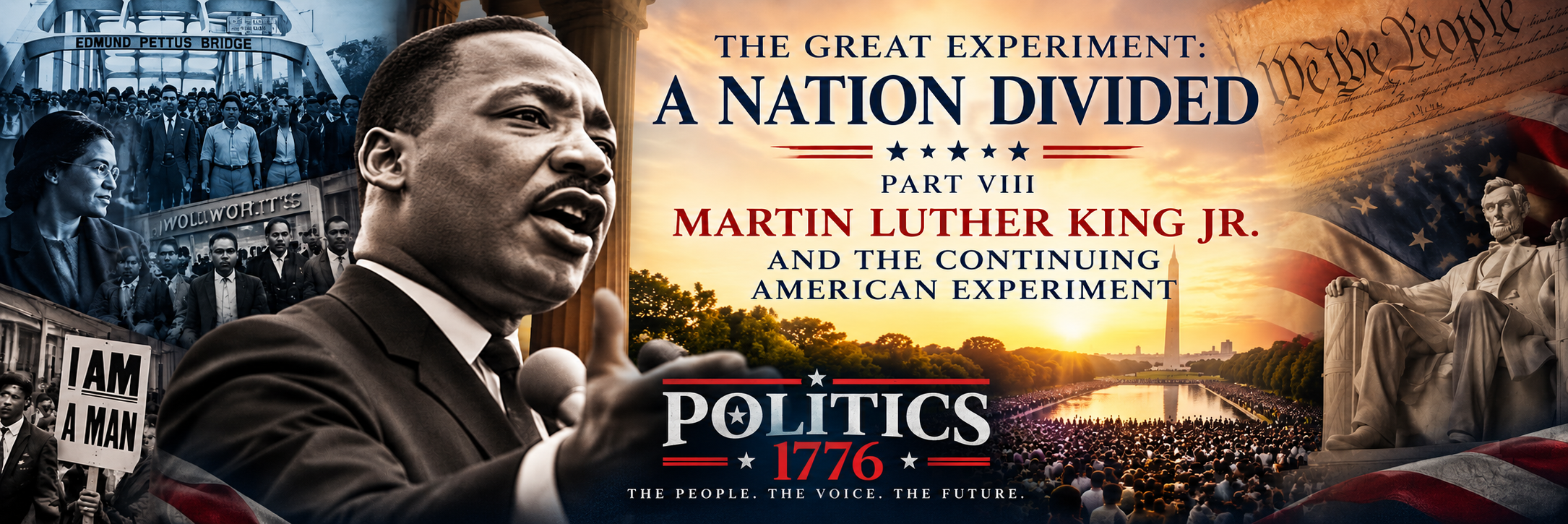
THE GREAT EXPERIMENT: A NATION DIVIDED
PART VI — FREEDOM AND RECONSTRUCTION
What Happened After Slavery Ended?
The Civil War was over.
The Union had survived.
The Confederacy had been defeated.
And slavery—the institution that had shaped American politics from before the founding through secession and war—was being abolished throughout the United States.
Approximately four million people who had been enslaved were entering freedom.
But ending slavery raised another enormous question:
What did freedom actually mean?
Was freedom simply the absence of slavery?
Or did it include citizenship?
Education?
Property?
Voting?
Equal protection under the law?
Political participation?
The ability to move freely, negotiate wages, reunite families, and build independent communities?
The Civil War had answered whether the United States would remain one nation.
Reconstruction would force Americans to confront another question.
What kind of nation would it become?
A Country That Had to Be Rebuilt
The physical destruction of the war was enormous.
Railroads had been destroyed.
Farms and cities had been damaged.
State governments had collapsed or been reorganized.
Hundreds of thousands of Americans were dead.
Families across the country were grieving.
The South faced particularly severe economic destruction.
And millions of formerly enslaved people were attempting to begin lives in freedom.
The word used for the period that followed was:
Reconstruction.
But Americans disagreed immediately over what exactly needed to be reconstructed.
Was the goal simply to restore the former Confederate states to the Union?
Or should southern society itself be transformed?
What conditions should former Confederate states meet before regaining full political representation?
What rights would formerly enslaved Americans possess?
And who would decide?
The president?
Congress?
The states?
The war had ended.
The political struggle had not.
Lincoln's Reconstruction Was Cut Short
Abraham Lincoln had already begun thinking about restoring the Union before the war ended.
His approach generally emphasized bringing states back into functioning relations with the federal government while requiring loyalty and accepting emancipation.
But Lincoln did not live to oversee Reconstruction.
His assassination in April 1865 changed the political situation dramatically.
Vice President Andrew Johnson became president.
Johnson was a Tennessee Democrat who had remained loyal to the Union and had joined Lincoln on the 1864 National Union ticket.
He now inherited one of the most difficult responsibilities any American president had faced.
How should the country put itself back together?
Freedom Begins With Families
For formerly enslaved Americans, Reconstruction was not initially an abstract constitutional debate.
Freedom could mean something immediate.
The ability to leave a plantation.
The ability to choose an employer.
The ability to establish an independent household.
The ability to have marriages legally recognized.
The ability to search for children, parents, husbands, wives, brothers, and sisters who had been separated through slavery.
The ability to build churches.
The ability to create schools.
The ability to learn to read.
The ability to control one's own labor.
Across the South, formerly enslaved people began doing these things.
Freedom was not simply something granted from Washington.
People were actively building it for themselves.
The Freedmen's Bureau
The federal government also became involved.
In March 1865, Congress created the Bureau of Refugees, Freedmen, and Abandoned Lands, usually called the Freedmen's Bureau.
Its responsibilities were broad.
The Bureau distributed food and clothing.
It operated hospitals and refugee camps.
It supervised some labor contracts between landowners and freedpeople.
It helped resolve disputes.
It assisted efforts to establish schools.
It helped legalize marriages that had existed during slavery but had lacked legal recognition.
It helped family members search for one another.
And it assisted Black veterans with matters including back pay and pensions.
The Bureau was temporary and its resources were limited.
Its work was also controversial.
But it represented something historically significant:
The federal government was becoming directly involved in protecting and assisting people making the transition from slavery to freedom.
Then Came the Thirteenth Amendment
The Emancipation Proclamation had been a wartime measure.
Something permanent was needed.
The answer was a constitutional amendment.
The Thirteenth Amendment was ratified in December 1865.
It declared:
“Neither slavery nor involuntary servitude, except as a punishment for crime…”
could exist within the United States or anywhere subject to its jurisdiction.
Slavery was now constitutionally prohibited throughout the nation.
The importance is difficult to overstate.
An institution that had existed in North America for generations was no longer legally protected as a system of human ownership.
But the amendment immediately raised another question.
If formerly enslaved people were no longer slaves, what were they?
Were they citizens?
What rights did citizenship provide?
And who was responsible for protecting those rights?
The Black Codes
Former Confederate states began reorganizing their governments.
Many enacted laws that became known collectively as the Black Codes.
The details differed from state to state.
But these laws attempted to regulate important aspects of Black life after slavery, including labor, movement, contracts, and employment.
Some imposed harsh vagrancy provisions.
Some created systems through which Black children could be bound into apprenticeships.
The laws reflected an effort to preserve a controlled labor system and restrict the independence of the newly freed population.
Slavery had been abolished.
But the meaning of freedom remained contested.
Congress increasingly concluded that additional federal action was necessary.
President and Congress Collide
Andrew Johnson and the Republican-controlled Congress developed sharply different approaches to Reconstruction.
Johnson favored relatively rapid restoration of the former Confederate states and opposed several congressional efforts expanding federal protection for freedpeople.
Congress became increasingly concerned about southern governments, Black Codes, violence, and the status of formerly enslaved Americans.
The disagreement became a struggle over the direction of Reconstruction itself.
Congress passed the Civil Rights Act of 1866, establishing federal protections for citizenship and civil rights.
Johnson vetoed it.
Congress overrode his veto.
The conflict between the president and Congress was becoming extraordinary.
And Congress was preparing something even more consequential.
Another constitutional amendment.
The Fourteenth Amendment
The Fourteenth Amendment was proposed by Congress in 1866 and ratified in 1868.
Its first section transformed American constitutional law.
It declared that:
“All persons born or naturalized in the United States…”
and subject to American jurisdiction were citizens of the United States and of the state in which they lived.
That language directly addressed one of the questions left by emancipation.
Formerly enslaved people were citizens.
But the amendment went further.
States could not deprive any person of:
“life, liberty, or property, without due process of law”
nor deny anyone within their jurisdiction:
“the equal protection of the laws.”
These words would become some of the most consequential language in the entire Constitution.
The Fourteenth Amendment fundamentally changed the constitutional relationship between individuals, states, and the federal government.
Citizenship and equal protection were now constitutional questions of national importance.
Reconstruction Becomes More Forceful
Congress passed Reconstruction legislation placing much of the former Confederacy under military administration and establishing requirements for readmission.
New state constitutions were written.
Former Confederate states were required to accept new political realities, including the Fourteenth Amendment.
Black men participated in politics on a scale that would have been unimaginable only a few years earlier.
They registered to vote.
They attended political conventions.
They served in state legislatures.
They held local offices.
And eventually Black Americans served in the United States Congress.
The political structure of the South was changing.
Black Americans Enter Government
Reconstruction produced an extraordinary development in American political history.
Formerly enslaved men and other Black Americans became public officials.
Hiram Revels of Mississippi became the first Black American to serve in the United States Senate.
Blanche K. Bruce, also of Mississippi, later served a full Senate term.
Black representatives served in the House.
Hundreds of Black men served in state and local offices throughout the South.
They participated in writing state constitutions.
They supported public education.
They participated in debates over taxation, infrastructure, labor, and civil rights.
This did not mean political equality had been fully achieved.
Women still could not vote nationally.
Racism remained widespread.
Violence was growing.
But for a brief period, the political system of the former Confederacy looked dramatically different from what had existed before the war.
The Fifteenth Amendment
One major question remained.
Could states deny Black men the vote?
Congress proposed another constitutional amendment.
The Fifteenth Amendment, ratified in 1870, declared that the right of United States citizens to vote could not be denied or abridged:
“on account of race, color, or previous condition of servitude.”
For the first time, the Constitution explicitly prohibited racial discrimination in voting on those grounds.
The Reconstruction Amendments now formed a remarkable constitutional transformation:
Thirteenth Amendment — Slavery abolished.
Fourteenth Amendment — Citizenship, due process, and equal protection.
Fifteenth Amendment — Voting could not be denied because of race, color, or previous condition of servitude.
In only five years, the Constitution had changed dramatically.
But constitutional rights are only as meaningful as the ability to exercise them.
And powerful resistance was already underway.
Violence Becomes Political
Not everyone accepted Reconstruction.
White supremacist organizations emerged across the South.
The most infamous was the Ku Klux Klan.
The Klan and similar organizations used intimidation, assault, murder, and terrorism against Black citizens and their political allies.
Their targets included people who voted.
People who organized politically.
People who served in government.
People who taught schools.
People who attempted to exercise the rights Reconstruction had created.
Violence was being used for a political purpose:
to prevent citizens from exercising constitutional rights and to destroy Reconstruction governments.
The federal government responded.
The Enforcement Acts
Congress passed a series of laws in 1870 and 1871 known as the Enforcement Acts, or Force Acts.
These laws gave the federal government stronger authority to protect voting rights and combat organized political violence.
They made certain forms of intimidation and interference with constitutional rights federal offenses.
Federal officials could supervise elections in some circumstances.
President Ulysses S. Grant used federal authority against the Ku Klux Klan.
For a period, federal enforcement significantly weakened the organization.
This represented another major development in the American experiment.
The federal government was using its power not merely to regulate relations among states or defend the country from foreign enemies.
It was using federal authority to protect individual citizens against organized violations of constitutional rights.
But maintaining that commitment required political support.
And over time, that support weakened.
Reconstruction Was Losing Support
By the 1870s, Reconstruction faced growing problems.
The country experienced an economic depression after the Panic of 1873.
Political scandals damaged public confidence in government.
Northern attention increasingly shifted toward economic and other political concerns.
White southern opposition to Reconstruction remained intense.
Violence and intimidation continued.
The Republican Party's commitment to sustained federal intervention weakened.
And political organizations often called Redeemers worked to regain control of southern state governments.
One by one, Reconstruction governments fell.
Federal protection became less consistent.
The constitutional amendments remained.
But enforcement was changing.
The Election of 1876
The presidential election of 1876 became one of the most disputed elections in American history.
Republican Rutherford B. Hayes faced Democrat Samuel J. Tilden.
Tilden won the popular vote, but electoral votes from several states were disputed.
A special electoral commission eventually awarded the disputed electoral votes to Hayes, giving him the presidency by a single electoral vote.
The political resolution surrounding the election became associated with the Compromise of 1877.
The exact nature of an explicit bargain remains a subject of historical discussion, but one outcome is clear:
Federal troops were withdrawn from the remaining southern statehouses where they had been supporting Reconstruction governments.
By 1877, formal Reconstruction had effectively ended.
The Amendments Did Not Disappear
This is an important distinction.
Reconstruction ended.
The Reconstruction Amendments did not.
The Thirteenth Amendment remained part of the Constitution.
So did the Fourteenth.
So did the Fifteenth.
Slavery did not become legal again.
Birthright citizenship remained constitutionally protected.
Equal protection remained in the Constitution.
Voting could not legally be denied specifically because of race, color, or previous condition of servitude.
But there was a growing difference between:
Rights written into the Constitution
and
rights people could effectively exercise in everyday life.
That gap would define much of the next era.
Disenfranchisement
Southern states increasingly developed methods for restricting Black political participation.
Poll taxes.
Literacy tests.
Complicated registration requirements.
Grandfather clauses.
Intimidation.
Economic retaliation.
Fraud.
Violence.
Many of these rules were written without explicitly saying that Black citizens could not vote.
But they were frequently designed or administered in ways that drastically reduced Black voting.
The Fifteenth Amendment remained on paper.
Yet millions of Black Americans would eventually find their practical access to the ballot severely restricted.
The political gains of Reconstruction were being dismantled.
Jim Crow
A broader system of racial segregation also developed.
Laws separated people by race in public life.
Schools.
Railroad cars.
Waiting rooms.
Public facilities.
Other spaces increasingly became divided by law or custom.
This system became widely known as Jim Crow.
The country had abolished slavery.
But a new system of legally enforced racial separation and political inequality was taking shape across much of the South.
And in 1896, the Supreme Court confronted one part of that system.
Plessy v. Ferguson
Louisiana had passed a law requiring separate railroad accommodations based upon race.
A group of citizens organized a legal challenge.
Homer Plessy deliberately violated the law and was arrested.
His case eventually reached the United States Supreme Court.
In Plessy v. Ferguson, decided in 1896, the Court upheld Louisiana's segregation law.
The ruling became associated with the doctrine of:
“Separate but equal.”
Justice John Marshall Harlan dissented.
He argued that constitutional civil rights should not depend upon race.
But the majority ruling stood.
Legal segregation would continue for decades.
The promises of Reconstruction had not disappeared from the Constitution.
But their enforcement had been dramatically narrowed.
Reconstruction Had Changed America
It would be easy to describe Reconstruction only as a failure.
That would miss part of the story.
Reconstruction permanently abolished slavery.
It established national birthright citizenship.
It placed due process and equal protection into the Constitution.
It created constitutional protection against racial discrimination in voting.
It produced Black political participation and officeholding on an unprecedented scale.
It expanded public education in the South.
It demonstrated that the federal government could intervene to protect individual constitutional rights.
Those changes mattered.
They still matter.
But Reconstruction also failed to secure many of those rights consistently against organized resistance, discriminatory state laws, violence, judicial limitations, and declining federal enforcement.
That is the contradiction of Reconstruction.
Its constitutional achievements were permanent.
Many of its immediate political achievements were not.
The Story Did Not Stop in 1877
Black Americans did not simply disappear from American political and civic life when Reconstruction ended.
They built churches.
Schools.
Businesses.
Newspapers.
Mutual-aid organizations.
Professional associations.
Families and communities.
They challenged segregation.
They organized politically.
They brought lawsuits.
They wrote.
They taught.
They protested.
They moved to other parts of the country.
And generation after generation continued pressing the United States to enforce the constitutional promises created after the Civil War.
The struggle changed.
It did not end.
The Constitution Was Waiting
This may be one of the most important connections in the entire series.
The Civil Rights Movement of the twentieth century did not appear from nowhere.
Many of its constitutional foundations had been written during Reconstruction.
The Fourteenth Amendment's Equal Protection Clause would become central to challenges against segregation.
The Fifteenth Amendment would remain central to the struggle over voting rights.
The federal government's responsibility to protect constitutional rights would again become a national question.
The amendments were there.
The question was whether the country would enforce their promises.
From Reconstruction to Rosa Parks
Decades passed.
Generations changed.
The United States industrialized.
Cities grew.
Millions of Americans moved across the country.
Black Americans continued challenging segregation and discrimination.
Organizations such as the NAACP developed legal strategies against racial inequality.
Court cases began challenging parts of the Jim Crow system.
Then, in 1954, the Supreme Court issued its decision in Brown v. Board of Education, rejecting racial segregation in public schools under the Equal Protection Clause of the Fourteenth Amendment.
One year later, in Montgomery, Alabama, a woman boarded a city bus.
Her name was:
Rosa Parks.
When Parks refused to surrender her seat under Montgomery's segregation system on December 1, 1955, she was not beginning America's struggle over freedom.
She was entering a struggle that stretched backward through generations.
Through Jim Crow.
Through Reconstruction.
Through emancipation.
Through the Civil War.
And ultimately back to the contradiction present at America's founding.
The Unfinished Promise
In 1776, Americans declared that all men were created equal.
In 1787, the Constitution created a new government while leaving slavery unresolved.
In 1803, the Louisiana Purchase expanded the country and enlarged the argument.
In 1820, Congress attempted compromise.
In the 1850s, those compromises began collapsing.
In 1861, the country went to war.
In 1865, slavery was abolished.
In 1868, citizenship and equal protection were written into the Constitution.
In 1870, racial discrimination in voting was constitutionally prohibited.
Yet by the end of the nineteenth century, segregation and disenfranchisement had become deeply entrenched across much of the South.
The words were there.
The amendments were there.
The constitutional promises were there.
But the struggle over what those promises meant in everyday American life continued.
And nearly a century after the Civil War, another generation would force the country to confront them again.
NEXT — PART VII
Rosa Parks and the Fight Against Segregation
One Bus Ride in a Much Longer American Story
Rosa Parks is often remembered through a simple story:
A tired woman refused to give up her seat on a bus.
The real history is much larger.
Parks had been involved in civil-rights work for years.
She served as secretary of the Montgomery chapter of the NAACP.
Her arrest became part of an organized community response to segregation.
Black residents of Montgomery launched a bus boycott that would last more than a year.
And among the leaders who emerged from that movement was a young Baptist minister relatively new to Montgomery.
His name was:
Dr. Martin Luther King Jr.
The Civil Rights Movement was entering a new phase.
But the constitutional questions it raised were much older.
Citizenship.
Equal protection.
Voting.
Liberty.
The power of government.
And the ability of ordinary citizens to demand that the law live up to the principles written into it.
The Great Experiment was continuing.
THE GREAT EXPERIMENT CONTINUES.
Our Money Matters.
Our Choices Matter.
Our Voice Matters.
The People. The Voice. The Future.
Politics 1776