THE GREAT EXPERIMENT: A NATION DIVIDED
PART VII — ROSA PARKS AND THE FIGHT AGAINST SEGREGATION
One Bus Ride in a Much Longer American Story
On December 1, 1955, Rosa Parks finished her workday at the Montgomery Fair department store in Montgomery, Alabama.
She boarded a city bus to go home.
She paid her fare.
She took a seat in the section where Black passengers were permitted to sit.
As the bus filled, the driver ordered Parks and several other Black passengers to move so that white passengers could be accommodated.
The others moved.
Rosa Parks did not.
The driver called the police.
Parks was arrested.
It is one of the most famous moments in American history.
But the familiar version of the story sometimes leaves out something important.
Rosa Parks did not simply become involved in civil rights because she happened to be tired that afternoon.
She was already an activist.
Others had challenged Montgomery's segregated buses before her.
Black organizations in Montgomery had been working against discrimination for years.
And when Parks was arrested, an organized community was ready to respond.
One woman's decision became the spark.
But there was already something waiting to ignite.
The Story Begins Long Before the Bus
To understand Rosa Parks, we have to return to the world created after Reconstruction.
The Thirteenth Amendment had abolished slavery.
The Fourteenth Amendment had established national citizenship and constitutional guarantees of due process and equal protection.
The Fifteenth Amendment had prohibited denying the vote on account of race, color, or previous condition of servitude.
But across much of the South, those constitutional promises existed alongside another system.
Jim Crow.
State and local laws separated Americans by race.
Schools were segregated.
Public facilities were segregated.
Transportation was segregated.
Voting restrictions prevented many Black citizens from participating effectively in elections.
And racial violence reinforced the system.
The Constitution had changed after the Civil War.
Everyday life had not changed nearly as much.
Rosa Parks
Rosa Louise McCauley was born in Tuskegee, Alabama, on February 4, 1913.
She grew up in a segregated society.
Racial inequality was not something she learned about from a history book.
It surrounded her.
Parks later married Raymond Parks, a barber who was involved in efforts surrounding the legal defense of the Scottsboro Boys.
Rosa Parks herself became increasingly involved in civil-rights work.
In 1943, she joined the Montgomery chapter of the NAACP.
She became the chapter's secretary and worked closely with local civil-rights leader E.D. Nixon.
Her work exposed her to cases involving discrimination, violence, and unequal treatment.
By 1955, Rosa Parks was not new to the struggle.
She had been part of it for years.
Montgomery's Buses
Public transportation was part of everyday life in Montgomery.
But the buses reflected the racial system of the city.
White passengers occupied seats toward the front.
Black passengers generally sat farther back.
The system also allowed bus drivers to require Black passengers to surrender seats when the white section filled.
Black passengers made up a substantial part of the bus system's ridership.
Yet they routinely faced discriminatory treatment.
For years, Montgomery's Black residents had complained about the system.
And Rosa Parks herself had previously encountered the same driver who would have her arrested in 1955.
The confrontation on December 1 did not happen in isolation.
It was part of a much longer history.
Rosa Parks Was Not the First
This is another important part of the story.
Other Black Americans had already challenged segregated transportation.
And in Montgomery itself, several women had resisted bus segregation before Parks.
One of them was a teenager named Claudette Colvin.
On March 2, 1955—nine months before Parks' arrest—15-year-old Colvin refused to surrender her seat on a Montgomery bus.
She was arrested.
Colvin knew about constitutional rights and later recalled thinking about the Fourteenth Amendment as she resisted.
Her story matters.
Because the Civil Rights Movement was never the work of one person.
And Rosa Parks was not the first person in Montgomery to say:
No.
Why Rosa Parks Became the Rallying Point
Civil-rights leaders had been considering how to challenge bus segregation.
Parks' arrest created a powerful opportunity.
She was respected in Montgomery's Black community.
She had an established record with the NAACP.
She understood civil-rights organizing.
And community leaders believed her case could unite people around the issue.
But what happened next was not automatic.
People had to organize.
They had to communicate.
They had to convince thousands of residents to act together.
And they had to do it quickly.
One of the people who made that possible was Jo Ann Robinson.
The Women's Political Council
Jo Ann Robinson was a professor at Alabama State College and a leader of the Women's Political Council.
The organization had already been concerned about discrimination on Montgomery's buses.
After Parks' arrest, Robinson and others moved rapidly.
Thousands of leaflets were produced calling upon Black residents to stay off city buses on Monday, December 5.
The message spread through churches, community organizations, neighborhoods, and personal networks.
The proposal was simple.
For one day:
Don't ride the buses.
Walk.
Drive.
Carpool.
Take another form of transportation.
But don't ride.
No one yet knew what would happen.
December 5, 1955
The boycott was overwhelmingly successful.
Montgomery's buses traveled through the city with many of their usual Black passengers absent.
That same day, Rosa Parks went to court.
She was convicted of violating Montgomery's segregation law.
But something much larger was now happening outside the courtroom.
Black community leaders established a new organization:
The Montgomery Improvement Association — the MIA.
They needed a president.
They selected a relatively young minister who had not been in Montgomery long enough to be deeply tied to existing local political divisions.
He was 26 years old.
He was pastor of Dexter Avenue Baptist Church.
His name was:
Martin Luther King Jr.
A Young Minister Steps Forward
King had been born in Atlanta in 1929.
He had studied at Morehouse College, Crozer Theological Seminary, and Boston University before becoming pastor of Dexter Avenue Baptist Church in Montgomery.
He had not yet become the internationally recognized figure history remembers.
In December 1955, he was a young minister with a family and a congregation.
Montgomery changed that.
The MIA selected King as its president.
That evening, thousands gathered at Holt Street Baptist Church.
The community had to decide whether the boycott would continue.
King addressed the crowd.
The boycott continued.
What had begun as a one-day protest was becoming a movement.
The Boycott
For 381 days, Montgomery's Black residents largely stayed off the city buses.
That required extraordinary organization.
People walked.
Some walked miles.
Churches supplied vehicles.
Volunteer drivers created carpools.
Dispatch systems coordinated transportation.
People shared rides.
Black taxi drivers helped where possible.
The movement had to solve an everyday problem:
How do thousands of people get to work, school, stores, churches, and appointments without using the city's bus system?
The answer was community organization.
The boycott worked because thousands of ordinary people participated day after day.
Not for a week.
Not for a month.
For more than a year.
Ordinary People Made the Movement
This is one of the most important lessons of Montgomery.
History often remembers the famous names.
Rosa Parks.
Martin Luther King Jr.
E.D. Nixon.
Jo Ann Robinson.
And they deserve to be remembered.
But a boycott cannot function because of a few leaders.
Someone had to drive the cars.
Someone had to organize schedules.
Someone had to print notices.
Someone had to raise money.
Someone had to repair vehicles.
Someone had to walk to work.
Someone had to keep participating when the protest became difficult.
Thousands of people whose names rarely appear in history books made the Montgomery Bus Boycott possible.
The movement depended upon ordinary citizens acting together.
There Was a Price
The boycott was peaceful.
That did not mean it was easy.
Participants faced harassment.
Some lost jobs.
Some faced economic retaliation.
Carpool drivers encountered police scrutiny.
Movement leaders were arrested.
King's home was bombed in January 1956 while his wife, Coretta Scott King, and their young daughter were inside.
They survived.
Other homes and churches were attacked during the struggle.
The pressure was designed to break the boycott.
Instead, the movement continued.
King increasingly emphasized nonviolent resistance.
The strategy was not simply refusing to fight back physically.
It was an organized method of confronting an unjust system while attempting to deny opponents the ability to turn the protest into reciprocal violence.
Montgomery became an early demonstration of how powerful that strategy could become.
But Protest Was Only Part of the Strategy
While people were walking and carpooling through Montgomery, another battle was taking place.
This one was in federal court.
And it connected directly to the constitutional amendments created after the Civil War.
The case was:
Browder v. Gayle.
Four Black women became plaintiffs:
Aurelia Browder.
Susie McDonald.
Claudette Colvin.
Mary Louise Smith.
They challenged the constitutionality of bus segregation.
Their argument reached backward almost ninety years.
Back to Reconstruction.
Back to the amendment ratified in 1868.
The Fourteenth Amendment.
The Constitution Returns to the Story
Remember what the Fourteenth Amendment said.
States could not deny people:
the equal protection of the laws.
That language had been written into the Constitution after the Civil War.
Now it was being used to challenge segregation in Montgomery.
The plaintiffs argued that racial segregation on public buses violated the Fourteenth Amendment.
In June 1956, a three-judge federal court agreed.
Montgomery's bus segregation laws were unconstitutional.
The city and state appealed.
The case eventually reached the United States Supreme Court.
The Supreme Court allowed the lower court ruling to stand.
The legal foundation of segregated buses in Montgomery had collapsed.
The Constitution written after the Civil War was reaching into a city bus in 1956.
Rosa Parks Wasn't a Plaintiff in Browder
This is another detail worth understanding.
Rosa Parks' arrest helped ignite the boycott.
But Browder v. Gayle was a separate federal lawsuit.
Parks was not one of its plaintiffs.
That distinction was strategic.
Parks' own criminal case was moving through Alabama's state court system.
Civil-rights attorneys pursued the federal constitutional challenge through the cases of Browder, McDonald, Colvin, and Smith.
So two different forms of action were operating together.
Public protest.
and
Constitutional litigation.
The boycott created economic and political pressure.
The lawsuit attacked segregation's legal foundation.
Together, they produced change.
December 1956
The legal orders ending bus segregation took effect in December 1956.
The Montgomery Bus Boycott ended after 381 days.
Black residents returned to the buses.
This time, the city's segregation rules could no longer legally dictate where they sat based upon race.
It was a major victory.
But nobody should mistake it for the end of segregation.
Schools remained contested.
Restaurants remained segregated in many places.
Hotels remained segregated.
Voting restrictions remained.
Public facilities remained divided.
Violence and intimidation continued.
Montgomery had won a battle.
The larger struggle remained.
Rosa Parks Paid a Personal Price
Historical victories can look clean from a distance.
They rarely feel that way to the people living through them.
Parks lost her department-store job during the boycott period.
Her family faced financial difficulties and harassment.
In 1957, Rosa and Raymond Parks eventually left Montgomery, later settling in Detroit.
Parks continued working for civil rights.
She remained active in struggles involving racial justice, housing, employment, political participation, and other issues for decades.
The bus did not define the entirety of Rosa Parks' life.
It became the most famous moment in a much longer commitment.
And Martin Luther King Jr. Had Changed Too
Before Montgomery, Martin Luther King Jr. was primarily known as a young pastor.
After Montgomery, he was becoming a national civil-rights leader.
The boycott had demonstrated several things.
Large numbers of ordinary citizens could sustain nonviolent protest.
Churches and community organizations could provide infrastructure for a movement.
Economic pressure could challenge segregation.
Constitutional litigation could work alongside direct action.
National media attention could transform a local dispute into a national conversation.
And disciplined nonviolent protest could expose the realities of segregation to people far beyond the community where the protest occurred.
Those lessons would travel.
So would King.
The Southern Christian Leadership Conference
In 1957, King and other southern ministers and civil-rights leaders helped establish the Southern Christian Leadership Conference, or SCLC.
The organization sought to coordinate nonviolent civil-rights activity across the South.
Montgomery had demonstrated what organized local action could accomplish.
Now leaders began thinking about something larger.
A regional movement.
More cities.
More demonstrations.
More voter-registration efforts.
More challenges to segregation.
The Civil Rights Movement was entering a new stage.
But Montgomery Was Part of Something Bigger
Even while Montgomery captured national attention, civil-rights activism was occurring across the country.
The NAACP had spent decades challenging racial discrimination through courts and political organizing.
The Supreme Court's 1954 decision in Brown v. Board of Education had ruled racial segregation in public schools unconstitutional.
Black veterans returning from World War II had challenged discrimination.
Journalists and activists documented racial violence.
Churches organized.
Students became involved.
Local leaders built networks.
Women played indispensable roles throughout these efforts.
There was no single beginning to the Civil Rights Movement.
And there was no single person who created it.
Montgomery became one of its great turning points.
The Connection to the Civil War
At first glance, Rosa Parks sitting on a Montgomery bus in 1955 can seem very far removed from the Civil War.
Nearly a century separated them.
But constitutionally, the connection is direct.
The Civil War destroyed slavery.
Reconstruction produced the Fourteenth Amendment.
The Fourteenth Amendment established national citizenship and equal protection.
After Reconstruction, segregation developed despite those constitutional guarantees.
Then civil-rights lawyers returned to the Constitution.
They asked:
If equal protection is guaranteed by the Fourteenth Amendment, how can a state legally require racial segregation?
That question helped produce Brown v. Board of Education.
And it helped produce Browder v. Gayle.
The constitutional transformation that followed the Civil War had not disappeared.
A later generation was using it.
One Bus Seat Was Connected to a Much Larger Story
The chain now stretches across nearly two centuries of American history.
The Declaration proclaimed equality and natural rights.
The Constitution created a national government while leaving slavery unresolved.
The Louisiana Purchase expanded the territory in which Americans argued about slavery.
The Missouri Compromise attempted to contain the conflict.
The compromises eventually failed.
The country divided.
Civil war followed.
Slavery was abolished.
Reconstruction changed the Constitution.
Jim Crow restricted freedom and political participation.
Civil-rights activists challenged segregation.
Then Rosa Parks refused to move.
Not because American history suddenly began again in 1955.
But because an old argument had reached another generation.
Who possesses the rights promised by America?
And:
What happens when ordinary citizens insist that those promises apply to them too?
Rosa Parks Said No
The power of Rosa Parks' story is not that she acted alone.
She didn't.
That is precisely what makes the story more important.
Others had resisted before her.
Organizations had been working for years.
Lawyers were prepared to challenge segregation.
Churches could mobilize communities.
Women had built networks of organization.
Thousands of residents were willing to walk.
And a young minister was prepared to help lead them.
Rosa Parks became the moment around which all of those forces came together.
One person said no.
Then thousands of people acted.
Then a court confronted the Constitution.
And a city changed.
But the Movement Was Just Beginning
Montgomery had introduced Martin Luther King Jr. to the nation.
The years ahead would take him far beyond Alabama.
There would be sit-ins.
Freedom Rides.
Birmingham.
A jail cell and a letter.
The March on Washington.
The words:
“I Have a Dream.”
The Civil Rights Act of 1964.
Selma.
The Voting Rights Act of 1965.
Opposition to poverty and war.
Memphis.
And finally, assassination.
King's story would become inseparable from the larger Civil Rights Movement.
But just as Rosa Parks did not create that movement alone, neither would Martin Luther King Jr.
Thousands upon thousands of Americans would participate.
Some would become famous.
Most would not.
Together, they would force the country to confront a question that had existed since the beginning of the American experiment:
Would the principles written into America's founding documents and Constitution be applied equally in practice?
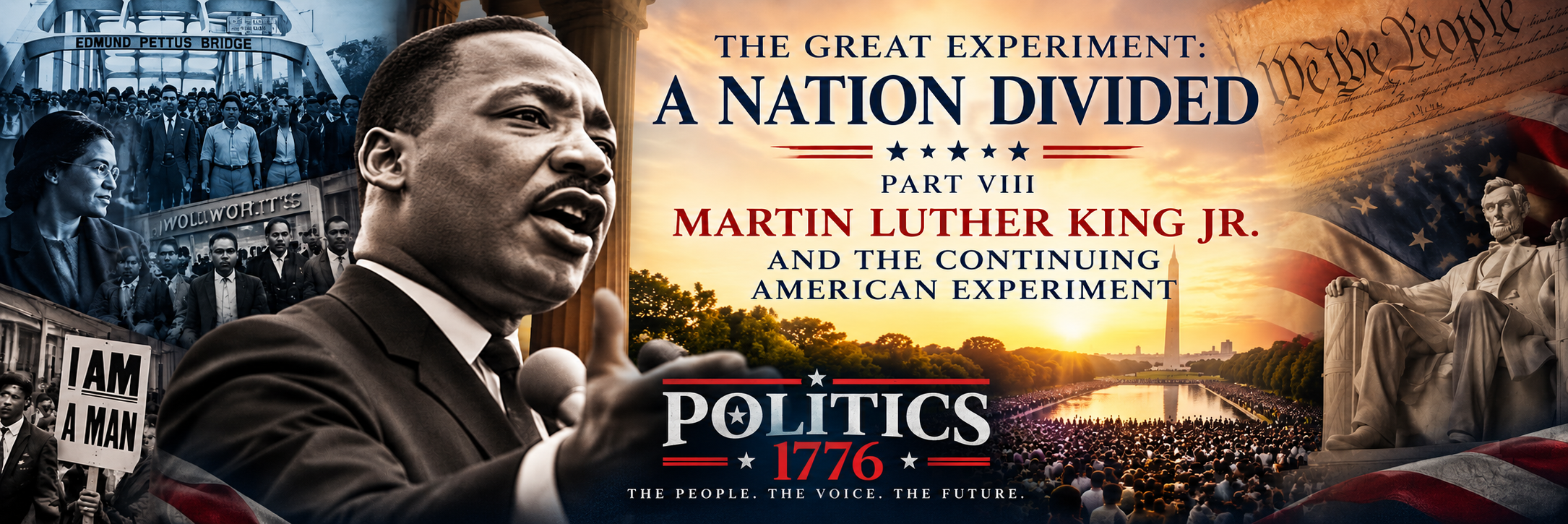
NEXT — PART VIII
Martin Luther King Jr. and the Continuing American Experiment
From Montgomery to the Voting Rights Act
Montgomery introduced Martin Luther King Jr. to the nation.
What followed would make him one of the most recognizable figures in American history.
But King's story was part of something larger.
Students would sit at lunch counters.
Freedom Riders would challenge segregated interstate transportation.
Children would march in Birmingham.
Hundreds of thousands would gather in Washington.
Civil-rights workers would risk—and sometimes lose—their lives.
Congress would pass landmark legislation.
And Americans would march from Selma toward Montgomery demanding access to the ballot.
The movement would challenge the country to enforce promises stretching backward through Reconstruction and ultimately to the founding itself.
The final chapter begins with a young minister who emerged from a bus boycott.
But it ends with a much larger question:
How does a constitutional democracy change when its citizens demand that the promises already written into its laws apply to everyone?
THE GREAT EXPERIMENT CONTINUES.
Our Money Matters.
Our Choices Matter.
Our Voice Matters.
The People. The Voice. The Future.
Politics 1776