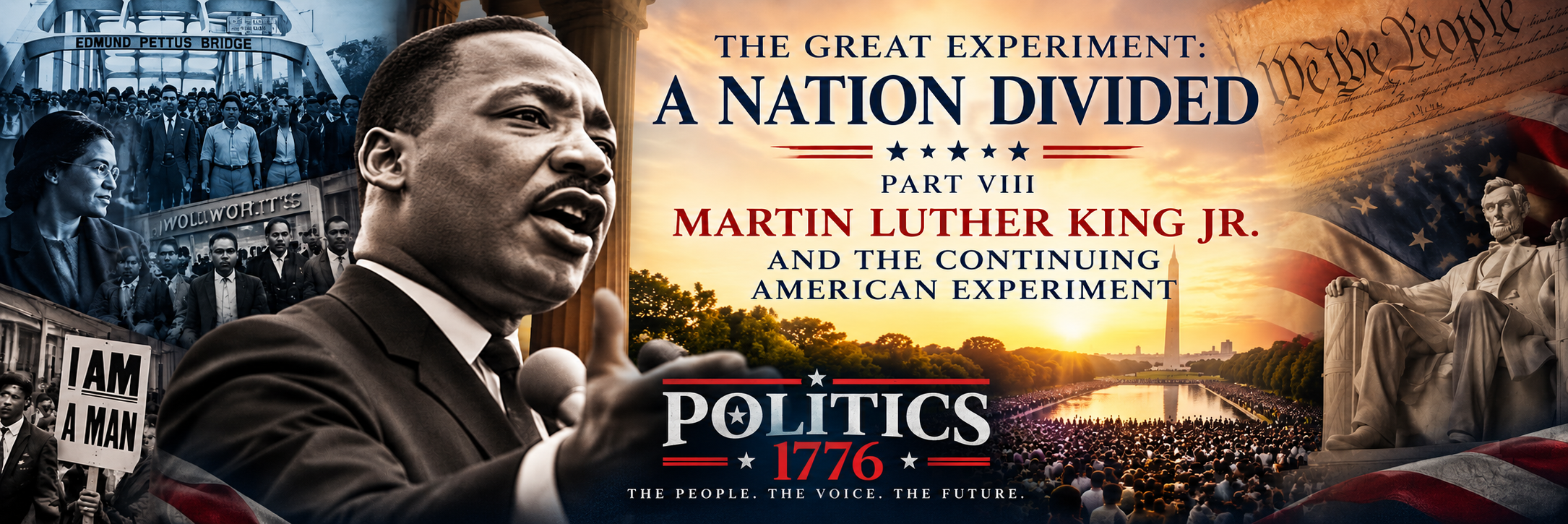
THE GREAT EXPERIMENT: A NATION DIVIDED
PART VIII — MARTIN LUTHER KING JR. AND THE CONTINUING AMERICAN EXPERIMENT
From Montgomery to the Voting Rights Act
In December 1956, the Montgomery Bus Boycott ended.
For 381 days, thousands of ordinary people had walked, carpooled, organized, sacrificed, and refused to participate in a segregated transportation system.
Rosa Parks had become a national symbol.
And a 26-year-old minister named Martin Luther King Jr. had emerged as one of the country's most recognizable civil-rights leaders.
But Montgomery was not the end of the story.
It was the beginning of another chapter.
Across the South, segregation remained deeply established.
Black citizens still encountered enormous obstacles to voting.
Schools remained contested.
Public accommodations remained segregated in many communities.
Discrimination affected employment and housing.
Violence and intimidation remained powerful tools of resistance to change.
The Constitution contained the Fourteenth and Fifteenth Amendments.
But once again, America confronted the difference between:
Rights written into law
and
rights people could exercise in everyday life.
A new generation was preparing to challenge that difference.
Martin Luther King Jr.
Martin Luther King Jr. was born in Atlanta, Georgia, on January 15, 1929.
He grew up in the segregated South.
His father and grandfather were ministers.
King attended Morehouse College, followed by theological studies at Crozer Theological Seminary and doctoral studies at Boston University.
He married Coretta Scott in 1953.
The following year, he became pastor of Dexter Avenue Baptist Church in Montgomery.
Then came Rosa Parks.
Then came the boycott.
And suddenly the young minister found himself helping lead a national movement.
King became closely associated with a philosophy that would define much of his public life:
nonviolent resistance.
Nonviolence Was Not Passivity
Nonviolence did not mean doing nothing.
It meant taking action without answering violence with violence.
March.
Boycott.
Sit down.
Refuse to leave.
Register voters.
Challenge laws in court.
Accept arrest.
Organize communities.
Create economic pressure.
Draw public attention to injustice.
And continue.
The strategy sought to confront discriminatory systems directly while denying opponents an easy justification for portraying peaceful demonstrators as the aggressors.
King's Christian beliefs strongly influenced his approach.
He was also influenced by traditions of nonviolent resistance associated with Mahatma Gandhi and by a much broader history of Black activism in the United States.
But King did not create the movement by himself.
And the movement did not wait for King to lead every campaign.
A younger generation was already preparing its own challenges.
Four Students Sit Down
On February 1, 1960, four Black college students entered a Woolworth's store in Greensboro, North Carolina.
Ezell Blair Jr.
David Richmond.
Franklin McCain.
Joseph McNeil.
They sat at a lunch counter reserved for white customers.
They requested service.
They were refused.
They remained seated.
The next day, more students joined them.
Then more.
The protest spread.
Soon sit-ins were occurring in communities across the South.
Students peacefully occupied segregated lunch counters and demanded service.
They faced insults.
Food and drinks were poured over them.
Some were assaulted.
Some were arrested.
But they kept sitting.
A simple act had become a movement.
Students Build Their Own Organization
The sit-in movement helped produce another important civil-rights organization:
The Student Nonviolent Coordinating Committee — SNCC.
Students wanted their own organization and their own voice within the movement.
SNCC became deeply involved in direct action and voter-registration work.
Its activists frequently worked in places where challenging the existing racial order could be extraordinarily dangerous.
This is an important part of the story.
The Civil Rights Movement was never one organization.
It included the NAACP.
SCLC.
SNCC.
CORE—the Congress of Racial Equality.
Local churches.
Student groups.
Labor organizations.
Community leaders.
Lawyers.
Ministers.
Teachers.
Workers.
Parents.
Young people.
And countless local organizations.
They sometimes cooperated.
They sometimes disagreed.
Different organizations preferred different strategies.
The movement was not one voice.
Just as the Founders had not been one voice generations earlier, the people pushing America toward change disagreed about methods, priorities, leadership, and how quickly change should occur.
The Freedom Riders
In 1961, another group challenged segregation in interstate transportation.
They became known as the Freedom Riders.
Black and white activists traveled together through the South to test federal rulings against segregation in interstate bus travel and facilities.
They encountered extraordinary violence.
In Alabama, one Freedom Riders' bus was attacked and burned near Anniston.
Riders were beaten.
In Birmingham and Montgomery, violence continued.
Yet additional volunteers arrived.
The violence drew national attention.
Eventually the federal government became increasingly involved, and the Interstate Commerce Commission issued stronger regulations prohibiting segregation in interstate transportation facilities.
Again, citizens had forced a question into public view.
And again, federal authority became part of the answer.
Birmingham
In 1963, the movement turned major attention toward Birmingham, Alabama.
Birmingham was one of the most segregated major cities in the United States.
Local activists, including the Reverend Fred Shuttlesworth, had challenged segregation there for years.
King and the Southern Christian Leadership Conference joined the campaign.
Demonstrators used marches, sit-ins, boycotts, and other nonviolent tactics.
King was arrested.
While imprisoned, he wrote what became known as his Letter from Birmingham Jail.
The campaign continued.
Then young people joined the demonstrations.
The response became one of the defining images of the Civil Rights Movement.
Police used dogs.
High-pressure fire hoses were turned against demonstrators.
Young protesters were arrested.
Television and newspaper coverage carried those images across the country and around the world.
Americans who had never visited Birmingham could see what was happening.
The struggle over segregation was becoming impossible to ignore.
The Power of Seeing It
Television changed the movement.
Earlier generations had challenged racial injustice through newspapers, photographs, speeches, organizing, and litigation.
Now Americans could watch confrontations unfold in their living rooms.
Peaceful demonstrators.
Police.
Dogs.
Fire hoses.
Arrests.
Violence.
The images did not automatically create agreement.
Americans continued to disagree over demonstrations, federal authority, civil disobedience, and the pace of change.
But the images forced the country to confront the reality of segregation in a new way.
The argument was no longer abstract.
People could see it.
President Kennedy Responds
President John F. Kennedy had initially approached civil-rights legislation cautiously.
But the growing movement and events including Birmingham increased pressure for federal action.
In June 1963, Kennedy addressed the country and called for major civil-rights legislation.
The issue, he argued, concerned fundamental questions of equal treatment under American law.
Legislation was introduced.
But before Congress completed its work, the country experienced another enormous moment.
This one took place in Washington.
The March on Washington
On August 28, 1963, approximately 250,000 people gathered in Washington, D.C., for the March on Washington for Jobs and Freedom.
It was not simply Martin Luther King Jr.'s event.
It was a massive coalition effort involving civil-rights, religious, student, and labor organizations.
Among its central organizers was A. Philip Randolph, who had been advocating a major march on Washington for years.
Bayard Rustin played an essential role in organizing the event.
Leaders from several major civil-rights organizations participated.
The march called attention to civil rights.
But its title is important:
Jobs and Freedom.
Economic opportunity was part of the movement too.
Participants gathered around the Lincoln Memorial.
And there Martin Luther King Jr. delivered the speech that would become the most famous of his life.
“I Have a Dream”
King spoke from the steps of the Lincoln Memorial.
Behind him sat the memorial to the president who had issued the Emancipation Proclamation.
Before him stretched the National Mall.
King connected the Civil Rights Movement to the Declaration of Independence, the Constitution, emancipation, citizenship, and the unfinished promises of American democracy.
His words became known around the world.
But the importance of the speech was larger than a single famous phrase.
King was making an argument about America itself.
The principles already existed.
The promises had already been written.
The question was whether the country would apply them.
It was the same tension running through this entire story:
American ideals versus American reality.
Then the Country Lost a President
Less than three months later, on November 22, 1963, President John F. Kennedy was assassinated in Dallas, Texas.
Vice President Lyndon B. Johnson became president.
Johnson urged Congress to continue the civil-rights legislation Kennedy had proposed.
The legislative fight was difficult.
There was strong opposition.
There was a lengthy Senate filibuster.
Supporters worked to assemble enough votes to end debate and pass the bill.
Eventually they succeeded.
On July 2, 1964, President Johnson signed the Civil Rights Act of 1964.
The Civil Rights Act of 1964
The Civil Rights Act became one of the most significant pieces of civil-rights legislation since Reconstruction.
Among its provisions, the law prohibited discrimination in public accommodations covered by the act.
It strengthened federal authority concerning school desegregation.
It prohibited discrimination in federally assisted programs.
And Title VII prohibited employment discrimination on the basis of race, color, religion, sex, or national origin.
The law also created the Equal Employment Opportunity Commission.
Nearly a century after the Civil War, the federal government was again using national authority to protect civil rights against discriminatory practices.
The connection to Reconstruction was becoming unmistakable.
But one enormous problem remained.
Voting.
The Fifteenth Amendment Was Already There
The Fifteenth Amendment had been ratified in 1870.
It prohibited denying or abridging a citizen's right to vote on account of race, color, or previous condition of servitude.
Yet generations later, many Black citizens across the South still faced enormous barriers to registration and voting.
Literacy tests.
Intimidation.
Economic retaliation.
Bureaucratic obstacles.
Violence.
Other discriminatory practices.
The constitutional language existed.
But once again, enforcement was the problem.
Civil-rights activists increasingly focused national attention on voting.
One of the most important campaigns took place in:
Selma, Alabama.
Selma
Black residents of Selma and surrounding Dallas County had been working for voting rights for years.
Local activists and organizations had laid the groundwork long before national leaders arrived.
SNCC organizers had worked in the area.
The Dallas County Voters League had pushed for registration.
SCLC later joined the campaign.
Martin Luther King Jr. came to Selma.
The objective was straightforward:
Black citizens wanted meaningful access to the ballot.
The obstacles were not.
Attempts to register could mean harassment.
Employment could be threatened.
Applicants faced discriminatory procedures.
Demonstrations resulted in arrests.
Tensions increased.
Then activists planned a march from Selma to the state capital in Montgomery.
Bloody Sunday
On March 7, 1965, approximately 600 marchers left Selma.
They crossed the Edmund Pettus Bridge.
On the other side, Alabama state troopers and other law-enforcement personnel confronted them.
The marchers were ordered to disperse.
Then officers attacked.
They used clubs.
Tear gas.
Mounted officers pursued demonstrators.
People were beaten.
Among those injured was John Lewis, a leader of SNCC who would later serve for decades in the United States House of Representatives.
Television cameras captured the violence.
The day became known as:
Bloody Sunday.
Once again, Americans watched.
And once again, images of violence against peaceful demonstrators changed the national conversation.
The Federal Government Responds
Eight days after Bloody Sunday, President Johnson addressed a joint session of Congress.
He called for voting-rights legislation.
The federal courts also became involved in the right of demonstrators to march.
A federally protected march from Selma to Montgomery began on March 21.
Thousands participated along the way.
By the time marchers reached Montgomery on March 25, the crowd had grown enormously.
They stood near the Alabama State Capitol.
The demand was clear.
Access to the vote.
Congress acted.
The Voting Rights Act of 1965
On August 6, 1965, President Lyndon Johnson signed the Voting Rights Act.
Martin Luther King Jr. and other civil-rights leaders were present.
The law targeted discriminatory voting practices that had prevented Black Americans from exercising voting rights promised by the Fifteenth Amendment.
It prohibited literacy tests used as voting barriers.
It provided mechanisms for federal examiners in certain jurisdictions.
And it created federal oversight provisions for jurisdictions with histories of discriminatory voting practices.
The connection across American history was extraordinary.
1870 — The Fifteenth Amendment.
1965 — The Voting Rights Act.
Ninety-five years separated them.
The constitutional promise had existed for generations.
Now Congress had created powerful federal mechanisms designed to enforce it.
The Movement Had Changed the Law
Consider what had happened in only a decade.
In 1955, Rosa Parks was arrested on a Montgomery bus.
In 1956, federal courts struck down Montgomery's bus segregation.
In 1960, students launched sit-ins.
In 1961, Freedom Riders challenged segregated interstate travel.
In 1963, Birmingham brought images of segregation and police violence before the nation.
That same year, hundreds of thousands marched on Washington.
In 1964, Congress enacted the Civil Rights Act.
In 1965, Selma focused the country's attention on voting.
Then Congress enacted the Voting Rights Act.
This did not happen because one person changed America.
It happened because millions of individual decisions accumulated into a movement.
People organized.
People marched.
People voted.
People went to court.
People wrote letters.
People preached.
People registered voters.
People sat at lunch counters.
People rode buses.
People went to jail.
People opened their homes.
People provided transportation.
People challenged laws.
Some lost their jobs.
Some were beaten.
Some were murdered.
Change came through institutions.
But citizens pushed those institutions to act.
King Kept Going
For Martin Luther King Jr., passage of the Civil Rights Act and Voting Rights Act did not mean the work was finished.
His attention increasingly expanded beyond legally mandated segregation.
He addressed poverty.
Housing.
Employment.
Economic inequality.
He became involved in campaigns outside the Deep South, including efforts in Chicago.
He spoke increasingly about the Vietnam War.
These positions sometimes brought criticism, including from people who had previously supported parts of his civil-rights work.
King's later years remind us of something important.
Historical figures are rarely frozen at the moment for which they become famous.
They continue changing.
Their priorities change.
Their coalitions change.
Their critics change.
King's story continued beyond the March on Washington and Selma.
And his final campaign would take him to Memphis, Tennessee.
Memphis
In 1968, Black sanitation workers in Memphis went on strike following years of concerns about working conditions, wages, and treatment.
The deaths of sanitation workers Echol Cole and Robert Walker after they were crushed in a malfunctioning garbage truck intensified the dispute.
The workers carried signs containing a simple statement:
I AM A MAN.
King traveled to Memphis to support them.
The words on those signs carried an extraordinary historical weight.
For generations, Black Americans had fought against systems that denied their full humanity and citizenship.
Slavery had treated human beings as property.
Reconstruction had established citizenship.
Jim Crow had imposed segregation.
Civil-rights activists had challenged it.
Now workers marched through Memphis declaring:
I AM A MAN.
April 4, 1968
On April 3, King delivered a speech in Memphis.
The following evening, April 4, 1968, he stepped onto the balcony of the Lorraine Motel.
He was shot.
Martin Luther King Jr. was 39 years old.
He died that evening.
Riots and unrest followed in cities across the country.
The assassination shocked the nation.
But the movement did not end.
Just as it had not begun with King, it could not end with him.
The Movement Was Always Larger Than One Man
Martin Luther King Jr. became one of the most recognizable leaders of the Civil Rights Movement.
But understanding the movement requires remembering the people around him.
Rosa Parks.
Coretta Scott King.
Jo Ann Robinson.
E.D. Nixon.
Fred Shuttlesworth.
Ella Baker.
John Lewis.
Diane Nash.
Bayard Rustin.
A. Philip Randolph.
James Farmer.
Roy Wilkins.
Whitney Young.
Fannie Lou Hamer.
Medgar Evers.
Thurgood Marshall.
And countless others.
Some worked through courts.
Some organized demonstrations.
Some registered voters.
Some built organizations.
Some led churches.
Some were students.
Some were workers.
Some became nationally famous.
Most did not.
The movement belonged to all of them.
And Now We Can See the Whole Story
Our story began long before Martin Luther King Jr.
Long before Rosa Parks.
Long before the Civil War.
It began with the creation of the United States itself.
In 1776, Americans declared that all men were created equal and possessed rights including life and liberty.
But slavery remained.
In 1787, the Constitution created a stronger national government while accommodating slavery and leaving its future unresolved.
In 1803, the Louisiana Purchase nearly doubled the country's territory.
Expansion raised the question:
Would slavery expand too?
In 1820, the Missouri Compromise attempted an answer.
It held for decades.
Then expansion reopened the argument.
The Compromise of 1850 tried again.
Kansas-Nebraska reopened territory.
Kansas descended into violence.
Dred Scott intensified the constitutional conflict.
The political system fractured.
Lincoln was elected.
States seceded.
And in 1861, Americans went to war.
Then the Constitution Changed
The Union survived.
Slavery did not.
The Thirteenth Amendment abolished slavery.
The Fourteenth Amendment established citizenship and constitutional protections including equal protection.
The Fifteenth Amendment prohibited racial discrimination in voting.
Reconstruction attempted to make those changes real.
Black Americans voted.
They held office.
They built institutions.
The federal government protected constitutional rights.
Then Reconstruction weakened.
Jim Crow expanded.
Voting rights were restricted.
Segregation became entrenched.
But the amendments remained.
The words remained.
And generations later, Americans returned to them.
Rosa Parks Sat Down
Then thousands stood up.
They boycotted.
Students sat at lunch counters.
Freedom Riders boarded buses.
Children marched in Birmingham.
Hundreds of thousands gathered in Washington.
Citizens crossed a bridge in Selma.
Congress acted.
Presidents signed legislation.
Courts enforced constitutional protections.
And the country changed again.
Not because the American experiment had failed.
And not because it had ever been completed.
But because each generation inherited both its principles and its unresolved questions.
The Great Experiment
The story of the Civil War and Civil Rights Movement is sometimes told as though it consists of separate chapters.
The Founders.
The Louisiana Purchase.
Slavery.
The Civil War.
Reconstruction.
Jim Crow.
Rosa Parks.
Martin Luther King Jr.
But when we follow the history closely, the chapters connect.
Territory affected slavery.
Slavery affected political power.
Political power affected expansion.
Expansion intensified sectional conflict.
Sectional conflict produced secession.
Secession produced war.
War produced emancipation.
Emancipation produced Reconstruction.
Reconstruction changed the Constitution.
The retreat from Reconstruction helped allow segregation and disenfranchisement to become entrenched.
Those systems produced new constitutional challenges.
Those challenges helped produce the modern Civil Rights Movement.
And that movement helped force the country to confront promises stretching all the way back to its beginning.
Liberty.
Equality before the law.
Citizenship.
Representation.
Voting.
The consent of the governed.
America Was Never a Finished Product
The Founders did not create a finished country.
They created institutions.
They created a constitutional framework.
They created mechanisms for elections.
They created a system capable of amendment.
And they left enormous contradictions unresolved.
Later generations inherited them.
Some made progress.
Some resisted it.
Some compromised.
Some fought.
Some marched.
Some went to court.
Some changed laws.
Some changed the Constitution itself.
That is part of what makes the American story an experiment.
The outcome was never guaranteed.
And the work was never performed by one generation alone.
The People Were Always Part of the Story
Governments matter.
Presidents matter.
Congress matters.
Courts matter.
Constitutions matter.
But throughout this entire series, another force has appeared again and again.
The people.
People petitioned.
People voted.
People organized.
People protested.
People served.
People challenged government.
People defended government.
People demanded change.
People resisted change.
People took arguments into legislatures and courtrooms.
And sometimes ordinary people made decisions that became extraordinary moments in history.
A teenager refusing to surrender her bus seat.
Four students sitting at a lunch counter.
Citizens walking instead of riding a bus.
Marchers crossing a bridge.
Workers carrying signs saying:
I AM A MAN.
History is shaped by institutions.
But institutions are ultimately occupied, challenged, changed, and sustained by people.
The Experiment Continues
The Civil War ended in 1865.
The Civil Rights Movement did not end every disagreement over equality, citizenship, voting, federal authority, or individual rights.
History rarely ends that neatly.
Later generations continued debating the meaning and application of the Constitution.
They still do.
That does not require us to agree about every political question.
The Founders didn't.
The generation of the Civil War didn't.
The leaders of Reconstruction didn't.
The Civil Rights Movement itself contained significant disagreements about strategy and goals.
Disagreement is part of a government built around citizens possessing different ideas and having the ability to express them.
What history gives us is something different.
It gives us the opportunity to understand how we arrived here.
To read the documents.
To hear different voices.
To examine the decisions.
To understand their consequences.
And to participate thoughtfully in the country inherited from those who came before us.
Because the American experiment was never designed to operate without its citizens.
FROM 1776 TO TODAY
The country expanded.
The country divided.
The country fought.
Slavery ended.
The Constitution changed.
Rights were challenged.
Citizens organized.
Laws changed.
And generation after generation continued the argument over what America's founding principles mean in practice.
That story does not belong only to presidents.
It does not belong only to Congress.
It does not belong only to courts.
It does not belong only to the people whose names appear in history books.
It belongs to the American people.
And every generation inherits a part of it.
THE GREAT EXPERIMENT CONTINUES.
Learn the history.
Read the documents.
Understand the arguments.
Ask questions.
Participate.
Use your voice.
Our Money Matters.
Our Choices Matter.
Our Voice Matters.
The People. The Voice. The Future.
Politics 1776