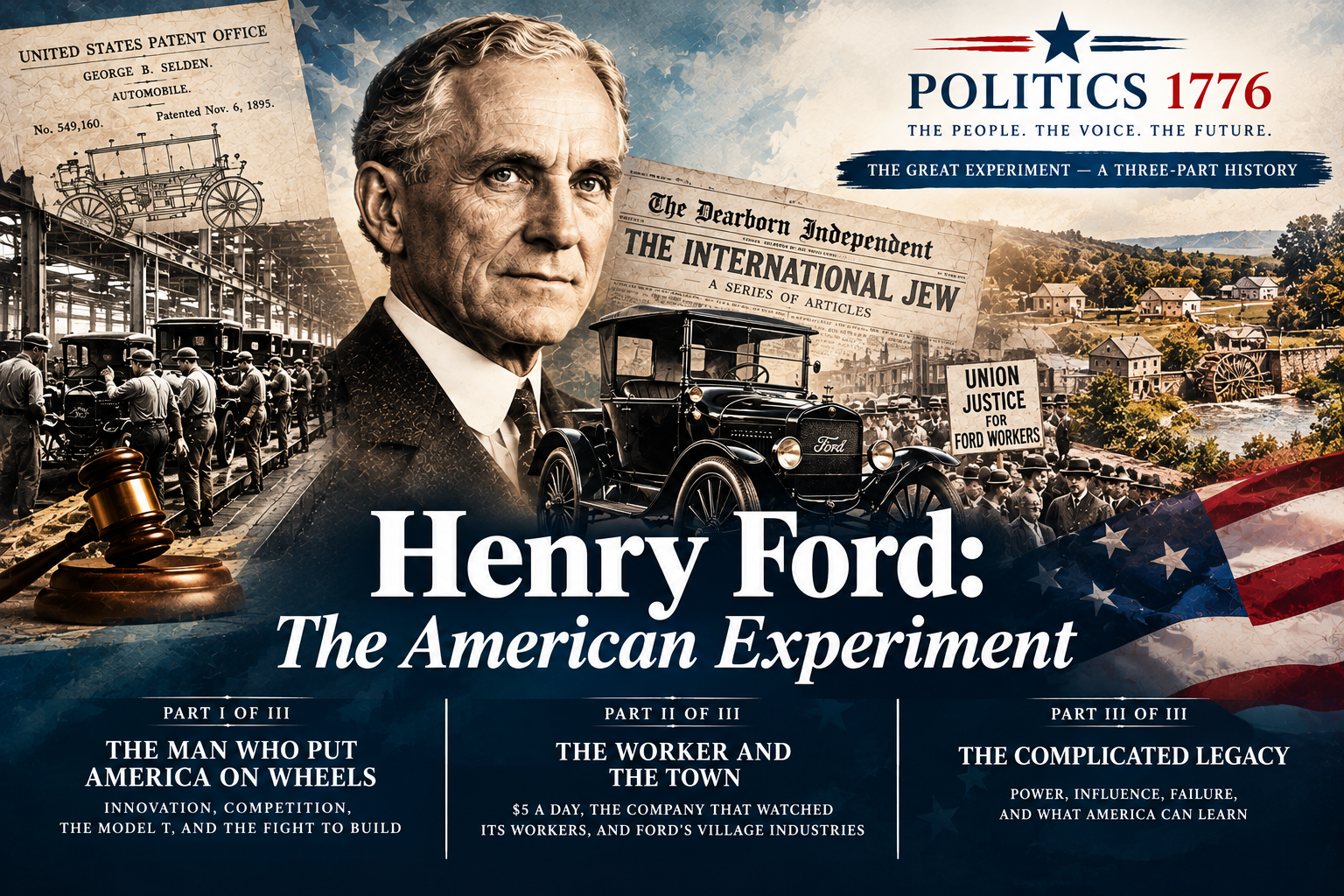
HENRY FORD: THE AMERICAN EXPERIMENT
Innovation, Work, Wages, and the American Worker THE GREAT EXPERIMENT — A THREE-PART HISTORY
PART II OF III
THE WORKER AND THE MACHINE
How the Model T, the $5 Day, and Ford's Industrial System Changed American Work
In Part I, we looked at Henry Ford the innovator.
We looked at the automobile industry he entered.
We looked at the Selden patent dispute and Ford's fight to continue competing.
We looked at the Model T.
And we looked at the moving assembly line that transformed automobile production.
But there was a problem hiding inside Ford's success.
The faster the machines moved, the faster the workers had to move with them.
Ford had discovered how to make automobiles cheaper and faster.
Now he had to figure out how to keep people working inside the system.
That would lead to one of the most famous wage decisions in American history.
It would also lead to one of the most controversial questions of Ford's career:
How much should an employer be allowed to control the life of an employee?
THE MODEL T CHANGES THE GAME
When Ford introduced the Model T in 1908, the automobile industry was still young.
There were already many automobile manufacturers.
There were competing designs.
There were competing engines.
There were competing ideas about what an automobile should be.
Ford's answer was remarkably simple:
Build a dependable automobile.
Build enormous numbers of them.
Lower the cost.
Make the automobile available to ordinary Americans.
The Model T became extraordinarily successful.
Ford kept refining his manufacturing process, and the company eventually developed a highly efficient moving assembly-line system at its Highland Park plant.
The result was dramatic.
Production became faster.
Output increased.
And the price of the automobile fell.
The Model T that cost $850 when introduced eventually became available for a fraction of that price.
By 1927, Ford had produced roughly 15 million Model Ts.
The automobile was no longer simply a toy for the wealthy.
It was becoming part of ordinary American life.
THE MACHINE CHANGES THE WORKER
But there is another side to every efficiency revolution.
The assembly line was designed around the movement of the product.
The automobile moved from station to station.
Workers performed specialized tasks.
The process was measured.
The process was timed.
The process was constantly refined.
From a business perspective, it was enormously successful.
From the worker's perspective, the experience could be very different.
The work could become repetitive.
The pace could be demanding.
And a worker who could not keep up could be replaced.
Ford's extraordinary production system created another problem:
worker turnover.
The company needed large numbers of people willing to perform difficult, repetitive industrial work.
And it needed them to stay.
Ford's answer would change American labor history.
THE $5 DAY
In January 1914, Ford announced a dramatic increase in compensation.
Eligible workers could receive $5 for an eight-hour day under the company's new compensation and profit-sharing arrangement.
The increase was extraordinary for the time.
It attracted enormous attention.
People came looking for work.
Ford's factory became a destination for workers from across the country and for immigrants arriving in the United States.
The company could attract workers.
But there was a catch.
The higher compensation was connected to rules governing worker behavior.
And Ford created a department specifically designed to enforce those expectations.
THE SOCIOLOGICAL DEPARTMENT
In 1914, Ford created the Sociological Department.
The name sounds harmless enough.
The reality was much more complicated.
The department investigated workers' lives outside the factory.
Company investigators could visit employees' homes.
They examined living conditions.
They looked at family circumstances.
They checked school attendance.
They examined financial habits.
They evaluated whether workers were living according to standards Ford considered acceptable.
The company also operated an English school for immigrant workers.
There were legitimate goals behind some of these programs.
Ford employed a huge and diverse workforce.
Communication could affect workplace safety.
Some company programs provided assistance to workers and their families.
The company also had an interest in reducing turnover and helping workers adapt to industrial employment.
But there was another side.
The employer was entering the employee's private life.
And that raises an important question:
Where does the employer's responsibility end?
A GOOD PAYCHECK DOES NOT BUY A PERSON'S PRIVATE LIFE
Ford's $5 day became one of the great symbols of industrial America.
Higher wages mattered.
They gave workers greater purchasing power.
They helped families.
They helped create customers.
And they demonstrated that productivity could potentially support higher compensation.
But the story cannot stop there.
A worker can appreciate a higher wage and still want privacy.
A worker can appreciate a job and still want dignity.
A worker can appreciate an employer and still disagree with the employer.
Those things are not contradictory.
Ford's experiment showed both sides of industrial paternalism.
The company could provide opportunities, wages, schools, assistance, and safer workplaces.
But it could also demand conformity and attempt to influence behavior beyond the factory floor.
That tension would follow Ford for decades.
THE AMERICAN WORKER IS NOT A MACHINE
This may be the most important lesson in the entire Ford story.
Ford became famous for building a system in which machines, materials, and workers operated together with extraordinary efficiency.
But people are not interchangeable parts.
A machine does not have a family.
A machine does not have a private life.
A machine does not have political opinions.
A machine does not decide whether a workplace is fair.
A machine does not have a voice.
A worker does.
And eventually, Ford's workers would insist on using it.
FORD AND ORGANIZED LABOR
Ford was deeply hostile to organized labor.
The company's resistance to unions became increasingly intense during the 1930s.
At Ford's massive River Rouge complex, Harry Bennett's Service Department became associated with aggressive anti-union tactics.
The conflict reached a dramatic point in 1937.
Union organizers and supporters attempting to distribute literature at the Rouge plant were attacked in what became known as the Battle of the Overpass.
The dispute did not end there.
Ford continued resisting unionization.
But the industrial economy was changing.
Workers were organizing across the country.
The United Auto Workers was growing.
And the question was becoming harder to avoid:
Could workers have a collective voice inside America's largest automobile factories?
THE 1941 STRIKE
In 1941, Ford workers went on strike at the River Rouge complex.
The conflict was significant because Ford had remained one of the major automobile companies resisting union recognition.
The strike eventually produced a settlement.
Workers voted overwhelmingly for UAW representation in the National Labor Relations Board election.
Ford then entered into an agreement with the union.
The agreement brought major changes.
Wages increased.
Seniority became an important factor in layoffs and rehiring.
The Ford Service Department was disbanded.
The company recognized the union.
The relationship between Ford and organized labor had fundamentally changed.
The man who had built one of America's most powerful industrial companies had finally accepted that his workers would have an organized voice.
THIS WAS NOT A SIMPLE STORY OF GOOD GUYS AND BAD GUYS
It would be easy to turn this into a morality play.
Henry Ford was the powerful industrialist.
The workers were the powerless employees.
The union was the hero.
Or perhaps the employer was the hero who created high-paying jobs.
Neither version tells the whole story.
Ford created enormous opportunities.
He helped make automobiles affordable.
He paid wages that could be unusually high for the time.
He invested heavily in production.
He helped create a modern industrial economy.
But he also attempted to control workers' lives.
His company fought organized labor.
Workers faced difficult and sometimes dangerous conditions in industrial America.
And workers eventually organized to demand a greater voice.
The historical lesson is not that one side was always right.
The lesson is that economic power and individual dignity can come into conflict.
FORD'S OTHER EXPERIMENT
THE VILLAGE INDUSTRIES
There was another side to Ford's vision of work.
Ford became fascinated with the relationship between agriculture and industry.
Instead of putting every factory in a massive industrial city, Ford experimented with smaller factories located in rural communities.
Beginning in the 1920s, Ford established what became known as Village Industries throughout southeastern Michigan.
Some operated in or near old mills.
Others were powered by hydroelectric facilities.
They produced tools, parts, gauges, electrical components, and other materials needed by Ford.
And there was a specific idea behind them.
Ford wanted local residents to be able to work in factories while maintaining connections to farming and rural life.
Some of the workers were farmers who could continue maintaining their farms while working at a Ford plant.
That was very different from the massive industrial model represented by the Rouge complex.
FARM AND FACTORY
The Village Industries represented an interesting idea.
A person did not necessarily have to choose between:
the farm
and
the factory.
A community could potentially have both.
A family could maintain its land.
A worker could earn industrial wages.
A small town could support manufacturing.
A factory could use local labor.
And an old mill or rural building could be given a new economic purpose.
Ford's experiment did not solve every problem.
But the idea itself was significant.
Economic development did not necessarily have to mean abandoning every small town for a giant city.
THE SMALL-TOWN LESSON
Today, we often talk about economic development as though there is only one model.
Build a massive facility.
Move thousands of people.
Create a large industrial center.
Concentrate everything.
Ford's Village Industries suggested another possibility:
What if opportunity could be brought closer to where people already lived?
That question remains relevant.
Small towns need jobs.
Families need opportunity.
Workers need wages.
Businesses need productive communities.
And people should not always have to leave their hometown simply to find a decent way to make a living.
Ford understood something important:
Economic opportunity is also a community issue.
BUT FORD'S SYSTEM HAD LIMITS
The Village Industries were not a rejection of Ford's industrial system.
They were another part of it.
The factories still existed to serve Ford Motor Company.
Ford still controlled the business.
Ford still expected workers to follow company rules.
And Ford's relationship with employees remained paternalistic.
That distinction matters.
Ford could provide opportunity while still exercising enormous power.
He could pay well while demanding conformity.
He could build communities while controlling the businesses inside them.
He could improve working conditions while opposing unions.
Human institutions are complicated.
And Henry Ford was no exception.
WHAT THE FORD STORY TELLS US ABOUT WORK
Ford's career raises questions that go far beyond automobiles.
What is a fair wage?
Ford's $5 day demonstrated that companies could dramatically increase wages when productivity and business conditions allowed it.
What belongs in an employee's private life?
Ford's Sociological Department demonstrated the dangers of allowing an employer to decide what constitutes acceptable personal behavior.
What rights should workers have?
Ford's resistance to unions demonstrated the conflict between management authority and collective worker organization.
Can businesses and communities grow together?
Ford's Village Industries suggested that industrial opportunity could exist alongside agriculture and small-town life.
What happens when technology changes work?
Ford's assembly line demonstrated that productivity can create enormous wealth while also changing the nature of work itself.
THE BIGGER AMERICAN QUESTION
The story of Henry Ford is ultimately about power.
Who has it?
Who gets to make decisions?
Who gets a voice?
And what happens when two sides have different ideas about what is fair?
Ford had enormous economic power.
His workers had their labor.
His customers had their money.
His competitors had their businesses.
And eventually, organized workers had collective bargaining power.
The American economic system has always involved negotiation among these competing forces.
Government has a role in establishing basic rules.
Businesses need room to innovate and compete.
Workers need legal protections and the ability to organize.
Consumers need meaningful choices.
And individuals need the freedom to decide how they will live their lives.
The challenge is maintaining a system where none of those forces becomes so powerful that everyone else loses meaningful choices.
THE GREAT EXPERIMENT CONTINUES
Henry Ford's greatest contribution may not have been a particular automobile.
It may have been the demonstration of what can happen when manufacturing, technology, competition, capital, and human ambition come together.
But Ford's story also demonstrates the limits of efficiency.
You can make a machine faster.
You can make a factory more productive.
You can lower a price.
You can increase a paycheck.
But eventually you still have to answer a very human question:
What kind of life are we building?
A stronger economy is not only about producing more.
It is about what people are able to do with what they produce.
Can they support a family?
Can they own something?
Can they remain in their community?
Can they speak freely?
Can they disagree with their employer?
Can they organize?
Can they have a private life?
Can they participate in the economy without surrendering their dignity?
Those questions were present in Ford's America.
They remain present today.
And that is why Henry Ford belongs in the story of the American Experiment.
WHAT CAN WE LEARN FROM PART II?
1. Productivity can create opportunity.
Ford's manufacturing innovations helped lower the cost of automobiles and expand access to them.
2. Higher wages matter.
The $5 day demonstrated the enormous economic impact that higher worker compensation could have.
3. Money is not the same thing as freedom.
A higher paycheck does not automatically justify control over a person's private life.
4. Workers are citizens, not machinery.
Workers have interests, rights, families, opinions, and voices of their own.
5. Businesses need room to operate.
Innovation and productivity require businesses to make decisions and take risks.
6. Workers need a voice.
The history of Ford's labor relations demonstrates why workers may seek collective representation when they believe individual bargaining power is insufficient.
7. Communities matter.
Ford's Village Industries showed that economic opportunity can be connected to local communities, agriculture, and small-town life.
8. There are no perfect institutions.
Ford's story contains achievements and failures, innovation and control, opportunity and conflict.
History should not require us to pretend otherwise.
NEXT: PART III
THE COMPLICATED LEGACY
Henry Ford became one of the most famous businessmen in American history.
His influence reached far beyond automobiles.
His ideas about production spread around the world.
His companies became enormous.
His public influence became enormous.
And with enormous influence came enormous responsibility.
But Ford's legacy contains some of the darkest chapters of his life as well as some of his most ambitious experiments.
Part III will examine the man behind the industrial legend—his public influence, his controversial views and actions, his legacy, and the difficult question every successful American eventually faces:
What should we do with power when we have it?
The Great Experiment continues.
The People. The Voice. The Future.
Politics 1776
SOURCES & FURTHER READING
The Henry Ford — Ford Motor Company Sociological Department & English School
Historical material documenting the $5 day, employee rules, home investigations, English-language education, and Ford's approach to managing its workforce.
Library of Congress — “How to Build an Ideal Worker at Ford's Highland Park Plant”
Primary-source material concerning Ford's $5 day, employee investigations, workplace rules, and the company's expectations for workers.
The Henry Ford — Henry Ford: Village Industries
Archival material documenting Ford's rural factories, hydroelectric plants, local employment, and the company's effort to employ people who could continue maintaining farms.
U.S. Department of Labor — Americans in Depression and War
Historical account of Ford's resistance to unionization, the 1937 Battle of the Overpass, the 1941 River Rouge strike, the UAW election, and the resulting labor agreement.
National Park Service — Ford Hunger March / Ford Labor History
Historical context for the labor conflict surrounding Ford Motor Company during the Depression.
The Henry Ford — Ford Village Industries archival collection
Photographs and records documenting the small-scale plants Ford established throughout southeastern Michigan during the 1920s and 1930s.