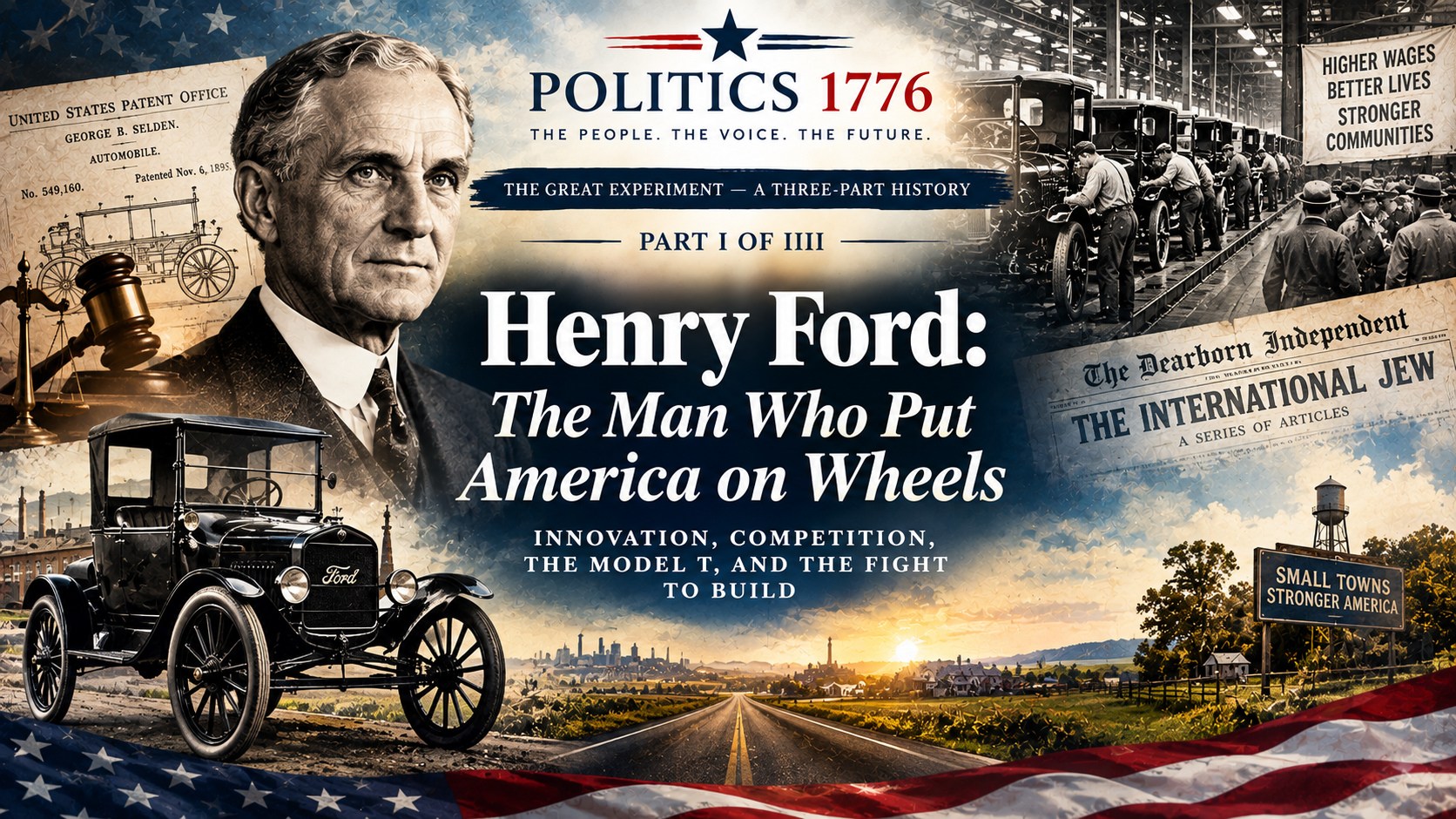
HENRY FORD: THE AMERICAN EXPERIMENT
Innovation, Competition, the Model T, and the Fight to Build THE GREAT EXPERIMENT — A THREE-PART HISTORY
PART I OF III
THE MAN WHO PUT AMERICA ON WHEELS
Henry Ford did not invent the automobile.
That is important to understand from the beginning.
Gasoline-powered automobiles were already being developed by inventors and manufacturers in America and Europe before Ford became famous.
Ford's contribution was different.
He helped transform the automobile from an expensive machine available to relatively few people into a mass-produced product that millions of ordinary Americans could eventually afford.
He changed how cars were built.
He changed how much they cost.
And in the process, he helped change America.
But before Ford became the symbol of mass production, he faced a very different kind of challenge.
It involved a patent.
It involved lawyers.
It involved an organization representing established automobile manufacturers.
And it raised a question that still matters today:
Who gets the opportunity to compete?
BEFORE THE MODEL T
Henry Ford was born in Michigan in 1863.
He grew up on a farm but developed an early fascination with machinery.
As a young man, he worked with machines, engines, and electricity before eventually turning his attention to automobiles.
In 1896, Ford completed his first automobile, the Quadricycle.
It was a very different machine from the automobiles that would eventually carry millions of Americans.
It was small.
It was primitive.
It had no modern comforts.
But it worked.
Ford continued experimenting.
He built additional automobiles.
He participated in automobile races.
He attracted investors.
And in 1903, the Ford Motor Company was established.
But Ford was entering a crowded and uncertain industry.
There were already numerous automobile manufacturers.
There were competing designs.
There were competing technologies.
And there was a legal fight taking shape over who had the right to build gasoline-powered automobiles.
THE SELDEN PATENT
When a Patent Became a Battle Over an Entire Industry
George B. Selden was a patent attorney and inventor who had filed a patent application for a self-propelled road vehicle.
His patent was ultimately granted in 1895.
The patent was unusual because it was interpreted as covering a broad category of gasoline-powered automobiles.
By the early 1900s, several automobile manufacturers had accepted the validity of the patent and were paying royalties.
In 1903, those manufacturers helped establish the Association of Licensed Automobile Manufacturers, commonly known as ALAM.
The organization licensed automobile manufacturers and sought to enforce the Selden patent.
Ford applied for a license.
He was rejected.
The reason given was largely that the organization did not consider Ford Motor Company a qualifying manufacturer.
Ford decided not to accept the decision.
He continued producing automobiles.
The organization sued.
And the fight began.
FORD VERSUS THE SYSTEM
The lawsuit lasted for years.
In 1909, a federal court ruled in favor of Selden's patent claim.
Ford appealed.
Then, in January 1911, a federal appellate court ruled in Ford's favor.
The decision effectively ended the attempt to use Selden's patent to control gasoline-powered automobile manufacturing in the broad way the licensing organization had claimed.
Automakers were no longer required to operate under the licensing system based on that broad interpretation of the patent.
Ford had won.
And the victory became an important part of his public image.
He was portrayed as the challenger taking on an established industry.
But the historical lesson is bigger than the personalities.
WHEN PROTECTION BECOMES A BARRIER
Patents serve an important purpose.
Inventors invest time and money developing new ideas.
The patent system gives inventors certain legal protections in exchange for publicly disclosing their inventions.
That can encourage innovation.
But every patent system faces a difficult question:
How much protection is enough?
Protect an invention too little, and inventors may have less incentive to invest.
Protect an idea too broadly, and competition can become more difficult.
The Selden dispute was an early example of that tension.
Ford's victory did not mean patents were bad.
It meant that one broad interpretation of a patent could not be used to control an entire emerging automobile industry.
That distinction matters.
The lesson isn't:
“All regulation is bad.”
The lesson is:
Rules should accomplish their purpose without unnecessarily preventing legitimate competition.
That idea would become central to Ford's story.
Because Ford wasn't finished challenging the automobile industry.
He was about to change the way the automobile itself was built.
THE MODEL T
A Car Designed for the Mass Market
In 1908, Ford introduced the Model T.
It was not the first automobile.
It was not the most luxurious automobile.
It was not the fastest automobile.
Ford wanted something else.
He wanted a car that was:
dependable,
relatively simple,
rugged,
practical,
and affordable enough to reach a mass market.
The Model T proved extraordinarily successful.
But making an affordable car required something more than a good design.
It required a completely different approach to manufacturing.
THE FACTORY BECOMES THE MACHINE
Ford and his engineers continually experimented with production.
They standardized components.
They developed interchangeable parts.
They reorganized workers and machinery.
They looked for ways to eliminate wasted movement.
And eventually, at Ford's Highland Park plant, they introduced a moving assembly-line system for automobile production.
The concept itself was not invented from nothing.
Moving production systems had been used elsewhere.
Ford's achievement was applying and refining the idea on an enormous scale for automobile manufacturing.
Instead of workers moving around a vehicle while completing numerous tasks, the vehicle moved through a sequence of stations.
Each worker performed a more specialized task.
Then the vehicle moved on.
And then another.
And another.
The factory became a system.
THE MOVING ASSEMBLY LINE
The results were extraordinary.
The time required to assemble a Model T fell dramatically as Ford refined the production process.
The Library of Congress notes that Model T production moved from more than twelve hours per vehicle to under an hour as Ford's manufacturing methods were refined.
That meant Ford could produce dramatically more vehicles.
And increased production allowed the company to lower prices.
The Model T cost $850 when it was introduced in 1908.
By 1914, the price had fallen to $490.
By 1924, it had fallen to $260.
The technology of mass production was becoming a technology of mass affordability.
That was the real revolution.
THE CAR FOR THE GREAT MULTITUDE
The Model T became known as the “Tin Lizzie.”
It was rugged.
It was relatively simple.
It could handle poor roads.
And it became enormously popular.
By May 1927, Ford had produced approximately 15 million Model Ts.
Fifteen million automobiles.
Think about what that meant.
Fifteen million people or families gaining access to a machine that could fundamentally change how they lived and worked.
The automobile was no longer merely a luxury.
It was becoming part of everyday American life.
AMERICA STARTS MOVING
The consequences went far beyond Ford's factory.
The automobile changed transportation.
It changed farming.
It changed commerce.
It changed employment.
It changed where people could live.
It changed how communities connected with one another.
A farmer could travel farther to reach a market.
A worker could travel farther to reach a job.
A family could travel beyond the immediate boundaries of its community.
Businesses could reach customers over greater distances.
New industries grew around the automobile.
Gas stations.
Repair shops.
Dealerships.
Road construction.
Tire manufacturing.
Steel.
Oil.
Rubber.
Insurance.
Tourism.
The automobile became an engine of economic change.
And Ford helped put that engine into the hands of ordinary Americans.
BUT SUCCESS CREATED A NEW PROBLEM
The assembly line was incredibly productive.
Workers did not necessarily love it.
The work could be repetitive.
It could be physically exhausting.
It moved at the pace of the production system.
And workers could leave for other jobs.
Ford's new manufacturing system created such high turnover that the company had to continually recruit new workers simply to maintain its workforce.
Ford had solved one problem:
How do we build automobiles faster?
Now he had another:
How do we convince people to stay?
Ford's answer would become one of the most famous wage decisions in American history.
THE $5 DAY
In January 1914, Ford announced a new compensation plan that could provide eligible workers with $5 for an eight-hour day.
That represented a dramatic increase over the previous basic wage.
The announcement became national news.
Thousands of people sought employment with Ford.
The $5 day was an economic decision.
It was also a labor decision.
And it was a business decision.
Ford needed workers.
The assembly line needed people who would stay.
The company needed to reduce turnover.
And Ford had another idea:
Workers could also become customers.
A worker who earned more money could buy more goods.
A worker who could afford a Ford automobile could become a customer of the company that employed him.
Higher wages could help create a larger consumer economy.
That idea would become an important part of the twentieth-century American economy.
But the $5 day also came with conditions.
And those conditions would create one of the most complicated chapters of Ford's relationship with his workers.
That is where our story continues.
THE FIRST GREAT LESSON
Henry Ford's story is often told as though everything happened because one man simply had a great idea.
History is rarely that simple.
Ford didn't invent the automobile.
He didn't invent every component of the assembly line.
He didn't create mass production from nothing.
He took existing technologies, manufacturing concepts, engineering ideas, business practices, and organizational methods—and combined them in a way that produced extraordinary results.
That is innovation too.
Innovation is not always creating something from nothing.
Sometimes it is seeing what already exists and asking:
“What if we did this differently?”
WHAT CAN WE LEARN FROM PART I?
1. Competition matters.
Ford challenged an established licensing structure and fought the Selden patent in court.
The lesson isn't that every patent or regulation is bad.
The lesson is that competition needs room to exist.
A system designed to protect innovation should not unnecessarily prevent the next innovator from entering the market.
2. Rules should serve their purpose.
The Selden patent dispute demonstrates that rules can have consequences far beyond their original purpose.
Good policy should ask:
What problem are we trying to solve?
Is the rule solving it?
What unintended consequences does it create?
Does it protect the public—or simply protect the people already inside the system?
Those are questions worth asking in every generation.
3. Innovation matters most when ordinary people can use it.
The Model T was important because it became affordable.
A technological breakthrough that remains available only to a tiny group can change an industry.
A technological breakthrough that millions of people can use can change a country.
4. Efficiency changes people's lives.
Ford's production system dramatically increased productivity.
But productivity is never just a number.
It changes the experience of work.
It changes the skills people need.
It changes wages.
It changes communities.
It changes consumer prices.
It changes the balance between employers and workers.
Every major technological change creates winners, losers, opportunities, and new problems.
5. The market is never standing still.
Ford eventually learned a lesson that every successful company eventually faces:
Yesterday's success does not guarantee tomorrow's success.
By 1927, the Model T had become a legend.
But customers were changing.
They wanted more comfort.
More power.
More choices.
More colors.
More modern designs.
Ford stayed with the Model T for a long time.
Eventually, the market moved ahead.
Even the most successful innovation can become yesterday's technology.
THE GREAT EXPERIMENT
Henry Ford's story is not simply the story of a businessman.
It is a story about what happens when an individual has enough freedom, capital, determination, and opportunity to challenge an established industry.
He fought a patent battle.
He entered a competitive market.
He built a company.
He experimented with production.
He changed manufacturing.
He lowered prices.
He helped put automobiles within reach of millions.
And he created an entirely new set of questions about work.
Because the next chapter isn't about the automobile.
It is about the people who built it.
What happens when a company pays workers dramatically more—but also wants to influence how they live?
What happens when workers decide that higher wages aren't enough and demand a voice?
And what happens when an industrialist decides that people shouldn't have to abandon their farms and small towns to find good-paying work?
Those questions take us into the next chapter of Henry Ford's story.
PART II
THE WORKER AND THE TOWN
$5 A Day, the Company That Watched Its Workers, and Ford's Experiment With Small-Town Industry
The Great Experiment continues.
The People. The Voice. The Future.
Politics 1776
SOURCES & FURTHER READING
The Henry Ford — Selden Patent Lawsuit Collection
Archival records concerning George B. Selden, the Association of Licensed Automobile Manufacturers, Ford's 1903 license application, the litigation, and the 1911 appellate decision.The Henry Ford — “Selden Patent Overthrown by Federal Court,” 1911
Contemporary newspaper material documenting the legal victory.Library of Congress — “Ford Implements the Moving Assembly Line”
Historical documentation of Ford's production methods, Model T pricing, and the development of automobile mass production.The Henry Ford — “Ford's Model T: A Car for the Great Multitude”
Historical analysis of the Model T, its production, affordability, popularity, and broader impact.The Henry Ford — “The Model T & The Assembly Line”
Archival collection documenting Ford's manufacturing innovations and the Highland Park assembly line.The Henry Ford — “Henry Ford: $5 Day”
Primary-source material documenting Ford's 1914 compensation program, worker turnover, and the company's response to the assembly line's labor problems.The Henry Ford — Ford Motor Company Meeting Minutes, 1911–1919
Primary-source corporate records documenting the announcement of the $5-a-day, eight-hour workday compensation plan.