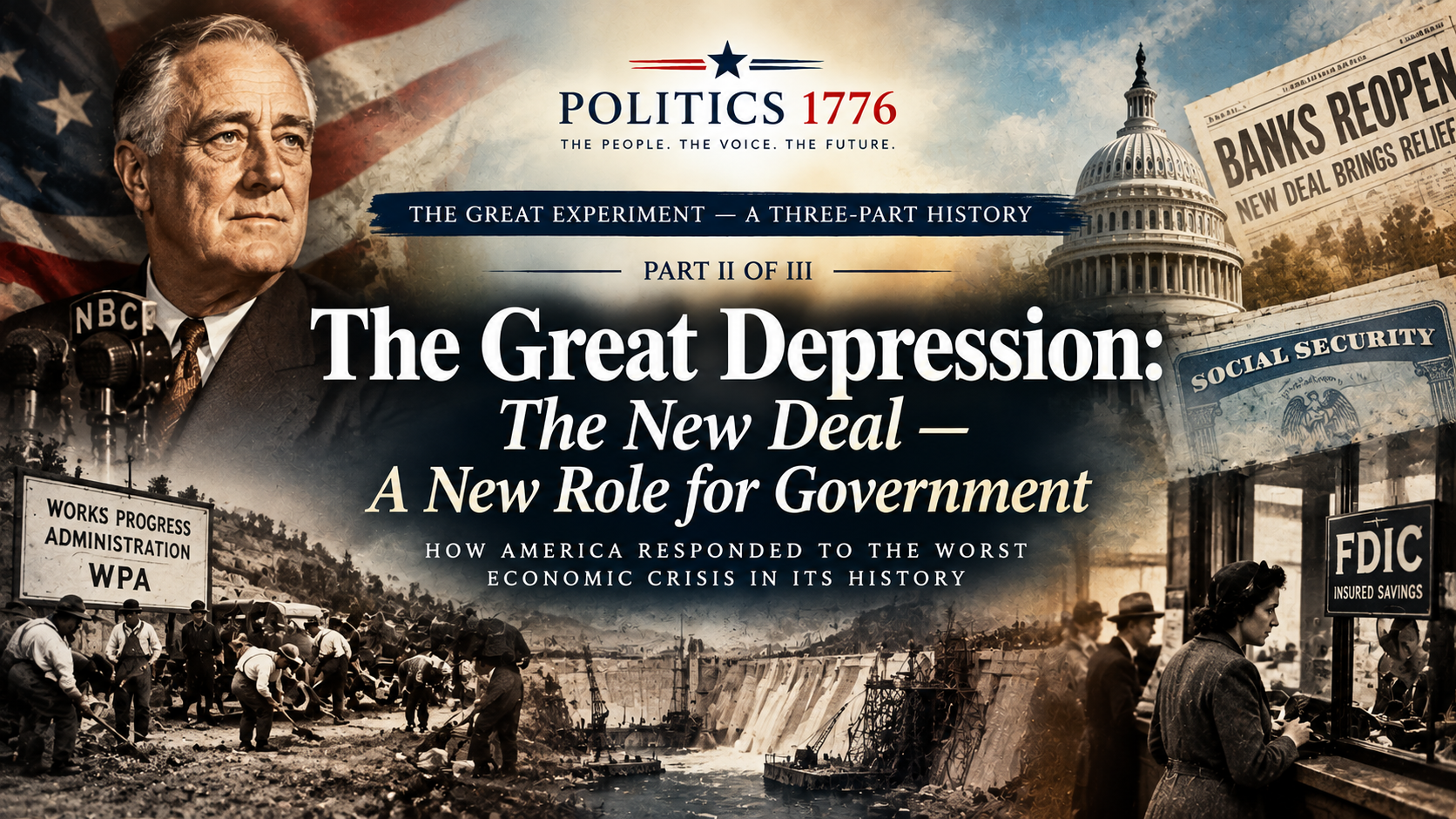
THE GREAT EXPERIMENT — A THREE-PART HISTORY
PART II OF III The Great Depression: The New Deal — A New Role for Government
How America Responded to the Worst Economic Crisis in Its History
Part I asked how America got there.
The stock market had crashed. Banks had failed. Businesses had closed. Farmers were struggling. Prices were falling. Millions of Americans were unemployed.
By early 1933, the crisis had reached a point where the normal machinery of government was being tested in ways the country had never experienced.
Now came the next question:
What should the government do?
The answer would transform the United States.
A Country in Crisis
When Franklin D. Roosevelt took office on March 4, 1933, the country was still deep in the Great Depression.
Approximately one-quarter of the American workforce was unemployed. Thousands of banks had failed. In the first two months of 1933 alone, more than 4,000 banks failed or suspended operations. Fear of losing savings caused people to withdraw their money, which put even more pressure on banks.
The banking system had reached a breaking point.
Roosevelt's administration immediately confronted the emergency.
On March 6, the president declared a nationwide bank holiday, temporarily closing the nation's banks.
Congress then moved rapidly.
The Emergency Banking Act was passed on March 9, only days after Roosevelt took office. The legislation gave the federal government additional authority to examine banks and determine which institutions were sound enough to reopen. The goal was straightforward:
Stop the panic and restore confidence in the banking system.
It is important to remember that this was not simply one president acting alone.
Congress passed the legislation.
Federal officials helped develop the plan.
And the emergency banking legislation drew on work that had begun before Roosevelt's inauguration, including work by Treasury officials during the Hoover administration.
That distinction matters.
History is rarely as simple as one person arriving with all the answers.
The First 100 Days
Roosevelt's first months in office became known as the Hundred Days.
Congress passed a remarkable amount of legislation in a very short period.
The programs did not all have the same purpose.
Some were designed to provide immediate relief.
Some were intended to promote economic recovery.
Others attempted to create permanent reforms that would change how the American economy operated.
Those three ideas—relief, recovery, and reform—became the basic framework of the New Deal.
The federal government was no longer simply responding to an emergency.
It was beginning to take on responsibilities that would permanently expand its role in American economic and social life.
Putting People to Work
One of the most visible problems of the Depression was unemployment.
Millions of Americans wanted to work but could not find jobs.
One response was the Civilian Conservation Corps, or CCC.
The program put young men to work on projects involving forests, parks, soil conservation, roads, and other public lands.
By the time the CCC ended in 1941, approximately two million people had participated.
The idea was simple:
Instead of simply giving unemployed people money, the government could pay people to perform useful work.
The program became one of the most recognizable symbols of the New Deal.
It also demonstrated something important about the changing relationship between citizens and Washington.
The federal government was increasingly becoming an employer, investor, builder, regulator, and provider of assistance.
That was a major change.
The Government Builds
Another major part of the New Deal involved public works.
Roads.
Bridges.
Schools.
Public buildings.
Dams.
Parks.
Utilities.
The Public Works Administration and later the Works Progress Administration, or WPA, became major parts of this effort.
The WPA eventually employed approximately 8.5 million Americans over its seven-year existence. Its projects included infrastructure as well as cultural programs involving writers, artists, musicians, and theater workers.
The question was not simply:
How do we help people survive?
It was also:
How do we put people back to work while building something useful for the country?
That distinction became an important part of the New Deal philosophy.
Helping the Farmer
The Depression was especially severe in rural America.
Farmers had already been struggling before the stock market crash. Agricultural prices had fallen sharply after World War I, leaving many farmers with debt and excess production.
The federal government responded with programs designed to raise farm prices and reduce agricultural surpluses.
The Agricultural Adjustment Administration, or AAA, attempted to accomplish this by paying farmers to reduce production.
It was an unusual approach.
The government was attempting to influence the supply of agricultural products in order to raise prices.
The program became controversial, and in 1936 the Supreme Court ruled the original Agricultural Adjustment Act unconstitutional.
The episode illustrated a recurring problem during the New Deal:
When government acts during an emergency, how far can it go?
And who gets to decide where that line is?
Regulating the Financial System
The Depression had also exposed serious weaknesses in America's financial system.
The federal government responded with major banking and financial reforms.
The Banking Act of 1933 created the Federal Deposit Insurance Corporation, or FDIC.
The purpose was to protect depositors when insured banks failed.
That changed the relationship between ordinary Americans and the banking system.
Before federal deposit insurance, a bank failure could mean losing a person's savings.
With federal deposit insurance, eligible depositors received protection up to the applicable insured limit.
The New Deal also created the framework for federal securities regulation.
The Securities Act of 1933 and Securities Exchange Act of 1934 were followed by creation of the Securities and Exchange Commission, or SEC, in 1934. The objective was to restore confidence in capital markets and establish rules governing securities markets and disclosure.
These institutions were not temporary responses that disappeared when the Depression ended.
They became permanent parts of the American financial system.
The Government and the Workplace
The New Deal also changed the relationship between workers, employers, and the federal government.
The National Labor Relations Act of 1935, commonly called the Wagner Act, strengthened workers' ability to organize and bargain collectively and established the National Labor Relations Board.
The law represented a significant expansion of federal involvement in labor relations.
Again, the larger historical question was bigger than any individual law:
How much should the federal government regulate the relationship between workers and employers?
That question would remain part of American political and economic debate long after the Depression ended.
Social Security Changes the Federal Role
Perhaps no New Deal program would become more important to the long-term relationship between Americans and the federal government than the Social Security Act of 1935.
Before the 1930s, support for elderly Americans was primarily handled by families, local communities, and state governments, with certain federal programs for veterans.
The Depression changed the political environment.
Millions of Americans had experienced unemployment, poverty, and financial insecurity.
Congress eventually passed the Social Security Act, which Roosevelt signed on August 14, 1935. The law established a federal old-age insurance system along with other forms of assistance.
This was a major turning point.
The federal government was no longer simply dealing with an immediate economic emergency.
It was creating a permanent system designed to provide economic security to Americans in certain circumstances.
The idea of what citizens could expect from their national government was changing.
But the New Deal Was Not One Giant Success—or One Giant Failure
This is where history becomes especially important.
It is tempting to look backward and divide the New Deal into two simple camps.
One side says:
The New Deal saved America.
The other says:
The New Deal failed and only World War II ended the Depression.
Neither statement captures the full historical debate.
New Deal programs clearly provided relief to millions of Americans and created institutions that became permanent parts of the federal government.
Economic conditions also improved substantially from the worst years of the Depression.
But unemployment remained high for much of the 1930s, and the economy experienced another serious downturn in 1937–38.
Historians continue to debate how much of the recovery should be attributed to New Deal policies and how much resulted from other factors, particularly the enormous increase in industrial production associated with World War II.
That distinction is important.
Helping people survive a depression is not exactly the same thing as permanently ending a depression.
Those are two different questions.
The Supreme Court Pushes Back
The New Deal also created a constitutional conflict.
Several New Deal programs expanded federal authority into areas that had traditionally been left more heavily to states, private businesses, or local institutions.
The Supreme Court challenged some of these programs.
In 1935, the Court struck down the National Industrial Recovery Act.
In 1936, it struck down the original Agricultural Adjustment Act.
These decisions raised a fundamental question about the American system:
Even during an emergency, are there limits to what the federal government can do?
That question goes directly to the structure created by the Constitution.
Congress makes laws.
The president executes them.
The courts interpret the Constitution and federal law.
The branches are supposed to check one another.
The Depression tested those principles under extraordinary pressure.
The Court-Packing Fight
In 1937, Roosevelt proposed legislation that would have allowed him to appoint additional Supreme Court justices when sitting justices reached a certain age and did not retire.
The proposal became known as the court-packing plan.
Supporters argued that the Court needed reform.
Opponents argued that the proposal threatened judicial independence and the separation of powers.
The proposal generated substantial opposition and ultimately failed.
Meanwhile, the Supreme Court upheld major New Deal legislation, including the National Labor Relations Act and Social Security Act.
The episode remains one of the clearest examples of the constitutional tension created when an elected government believes its policies are necessary but the judiciary places limits on those policies.
The lesson is bigger than Roosevelt.
It is bigger than the New Deal.
It demonstrates why the American system was designed with multiple branches of government.
Power was never supposed to belong entirely to one person.
The Recession Within the Depression
Then came another warning.
In 1937, the American economy entered another significant downturn.
Industrial production fell.
Unemployment rose.
Economic recovery stalled.
The recession of 1937–38 demonstrated that recovery from a depression was not a straight line upward.
The episode also generated another round of debate over government spending, taxation, monetary policy, and the proper pace of economic recovery.
Once again, there was no single answer accepted by everyone.
What the New Deal Changed
By the end of the 1930s, America was a different country.
The federal government had assumed responsibilities it had never exercised on such a scale before.
The country now had major federal institutions involved in:
banking stability
deposit insurance
securities regulation
agricultural policy
labor relations
unemployment relief
public works
housing finance
retirement security
economic assistance
Many of those institutions survived long after the Depression.
The New Deal therefore cannot be understood simply as a collection of temporary programs.
It changed what Americans expected the federal government to do.
That may be its most important historical legacy.
The Great Experiment Was Tested Again
The Founders created a government based on a difficult idea:
Government gets its authority from the people, but government itself must also be limited by law.
The Great Depression created an extraordinary challenge to that principle.
Millions of Americans were suffering.
Banks were collapsing.
Businesses were failing.
Families were losing homes and farms.
People needed help.
The federal government responded.
But every expansion of government power raised another question:
Where are the limits?
How much authority should Washington have during an emergency?
How much responsibility belongs to states and local communities?
How much should government regulate private business?
How much assistance should government provide?
What happens when government programs become permanent?
How do we make sure emergency powers do not become unlimited powers?
And perhaps most importantly:
How do we protect both economic security and individual liberty?
The New Deal did not answer those questions once and for all.
It created a new chapter in the debate.
WHAT CAN WE LEARN FROM PART II?
The history of the New Deal offers several lessons.
1. Crisis changes government.
When a nation experiences an extraordinary crisis, citizens often become willing to accept government actions that would have seemed impossible during normal times.
2. Emergency programs can become permanent institutions.
Some New Deal programs were created in response to an immediate crisis.
Others became lasting parts of American government.
3. Government action can have both intended and unintended consequences.
Programs can provide real assistance while also creating costs, incentives, administrative burdens, or conflicts that deserve examination.
4. The Constitution still matters during emergencies.
A crisis does not automatically eliminate separation of powers.
The Depression demonstrated that Congress, the president, and the courts could disagree—even when the country was facing severe hardship.
5. Economic recovery is complicated.
It is difficult to attribute an enormous economic transformation to one law, one president, or one program.
The Great Depression involved banking, monetary policy, agriculture, international finance, trade, production, employment, and eventually war.
6. Institutions can outlive the crisis that created them.
The Depression ended, but many institutions created during the New Deal remained.
That means decisions made during emergencies can shape a country for generations.
THE QUESTION AMERICA STILL HAD TO ANSWER
The Great Depression began as an economic catastrophe.
The New Deal transformed it into something larger:
a debate about the proper role of the federal government in American life.
The question was no longer simply:
How do we get through this crisis?
It became:
What should government be responsible for after the crisis is over?
That question would continue long after Roosevelt left office.
And then history delivered another answer.
The United States entered World War II.
Factories transformed.
Industrial production exploded.
Millions of Americans entered military service.
Millions more went to work producing the equipment, weapons, vehicles, ships, aircraft, and supplies needed for the war.
The American economy changed again.
And by the time the war ended, the economic world of the Great Depression had largely disappeared.
But the government created during the Depression did not disappear with it.
That is where Part III begins.
PART III — THE LEGACY
What the Great Depression Changed—and What America Can Learn
What ended the Great Depression?
What role did World War II play?
Which New Deal institutions became permanent?
What did Americans come to expect from Washington?
And what can the Great Depression teach a modern America about economic crisis, government power, individual liberty, institutional responsibility, and the dangers of believing that complicated problems always have simple answers?
History does not give us a perfect formula.
But it gives us something more valuable:
experience.
And the Great Experiment continued.
The People. The Voice. The Future.