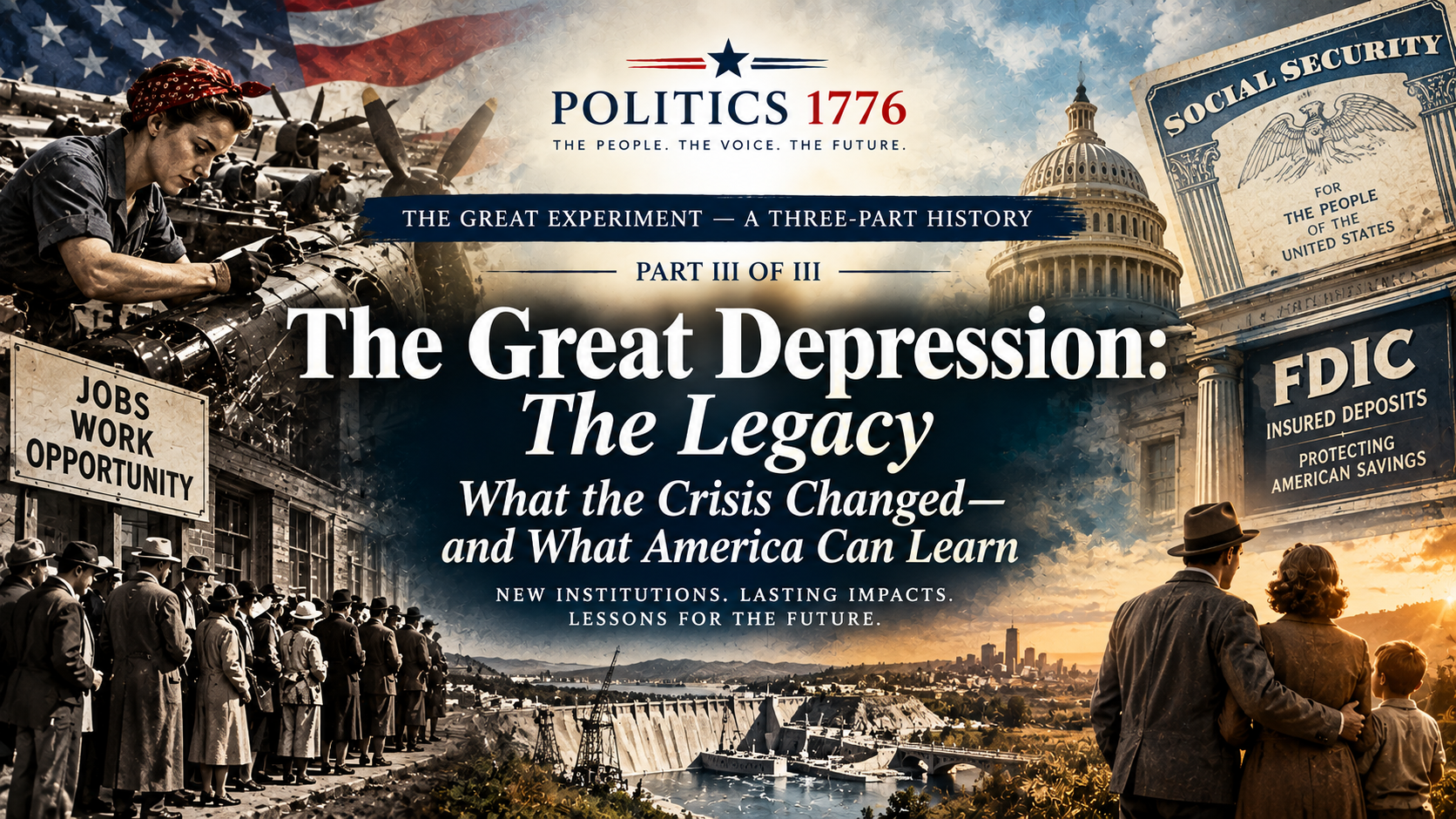
THE GREAT EXPERIMENT — A THREE-PART HISTORY PART III OF III
The Great Depression: The Legacy
What the Crisis Changed—and What America Can Learn
Part I was about the crisis.
America entered the Great Depression through a combination of financial instability, banking failures, deflation, collapsing production, agricultural problems, and international economic pressures.
Part II was about the response.
The New Deal brought an unprecedented expansion of federal activity into banking, employment, agriculture, labor, financial markets, infrastructure, and economic security.
But there was still one enormous question:
How did the Great Depression finally end?
And perhaps an even more important question:
What did America become because of it?
The Depression Did Not End Overnight
The Great Depression is generally dated from 1929 to 1941.
The economy began recovering from its 1933 low point, but the recovery was uneven.
There was even another major recession in 1937–38.
Real GDP fell about 10 percent during that recession, and unemployment reached roughly 20 percent. The recovery ultimately continued into the enormous economic mobilization associated with World War II.
That matters because it challenges one of the easiest stories to tell about the Depression.
There was no single moment when America passed one law and suddenly everything was fixed.
The recovery took years.
It involved monetary policy.
Banking reform.
Private investment.
Government spending.
Industrial production.
Agricultural conditions.
International events.
And eventually something much larger than an economic recovery:
a world war.
Then America Went to War
In September 1939, war broke out in Europe.
The United States initially remained outside the conflict, but American factories increasingly supplied the Allied powers.
Then, on December 7, 1941, Japan attacked Pearl Harbor.
The United States entered World War II.
The effect on the American economy was enormous.
Factories that had been producing consumer goods were converted to wartime production.
Aircraft.
Ships.
Tanks.
Trucks.
Weapons.
Ammunition.
Uniforms.
Food.
Industrial production expanded dramatically.
Millions of Americans entered military service, while millions more entered defense-related jobs.
The Federal Reserve also played an important role in financing and stabilizing the wartime economy.
The result was a dramatic reduction in unemployment and a massive expansion of production.
The Federal Reserve's historical account places the return to full output and employment during World War II.
That creates an important historical distinction:
The New Deal helped reshape the economy and federal government during the 1930s, but the enormous wartime mobilization was a major part of the process that finally brought the United States to full employment.
History does not require us to pretend that only one explanation exists.
Did the New Deal End the Depression?
This is one of the most debated questions in American economic history.
The safest historical answer is:
The New Deal changed America and contributed to recovery, but the Depression was not completely eliminated during the 1930s.
Economic activity improved substantially after 1933.
Banking conditions stabilized.
Financial regulation changed.
Millions of Americans received assistance or employment through federal programs.
New institutions were created.
But unemployment remained high, and the economy suffered another major contraction in 1937–38.
Full employment came with wartime mobilization.
That does not make the New Deal irrelevant.
It makes the history more complicated.
The New Deal was not simply a switch that turned the Depression off.
It was a collection of programs and institutional changes operating alongside monetary, financial, domestic, and international developments.
That distinction is important whenever we study major economic events.
The Institutions Remained
The Depression eventually ended.
But many of the institutions created during the crisis remained.
That may be the most important part of the story.
The federal government had entered the 1930s with a much smaller role in many areas of economic and social life.
It emerged with a much larger one.
The Federal Deposit Insurance Corporation helped establish a permanent federal system for protecting eligible bank deposits.
The Securities and Exchange Commission became a permanent federal regulator of securities markets.
The Social Security system established federal old-age benefits and other programs.
Federal labor law changed.
Agricultural policy changed.
Banking regulation changed.
Public works and federal infrastructure programs demonstrated a new scale of federal involvement.
The Federal Reserve itself was reorganized and its role in the financial system changed through legislation passed during the 1930s.
The crisis was temporary.
The institutional changes were not.
Social Security and the New Definition of Security
Few changes illustrate this better than Social Security.
Before the 1930s, support for elderly Americans was primarily a matter for families, communities, and state governments, apart from federal veterans' programs.
The Depression changed the political environment.
The Social Security Act was signed into law in August 1935.
It established a federal old-age benefits system and also included unemployment compensation and assistance programs for several groups.
The significance was larger than the individual program.
The federal government was now taking permanent responsibility for a form of economic security that had previously been handled primarily outside Washington.
That changed the relationship between citizens and the federal government.
Americans could now look to Washington for forms of economic protection that had previously been considered primarily local, state, familial, or private responsibilities.
That expectation would become part of American political life for generations.
Banking Would Never Be Quite the Same
The same thing happened with banking.
Before the Depression, a bank failure could destroy an ordinary family's savings.
The creation of federal deposit insurance changed that risk for insured deposits.
The banking reforms of the 1930s also altered the structure and supervision of the financial system.
The Federal Reserve itself emerged from the decade with a different institutional structure and responsibilities.
The lesson was clear:
Financial stability is not something a modern industrial economy can simply take for granted.
Banks are connected.
Credit is connected.
Businesses are connected.
Consumers are connected.
When confidence disappears, problems can spread quickly.
The Depression demonstrated just how quickly.
The Federal Government Became Bigger
There is another part of the legacy that cannot be ignored.
The New Deal expanded the federal government.
More agencies.
More programs.
More regulations.
More federal employees.
More federal spending.
More federal responsibility.
The National Archives describes the New Deal as a transformation in the role of the federal government.
This was not an accidental consequence.
The Roosevelt administration and Congress deliberately created a more active federal government.
Supporters believed the scale of the crisis required it.
Critics argued that the expansion threatened economic freedom, private enterprise, constitutional limits, or the traditional balance between Washington and the states.
Those disagreements were real.
And they did not disappear when the Depression ended.
A New Question: What Does Government Owe Its Citizens?
The Depression changed expectations.
Before the crisis, Americans generally had a different understanding of what Washington was expected to do during economic hardship.
After the crisis, expectations were different.
Citizens increasingly expected the federal government to play a role in:
economic stability
unemployment
retirement
banking security
labor relations
agriculture
financial markets
public infrastructure
That does not mean Americans suddenly agreed about the proper size of government.
They did not.
The debate simply moved.
Instead of asking whether Washington should have any role in these areas, Americans increasingly debated:
How large should that role be?
What should government control?
What should remain private?
What belongs to the states?
What should citizens be responsible for themselves?
Those questions became permanent parts of American political and economic life.
The Depression Also Changed Economic Thinking
The experience of the 1930s influenced economists and policymakers around the world.
The combination of massive unemployment, collapsing demand, banking failures, deflation, and eventual wartime full employment changed how many people thought about economic policy.
The experience contributed to the growth of Keynesian economic thinking, particularly the idea that government fiscal and monetary policy could play an important role in stabilizing economic activity.
The contrast between high unemployment during the Depression and extremely low unemployment during World War II was especially influential in the development of postwar economic thinking.
But economic thinking did not stop evolving.
It never does.
Economists continued to disagree about monetary policy, fiscal policy, inflation, regulation, taxation, deficits, trade, and the proper role of government.
The Depression became a case study.
Not a final answer.
What About the Federal Reserve?
The Great Depression also permanently changed how Americans understood central banking.
The Federal Reserve had been created in 1913.
One of its central purposes was to promote stability in the banking system.
But during the Depression, the financial system experienced a catastrophic series of banking panics.
The money supply fell dramatically.
The Federal Reserve's response became one of the most heavily studied episodes in economic history.
Later reforms changed the Federal Reserve and the broader financial system.
The experience became a lesson in what can happen when a central bank fails to prevent financial collapse from spreading through the economy.
The lesson was not simply:
Government failed.
Nor was it:
Government solved everything.
The more useful lesson is:
Institutions matter, and institutional design matters.
Rules matter.
Authority matters.
Leadership matters.
And when financial systems are interconnected, mistakes can become enormous.
Government Can Help—and Government Can Get It Wrong
This may be one of the most important lessons of the entire series.
The New Deal produced programs that helped millions of Americans.
It also produced programs that were controversial.
Some were struck down by the Supreme Court.
Some were later abandoned.
Some were modified.
Some survived for generations.
That tells us something important about government.
Government is not a machine that automatically produces perfect answers.
It is made up of people.
People make decisions with incomplete information.
They respond to political pressure.
They make mistakes.
They correct mistakes.
They sometimes create unintended consequences.
And sometimes a policy created for one emergency continues long after the emergency has passed.
That is why accountability matters.
Emergency Power Deserves Attention
The Great Depression also demonstrates why emergency government action deserves careful scrutiny.
When people are desperate, government can gain extraordinary authority.
Sometimes that authority may be necessary.
Sometimes it may produce important benefits.
But extraordinary powers can also change institutions permanently.
The Depression showed both sides of that reality.
The federal government acted on a scale previously unseen in American economic life.
Some of those actions became permanent.
Others disappeared.
The constitutional system remained important throughout the process because Congress, the president, and the courts did not always agree.
The lesson is not that government should never act.
It is not that government should always act.
The historical lesson is more basic:
When government takes on new power, citizens should understand what that power is, why it exists, who controls it, and whether it remains necessary after the crisis has passed.
The People Matter, Too
It is easy to tell the Great Depression as a story about presidents, Congress, economists, banks, and government agencies.
But millions of ordinary Americans lived through it.
They lost jobs.
They lost farms.
They lost homes.
They stood in breadlines.
They moved across the country searching for work.
They planted crops in difficult conditions.
They built roads and dams.
They worked in factories.
They served in the military.
They adapted.
They endured.
And eventually, they helped build the enormous industrial economy that emerged from World War II.
The Depression was not just a story about Washington.
It was a story about the American people.
The Great Experiment Was Never Supposed to Be Easy
The American experiment was built around a difficult proposition:
Can free people govern themselves?
The Great Depression did not make that question disappear.
It made the question harder.
What happens when markets fail?
What happens when banks collapse?
What happens when millions of people cannot find work?
What happens when private charity and local government cannot meet the scale of a national disaster?
What happens when Washington intervenes?
What happens when Washington becomes responsible for something it was never responsible for before?
And what happens when the crisis ends?
Those questions were not answered permanently in the 1930s.
They became part of the continuing American debate.
WHAT CAN WE LEARN FROM THE GREAT DEPRESSION?
After three parts, the lessons are not one political slogan.
They are a collection of historical observations.
1. Economic crises rarely have one cause.
The Depression involved financial markets, banking failures, monetary policy, agriculture, international finance, deflation, production, and employment.
Simple explanations can hide important facts.
2. Financial stability matters.
Bank failures and collapsing credit can turn economic weakness into a much deeper crisis.
3. Institutions matter.
The Federal Reserve, Treasury, Congress, banks, courts, and new federal agencies all played roles.
The structure of those institutions affected the outcome.
4. Government decisions have consequences.
Policies can produce intended results.
They can also create unintended effects.
5. Emergency programs can become permanent.
The crisis ended.
Many of the institutions created during it did not.
6. Economic recovery can take years.
Even after the worst point passes, unemployment, investment, debt, and confidence can take a long time to recover.
7. Recovery and full employment are not necessarily the same thing.
The economy improved significantly during the 1930s, but full employment came with the extraordinary mobilization of World War II.
8. Constitutional limits still matter during emergencies.
A crisis does not eliminate the separation of powers.
9. Government can be necessary without being infallible.
The historical record does not require us to believe that every government action was correct—or that every government action was wrong.
10. Citizens should understand the systems they depend on.
Banking.
Money.
Taxes.
Government spending.
Regulation.
Social insurance.
Markets.
The Constitution.
These systems affect ordinary Americans every day.
Understanding them is part of being an informed citizen.
THE GREAT EXPERIMENT CONTINUES
The Great Depression is now history.
But its consequences are still around us.
The Social Security system exists.
The FDIC exists.
The SEC exists.
The Federal Reserve operates under a structure shaped in part by the lessons of the Depression.
Federal economic policy is far more expansive than it was before 1929.
And Americans continue to debate where the proper boundaries of government should be.
That is not a failure of history.
That is democracy.
The Founders did not create a government that would never face a crisis.
They created a constitutional system designed to adapt while preserving fundamental structures of representative government.
The Great Depression tested those structures.
World War II tested them again.
Every generation faces its own tests.
THE LESSON IS NOT TO FEAR HISTORY
It is to learn from it.
The Great Depression teaches us that economies can break.
It teaches us that financial institutions can fail.
It teaches us that government can respond.
It teaches us that government responses can reshape a country.
It teaches us that emergency decisions can become permanent.
And it teaches us that recovery can come from a combination of forces rather than a single program, president, or political philosophy.
Most importantly, it reminds us that history is rarely as simple as:
good guys versus bad guys.
The people living through the Depression did not have the benefit of knowing how the story would end.
They had to make decisions with the information they had.
So do we.
That is why studying history matters.
Not because history gives us a perfect answer.
But because history gives us experience.
THE GREAT EXPERIMENT
America has experienced wars.
Recessions.
Depressions.
Political divisions.
Technological revolutions.
Financial crises.
Social change.
Government expansion.
Government reform.
Through all of it, one thing has remained:
the American people.
The Great Depression changed the United States.
It changed government.
It changed economic policy.
It changed expectations.
It changed institutions.
But it did not end the American experiment.
It became part of it.
And perhaps that is the greatest lesson of all:
A free country does not prove itself by never facing a crisis.
It proves itself by how its people, institutions, and laws respond when the crisis comes.
Learn the history.
Question the easy answers.
Understand the institutions.
Know what your government can do—and what it cannot.
Know your rights.
Know your responsibilities.
And never forget that in a constitutional republic, government ultimately exists under the authority of the people.
The People. The Voice. The Future.
THE GREAT EXPERIMENT CONTINUES.
HOW THE GREAT DEPRESSION SHAPED THE UNITED STATES WE KNOW TODAY
The Great Depression ended more than eighty years ago.
But in many ways, we still live in the America it helped create.
The crisis of the 1930s did more than devastate the economy. It changed the relationship between Americans, businesses, financial institutions, and the federal government.
Some of those changes were temporary.
Others became part of everyday American life.
Social Security
One of the most lasting changes was the creation of Social Security in 1935.
Before the Great Depression, providing for elderly Americans was primarily considered a family, local, or state responsibility rather than a federal one.
The Depression changed that.
The Social Security Act created a federal old-age insurance system and established other forms of economic assistance.
Today, Social Security remains one of the largest and most familiar federal programs in the country.
Whatever one's opinion about the program itself, its existence represents a fundamental change in what Americans came to expect from their national government.
Banking Changed Forever
The Depression also changed how Americans interact with banks.
Thousands of banks failed during the crisis, and many Americans lost their savings.
The creation of the Federal Deposit Insurance Corporation, or FDIC, established federal protection for insured bank deposits.
The basic idea was simple:
If an insured bank fails, eligible depositors should not automatically lose their savings.
The FDIC became a permanent institution of the American financial system.
Today, most Americans probably think very little about the possibility of a bank failure when they deposit a paycheck.
That confidence is itself part of the Depression's legacy.
Financial Markets Became More Regulated
The stock market crash also changed the rules governing American securities markets.
Congress passed the Securities Act of 1933 and the Securities Exchange Act of 1934.
The Securities and Exchange Commission, or SEC, was created in 1934 to oversee securities markets and help establish rules for disclosure and fair dealing.
Before the Depression, the federal government played a much smaller role in regulating financial markets.
Afterward, federal oversight became a permanent part of the system.
Washington Became More Involved
Perhaps the biggest change was not one particular program.
It was the scale of federal responsibility.
The New Deal created federal programs and agencies involved in employment, agriculture, banking, financial markets, labor, housing, infrastructure, and economic assistance.
The Library of Congress describes the New Deal as establishing a precedent for the federal government to play a larger role in the nation's economic and social affairs.
That changed the basic expectations surrounding Washington.
Americans increasingly looked to the federal government not simply to protect the country and administer federal law, but also to respond to major economic problems.
That expectation remains part of American government today.
But the Impact Was Not One-Dimensional
It is important not to turn this history into a simple story of either success or failure.
The New Deal provided relief to millions of Americans and created institutions that remain important today.
At the same time, not every program worked as intended.
Some programs were controversial.
Some were struck down by the courts.
Some disappeared.
And the Great Depression itself was not completely eliminated during the 1930s.
Economic recovery continued unevenly, and the enormous industrial mobilization of World War II played a major role in bringing unemployment down and restoring full economic production. Historians continue to debate the relative importance of the New Deal and wartime mobilization in the recovery.
That is why history deserves more than a political slogan.
WHAT CHANGED?
The Great Depression changed America in several lasting ways:
Government became more involved in the economy.
Financial institutions became more heavily regulated.
Bank deposits received federal protection.
Social Security became part of American life.
Federal responsibility for economic security expanded.
Workers gained new federal protections and rights.
Public works and federal infrastructure became larger parts of national policy.
And perhaps most importantly:
Americans developed a different understanding of what their federal government could and should do during an economic crisis.
THE LASTING LESSON
The Great Depression does not give us a simple political answer.
It gives us a historical example.
It shows what can happen when financial systems collapse.
It shows how quickly economic problems can spread.
It shows that government intervention can fundamentally change a nation's institutions.
And it shows that decisions made during a crisis can remain long after the crisis itself has disappeared.
That is perhaps the most important lesson.
Temporary crises can create permanent changes.
The America of 2026 is not the America of 1929.
But some of the institutions Americans interact with every day were born from the decisions made during that crisis.
The FDIC.
The SEC.
Social Security.
A much larger federal role in economic affairs.
These are not simply chapters in a history book.
They are part of the United States we live in today.
And that is why the Great Depression still matters.
Not because it tells us exactly what government should do today.
But because it reminds us to understand what government did yesterday, why it did it, what changed because of it, and what those changes mean for the country we inherited.
The Great Experiment continues.
The People. The Voice. The Future.
The Great Experiment Continues
As America struggled through the final years of the Great Depression, events overseas were changing the course of world history. Economic instability, expanding military aggression, and the rise of dictatorships were bringing nations closer to another global conflict.
Our journey continues with The Great Experiment — World War II, Part I: The Road to War, where we explore how the world entered another devastating war and how the United States eventually became involved.