A NOTE OF GRATITUDE
Before we tell this story, there is something that should be said first.
Thank you.
Thank you to the men and women who put on a uniform and went to war.
To the soldiers who crossed oceans and walked into battle.
To the sailors who served aboard ships and faced the dangers of the sea.
To the Marines who fought from island to island.
To the airmen who climbed into aircraft and flew into skies filled with danger.
To the nurses, medics, doctors, mechanics, engineers, and countless others who served alongside them.
And to the families who stayed home.
The mothers and fathers who waited.
The wives and husbands who carried on.
The children who grew up with an empty chair at the table.
The families who received a telegram that changed their lives forever.
And to the millions of Americans who never wore a uniform but still served their country every day—working in factories, farms, shipyards, offices, hospitals, and communities across America.
Some came home.
Some came home carrying wounds that could not always be seen.
And some never came home at all.
Many of the generation that fought World War II have now passed away.
Their voices are quieter.
Their photographs have begun to fade.
Their stories are sometimes known only by their children, grandchildren, or great-grandchildren.
But they should never be forgotten.
We cannot go back and thank them ourselves.
So we can do the next best thing.
We can remember.
We can learn what they faced.
We can tell their stories honestly.
We can remember both their courage and the sacrifices made by those who served on the home front.
And we can remember that behind every number in a history book was a real person—a son, a daughter, a husband, a wife, a father, a mother, a brother, a sister, a friend.
World War II was fought by nations.
But it was lived by people.
This story is dedicated to them.
To those who served.
To those who sacrificed.
To those who waited.
To those who never returned.
And to the families who carried their memory forward.
Thank you.
We remember.
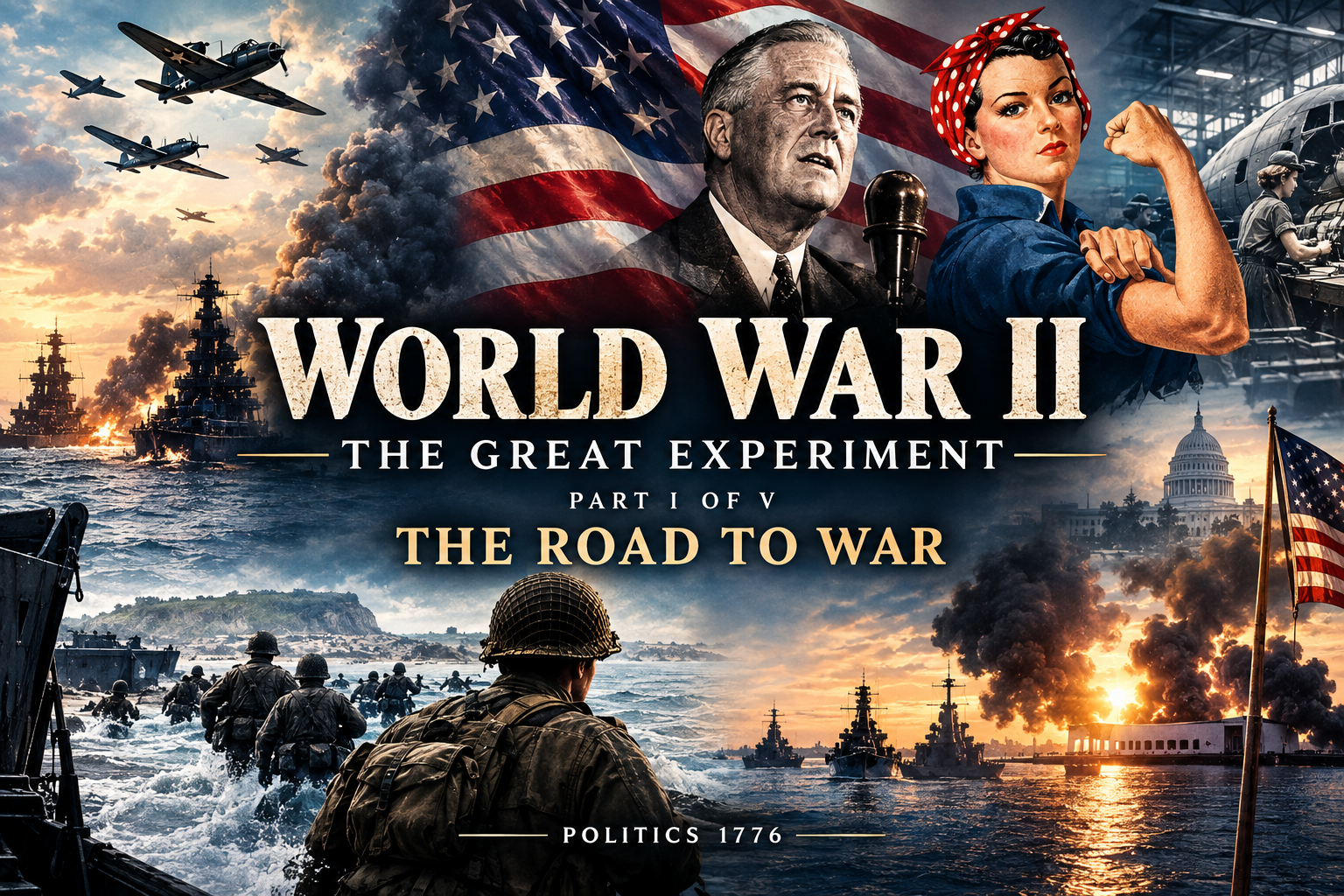
THE GREAT EXPERIMENT
WORLD WAR II
PART I OF V
THE ROAD TO WAR
How America Went From Watching the World at War to Fighting It
There are moments in history when the future seems to change in a single day.
December 7, 1941 was one of them.
Before that day, the United States was already deeply connected to a world at war.
American factories were producing materials.
American ships were crossing oceans.
American leaders were debating how much the United States should become involved.
Americans themselves were divided over what the country should do.
But the United States was not formally at war.
Then came Pearl Harbor.
In less than two hours, the question changed.
America was no longer asking whether the war might reach the United States.
America was in the war.
But Pearl Harbor was not the beginning of the story.
To understand why America entered World War II, we have to go back.
A WORLD THAT HAD NOT HEALED
World War II did not appear out of nowhere.
It grew out of the instability left behind by World War I, economic crisis, political extremism, territorial expansion, and the collapse of international efforts to prevent another major war.
Germany had been defeated in World War I.
The Treaty of Versailles imposed territorial losses, military restrictions, and financial obligations on Germany.
The German economy and political system then experienced enormous instability.
The worldwide Great Depression beginning in 1929 made conditions even worse.
In Germany, Adolf Hitler and the Nazi Party gained political power by promising national revival, overturning the postwar settlement, and blaming various groups for Germany's problems.
Hitler became chancellor in January 1933.
Within a short time, Germany's democratic system had been dismantled.
The Nazi government became a dictatorship.
Germany began rearming.
It withdrew from restrictions imposed after World War I.
And Hitler began pursuing territorial expansion.
The world watched.
JAPAN LOOKS OUTWARD
The crisis was not limited to Europe.
Japan had developed into a major industrial and military power.
Japanese leaders pursued expansion across East Asia and the Pacific.
Japan invaded Manchuria in 1931.
In 1937, full-scale war broke out between Japan and China.
Japanese forces captured large areas of Chinese territory.
The conflict became increasingly brutal.
Japan also sought access to resources in Southeast Asia and the Pacific.
That expansion eventually brought Japan into direct conflict with the United States.
America's relationship with Japan deteriorated steadily.
The United States imposed economic restrictions and eventually an oil embargo.
Japan faced a strategic problem.
Its military depended heavily on imported resources.
Its leaders could either back away from expansion or attempt to secure access to resources by force.
They chose the latter.
The Pacific was moving toward war.
AMERICA WATCHES
While Europe and Asia moved toward conflict, Americans debated what the United States should do.
The memory of World War I was still powerful.
More than 116,000 Americans had died in that war.
Many Americans believed the United States should avoid becoming entangled in another European conflict.
Isolationism was not simply indifference to the rest of the world.
It reflected a genuine argument about America's interests, the costs of foreign wars, and the proper role of the United States.
Congress passed a series of Neutrality Acts during the 1930s.
The goal was to keep America from being pulled into another foreign war.
But complete neutrality became increasingly difficult.
Germany invaded Poland on September 1, 1939.
Britain and France declared war on Germany.
World War II had begun in Europe.
America remained officially outside the conflict.
But the United States was watching.
And increasingly, America was helping the countries fighting Germany.
THE ARSENAL OF DEMOCRACY
President Franklin D. Roosevelt understood that the United States could not simply pretend the war did not exist.
In a December 1940 speech, Roosevelt described America as the “arsenal of democracy.”
The phrase captured a major change.
America could support countries fighting the Axis powers without immediately sending millions of American soldiers into combat.
The United States increasingly supplied Britain and other Allied nations with weapons, ammunition, aircraft, ships, food, and other materials.
The Lend-Lease Act of 1941 expanded this assistance.
America was not yet officially at war.
But American factories were beginning to prepare for one.
And this would become one of the defining characteristics of World War II.
The war would not be fought only by armies.
It would be fought by factories.
Shipyards.
Farmers.
Scientists.
Engineers.
Truck drivers.
Machinists.
Railroad workers.
Office workers.
Women entering industrial jobs.
Millions of ordinary Americans would eventually become part of the largest mobilization the country had ever attempted.
THE BATTLE FOR BRITAIN
In 1940, Britain stood largely alone in Western Europe against Nazi Germany.
France had fallen.
Germany controlled much of continental Europe.
Hitler prepared for a possible invasion of Britain.
But first, Germany needed control of the skies.
The resulting Battle of Britain became one of the first major air campaigns of the war.
German aircraft attacked British airfields, radar stations, military targets, and eventually cities.
British Fighter Command fought to prevent German air superiority.
Radar became increasingly important.
It gave British defenders warning of approaching aircraft and helped direct fighters toward incoming formations.
The battle demonstrated something that would define the rest of the war:
The sky had become a battlefield.
And it was about to become much larger.
THE WAR COMES TO THE NIGHT SKY
World War II introduced warfare on a scale previous generations had never experienced.
Aircraft could travel hundreds of miles.
Bombers could carry enormous loads.
And darkness did not necessarily protect a city.
Britain began conducting bombing operations against Germany.
The Royal Air Force increasingly used nighttime bombing because flying over heavily defended German territory during daylight was extraordinarily dangerous.
But night bombing created a different problem:
How do you find your target in the dark?
Early navigation technology was limited.
Clouds could obscure cities.
Smoke could hide targets.
Aircraft could drift off course.
Bombers could miss their intended objectives by miles.
The RAF Museum notes that early nighttime bombing was extremely inaccurate; one 1941 assessment found that only a small fraction of bombs were landing within five miles of their intended targets.
Technology began changing that.
Radio navigation.
Pathfinder aircraft.
Radar.
Electronic countermeasures.
Specialized bombing techniques.
Better aircraft.
Better intelligence.
The war in the air became a technological contest as much as a contest between pilots.
And eventually, the bombing campaigns became enormous.
Cities across Germany were attacked.
Industrial facilities, transportation networks, military targets, and residential areas were damaged or destroyed.
The strategy remains historically controversial.
It is important to understand both the military reasoning and the enormous civilian cost.
World War II had changed warfare.
The battlefield was no longer necessarily somewhere far away.
The battlefield could be above a city at midnight.
THE UNITED STATES MOVES CLOSER
By 1941, the United States was increasingly involved in the conflict even though American soldiers were not yet fighting a declared war against Germany or Japan.
American ships were transporting supplies.
American industry was producing weapons.
American military forces were preparing.
The Atlantic was becoming dangerous.
German submarines were attacking shipping.
And tensions with Japan were becoming increasingly severe.
Diplomatic negotiations continued.
But the relationship between Washington and Tokyo was deteriorating rapidly.
Japan was preparing for something much larger.
DECEMBER 7, 1941
It was Sunday morning in Hawaii.
Shortly before 8:00 a.m., Japanese aircraft attacked the American naval base at Pearl Harbor.
The attack came in waves.
Aircraft struck battleships, airfields, aircraft, and military facilities across Oahu.
The USS Arizona exploded and sank.
The USS Oklahoma capsized.
Other battleships were damaged.
Aircraft were destroyed on the ground.
American servicemen were killed while eating breakfast, working, sleeping, or preparing for an ordinary Sunday.
The attack lasted less than two hours.
More than 2,400 Americans were killed.
Thousands more were wounded.
The Pacific Fleet had suffered a devastating surprise attack.
But the attack did not destroy everything.
Several American aircraft carriers were not at Pearl Harbor that morning.
Submarine facilities and fuel storage were not destroyed in the way Japanese planners had hoped.
And most importantly, the United States was still capable of rebuilding.
The National Archives describes Pearl Harbor as one of the greatest military surprises in history and records more than 3,500 Americans killed or wounded.
The date would become permanently embedded in American memory.
“A DATE WHICH WILL LIVE IN INFAMY”
President Roosevelt received word of the attack that afternoon.
Reports were still incomplete.
The extent of the damage was still being determined.
But Roosevelt knew what had happened.
That evening, he dictated a short address to his secretary, Grace Tully.
His original wording began:
“a date which will live in world history.”
Then Roosevelt changed it.
He crossed out “world history.”
He wrote:
“infamy.”
The next day, December 8, 1941, Roosevelt addressed Congress.
His opening words became one of the most famous sentences in American history:
“Yesterday, December 7, 1941—a date which will live in infamy—the United States of America was suddenly and deliberately attacked by naval and air forces of the Empire of Japan.”
He did not deliver a long history lecture.
He did not attempt to explain every diplomatic disagreement.
He made the immediate case for war.
And then he gave the American people a promise:
“With confidence in our armed forces—with the unbounding determination of our people—we will gain the inevitable triumph—so help us God.”
Congress declared war on Japan.
The United States was officially in World War II.
The National Archives preserves Roosevelt's original drafts and records how he personally revised the famous opening from “world history” to “infamy.”
THE WAR BECOMES GLOBAL FOR AMERICA
Pearl Harbor brought America directly into the Pacific war.
But the consequences went beyond Japan.
On December 11, Germany and Italy declared war on the United States.
Congress responded with declarations of war against Germany and Italy.
The United States was now fighting on two enormous fronts.
Europe.
And the Pacific.
The country would eventually send millions of men and women into uniform.
American factories would produce ships, aircraft, tanks, trucks, weapons, ammunition, uniforms, food, and countless other supplies.
The scale would be difficult to comprehend.
But America had not yet demonstrated what it could produce.
That story was coming.
THE FIRST ANSWER: DOOLITTLE
Four months after Pearl Harbor, America struck back.
On April 18, 1942, sixteen B-25 bombers launched from the aircraft carrier USS Hornet.
The mission was commanded by Lieutenant Colonel James “Jimmy” Doolittle.
The target was Japan.
The B-25 was not normally an aircraft designed to operate from an aircraft carrier.
Yet the crews had trained for the mission.
They flew hundreds of miles toward Japan.
They bombed targets in Tokyo and other locations.
Then they attempted to reach China.
Most of the aircraft were eventually lost or crash-landed.
The raid caused limited physical damage compared with the enormous bombing campaigns that would come later.
But its psychological significance was enormous.
America had been attacked.
Now American bombers had reached the Japanese homeland.
The National Archives describes the raid as both retaliation for Pearl Harbor and a demonstration that American bombers could reach Japan.
The message was simple:
America was still here.
BUT THE WAR WOULD NOT BE WON IN ONE DAY
The Doolittle Raid did not end the war.
Pearl Harbor did not end the war.
One battle would not end it.
One general would not end it.
One weapon would not end it.
World War II would become a conflict of enormous scale.
It would be fought:
On land.
At sea.
In the air.
Underwater.
In factories.
In laboratories.
In code rooms.
On beaches.
In jungles.
Across deserts.
And in cities thousands of miles from the front.
American soldiers would fight in North Africa, Italy, France, Germany, the Pacific, and countless islands and battlefields.
American sailors would fight across two oceans.
American airmen would fly missions over Europe and Asia.
American workers would build the machines that carried them there.
And millions of families would wait at home.
THE TECHNOLOGY OF A DIFFERENT KIND OF WAR
World War II was also a technological turning point.
Radar helped detect aircraft.
Sonar helped locate submarines.
Aircraft carriers transformed naval warfare.
Long-range bombers could attack targets hundreds or thousands of miles away.
Penicillin became increasingly available to Allied forces.
New aircraft designs appeared.
Computers and calculating machines were developed for military purposes.
The proximity fuze made artillery shells more effective against aircraft and other targets.
And military communications became a science of their own.
One of the most remarkable examples came from Native American servicemen.
The U.S. Marine Corps recruited Navajo men to serve as Code Talkers.
They developed a communications system based on the Navajo language.
The original group consisted of 29 Navajo recruits.
The system was expanded during the war.
The National Archives records that more than 400 Navajo men eventually served as Code Talkers, while other Native American languages were also used in military communications.
Their work was kept secret for decades.
The story is remarkable for another reason.
The United States had a complicated history with Native peoples.
Yet during the war, Native Americans were serving in the armed forces and using their own languages as an important military resource.
History is full of contradictions.
World War II would contain many of them.
THE HOME FRONT
While soldiers fought overseas, another war was taking place at home.
Factories changed overnight.
Automobile plants began producing military equipment.
Shipyards expanded.
Aircraft production exploded.
Millions of women entered industrial work.
The National WWII Museum estimates that more than six million women entered the workforce during the war, filling jobs created by the enormous demand for labor in war industries.
The image of Rosie the Riveter became one of the most recognizable symbols of the American home front.
But Rosie was more than a poster.
She represented a real change.
Women welded.
Built aircraft.
Produced ammunition.
Worked in shipyards.
Operated machinery.
And performed countless jobs previously dominated by men.
At the same time, Americans faced rationing.
Gasoline.
Rubber.
Sugar.
Meat.
Other commodities.
Families bought war bonds.
Children collected scrap metal.
Communities planted victory gardens.
People were asked to sacrifice ordinary comforts for the war effort.
The war was becoming something that touched nearly every American household.
AND AMERICA WAS NOT PERFECT
This is where the story becomes more complicated.
America was fighting Nazi Germany and Imperial Japan.
It described the war as a fight against aggression and dictatorship.
But America still had serious problems at home.
Racial segregation remained.
Discrimination remained.
Japanese Americans were forcibly removed from their homes and incarcerated under federal policy.
The country was asking its citizens to fight for freedom abroad while freedom remained unequal at home.
That contradiction deserves to be remembered.
It does not erase the service or sacrifice of Americans who fought.
It does not erase the crimes of Nazi Germany or Imperial Japan.
It simply reminds us that countries can fight for ideals they have not yet fully achieved themselves.
The Great Experiment has always contained contradictions.
World War II did not eliminate them.
It exposed them.
THE WORLD IS NOW AT WAR
By the end of 1941, the United States had entered the largest war the world had ever experienced.
But America had not yet reached its full strength.
The military was expanding.
Factories were being transformed.
New weapons were being developed.
Millions of men were entering training.
Women were entering war industries.
Scientists were working on projects that few Americans knew existed.
Ships were being launched at extraordinary speed.
Aircraft were rolling off assembly lines.
And American commanders were beginning to plan the campaigns that would eventually carry Allied forces back across Europe and toward Japan.
The country had entered the war.
Now it had to figure out how to fight it.
And that would require something even larger than an army.
It would require an entire nation.
THE GREAT EXPERIMENT
World War II began as a global catastrophe.
America did not start the war.
But America eventually became one of its decisive participants.
The road to Pearl Harbor had been complicated.
The road after Pearl Harbor would be even more complicated.
There would be victories.
There would be defeats.
There would be mistakes.
There would be extraordinary courage.
There would be terrible destruction.
There would be technological breakthroughs.
There would be moral failures.
There would be moments when victory seemed distant.
And there would be moments when the entire future appeared to depend upon decisions made in a matter of hours.
The story was only beginning.
PART II
THE ARSENAL OF DEMOCRACY
The next chapter will move away from the battlefield and into America itself.
Because one of the greatest stories of World War II was not only how Americans fought.
It was how America built.
Factories that had once produced automobiles began producing tanks and aircraft.
Shipyards produced vessels at extraordinary speed.
Women entered industrial jobs.
Scientists developed new technologies.
Farmers increased production.
Workers worked longer hours.
Families rationed.
Communities organized.
And a country still recovering from the Great Depression transformed itself into an industrial powerhouse.
The question was no longer simply:
Could America fight?
It was:
How much could America build?
THE GREAT EXPERIMENT CONTINUES.
THE PEOPLE. THE VOICE. THE FUTURE.
Politics 1776