THE MAYFLOWER PART 1- BEFORE THE VOYAGE
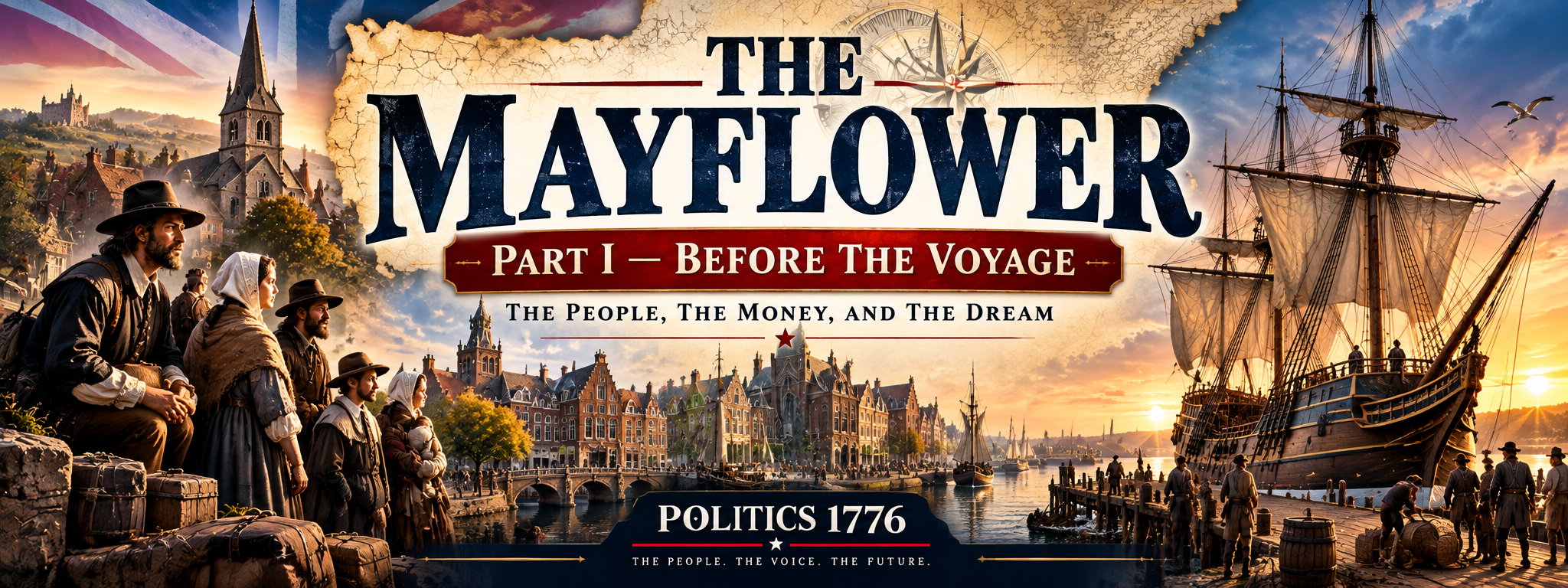
BEFORE THE VOYAGE
The People, the Money, and the Dream
An Atlantic Crossing That Would Become Part of America's Founding Story
Imagine a small English village in the early seventeenth century.
The roads are narrow.
Fields stretch beyond clusters of timber-framed houses.
Church bells mark the passing hours.
Farmers work the land.
Merchants travel between market towns.
And in homes and meeting places, people quietly debate questions that could change their lives.
What should a church believe?
Who should determine how people worship?
What authority should the king possess over religious affairs?
And what happens when a person's conscience comes into conflict with the laws of the country?
These were not abstract questions in early seventeenth-century England.
They could determine where someone lived, whether they could worship openly, and whether they faced punishment for defying religious authorities.
Among those wrestling with these questions was a relatively small group of English Protestants.
They were not kings.
They were not great military leaders.
Most were not wealthy.
They were farmers, craftsmen, tradespeople, families, and religious believers.
They could not have known that their decisions would eventually become part of one of the most recognizable stories in American history.
They were simply trying to determine how and where they could live according to their beliefs.
Their journey would carry them from England to the Netherlands.
From the Netherlands back to an English port.
And eventually across the Atlantic Ocean.
But before they could make that voyage, they would need something more than determination.
They would need permission, money, supplies, investors, and a ship.
The story of the Mayflower began long before the Mayflower set sail.
England at the Beginning of the Seventeenth Century
To understand the Mayflower passengers, we first need to understand the England they knew.
During the sixteenth century, England experienced profound religious and political changes.
The English Reformation separated the Church of England from papal authority in Rome during the reign of Henry VIII.
But that separation did not settle every religious disagreement.
Over the following decades, English monarchs and religious leaders debated the doctrines, ceremonies, and organization of the national church.
Some Protestants believed the Church of England had not gone far enough in reforming its practices.
These reform-minded Protestants became known broadly as Puritans.
But Puritans did not all agree about what should happen next.
Many wanted to reform the established church from within.
Others believed that the existing church could not be sufficiently reformed.
They concluded that faithful congregations should separate from it entirely.
These people became known as Separatists.
The distinction matters.
The Mayflower passengers are often described collectively as Pilgrims or Puritans.
But the religious core of the Plymouth expedition emerged from the English Separatist movement.
And not everyone who eventually sailed aboard the Mayflower belonged to that movement.
Religion and the Authority of the Crown
England was not a country in which religious institutions operated independently of the monarchy.
The Church of England was an established national church.
The monarch held a central position in its governance.
Under King James I, who came to the English throne in 1603, religious conformity remained an important concern.
Separatists challenged the idea that their congregations should be governed through the established church's hierarchy.
They believed their religious communities should organize worship and church affairs according to their understanding of Scripture.
English authorities often regarded unauthorized religious gatherings and separation from the established church as threats to religious and political order.
Some Separatists faced fines, surveillance, imprisonment, or other forms of pressure.
Their circumstances varied, and not every member experienced the same treatment.
But for certain congregations, remaining in England became increasingly difficult.
One such congregation developed in the region around Scrooby, Nottinghamshire.
Its story would become closely connected to the Mayflower.
The Scrooby Congregation
Scrooby was a village in northern England.
There, a Separatist congregation gathered around religious leaders and supporters who rejected the authority of the established church over their worship.
Among the important figures associated with this community were William Brewster, Richard Clyfton, and John Robinson.
Brewster had experience in government service and was connected to the manor at Scrooby.
Robinson became an influential minister and religious leader.
The congregation believed it should be able to worship according to its convictions.
But remaining outside the established church created serious difficulties.
By the first decade of the seventeenth century, members were considering a remarkable decision.
They would leave England.
Not to travel temporarily.
Not to seek a new trading opportunity.
But to relocate their religious community to another country.
Their destination would be the Dutch Republic.
Why the Netherlands?
During this period, the Dutch Republic offered comparatively greater opportunities for some religious dissenters to live and worship outside an established national church.
It was also an important center of European commerce.
Dutch merchants operated extensive international trading networks.
Ports connected the republic to the Baltic, Atlantic, Mediterranean, and markets farther overseas.
Cities supported printing, manufacturing, shipping, and commercial finance.
But the Netherlands was not a modern society with unrestricted religious equality.
Its political and religious arrangements were complicated, and toleration varied.
Nevertheless, for the English Separatists, it offered possibilities unavailable to them at home.
They could establish a congregation and practice their faith with greater freedom.
Leaving England, however, presented obstacles.
Unauthorized emigration could attract official attention.
Moving families required money and arrangements for travel.
And the congregation had to find a way to relocate without being stopped.
Their first efforts were difficult.
The Difficult Escape From England
In 1607, members of the Separatist community attempted to leave England.
One planned departure ended badly when authorities intervened.
Accounts associated with William Bradford describe arrests and the confiscation of belongings.
Another attempt in 1608 also encountered serious problems.
Some men succeeded in departing while women and children were left behind temporarily, creating distress and uncertainty.
The details survive primarily through later accounts written by participants, particularly Bradford.
Those accounts provide valuable evidence, although they also reflect the perspectives and purposes of their authors.
Eventually, members of the congregation reached the Netherlands.
They had escaped the immediate pressures they faced in England.
But leaving their country did not mean their difficulties were over.
A New Life in Leiden
After spending time in Amsterdam, the Separatists established their community in Leiden, a Dutch city known for its university, textile production, and commercial activity.
Leiden offered an opportunity to worship according to their beliefs.
John Robinson became the congregation's principal minister.
William Brewster remained an important leader.
Families settled into the city.
They found employment.
They raised children.
They participated in the life of a busy European community.
But economic circumstances were often difficult.
Many immigrants had to learn new occupations or accept demanding work.
Leiden's textile industry provided employment, but wages and working conditions could be challenging.
Some members had previously lived in rural English communities.
Now they were adjusting to urban life in a foreign country.
Religious freedom had come with economic sacrifices.
Freedom Did Not Mean Prosperity
This is one of the most important parts of the Mayflower story.
The Separatists did not immediately decide to cross the Atlantic after leaving England.
They spent roughly a decade living in the Netherlands.
And during that time, they confronted an uncomfortable reality.
They had gained greater freedom to practice their religion.
But supporting their families could be difficult.
Their children were growing up in Dutch society.
Some leaders worried about the community's long-term identity and whether younger generations would remain connected to its English language and religious traditions.
They were also concerned about the hardships of industrial employment.
And they recognized that the political situation in Europe could change.
The Twelve Years' Truce between the Dutch Republic and Spain was scheduled to expire in 1621, raising concerns about renewed warfare.
These pressures did not all carry equal weight for every family.
But together they helped encourage the congregation to consider another move.
This time, much farther away.
The Idea of America
By the early seventeenth century, European powers were establishing settlements and commercial enterprises in North America.
Spain had maintained colonies in the Americas for more than a century.
France had developed important commercial and colonial interests.
England was expanding its own overseas ambitions.
In 1607, English settlers established Jamestown in Virginia.
The settlement was financed through the Virginia Company of London.
Its backers hoped that colonial development would generate commercial returns.
But Jamestown's early history demonstrated the dangers of settlement.
Disease.
Food shortages.
Conflict.
Political uncertainty.
And high mortality.
The English colonization of North America was neither simple nor guaranteed to succeed.
Nevertheless, the continent represented an opportunity for the Leiden congregation.
They hoped to establish a community where they could maintain their religious practices and build a more sustainable future for their families.
They also anticipated economic opportunities through farming, fishing, and trade.
Their motives were not exclusively religious.
Faith helped shape their decision, but economic survival and the future of their community were also central concerns.
America Was Not Empty
There is another essential part of this history.
The lands the Separatists considered settling were already inhabited.
Indigenous nations had lived throughout North America for thousands of years.
They possessed established communities, governments, trading networks, agricultural practices, and relationships with the land.
Along the northeastern coast, Indigenous peoples maintained extensive connections through waterways, trails, diplomacy, and commerce.
European fishermen and traders had visited portions of the region before 1620.
Some Indigenous people had been captured and forcibly taken across the Atlantic.
European diseases had also begun devastating certain coastal communities.
The prospective settlers understood that Indigenous peoples inhabited North America, although their knowledge of those societies was incomplete and often shaped by European assumptions.
The land was not an unoccupied wilderness waiting to be discovered.
It was home to people with their own histories.
And the arrival of English settlers would have lasting consequences for them.
We will explore those consequences in detail in Part III.
A Settlement Required More Than a Dream
The Leiden congregation could not simply purchase passage across the Atlantic and establish a colony wherever it wished.
An overseas settlement required considerable planning.
They needed a location.
They needed some form of English authorization or legal protection.
They needed ships.
Food.
Tools.
Clothing.
Weapons.
Building materials.
Seeds.
Fishing equipment.
And supplies sufficient to survive until the settlement could begin supporting itself.
They also needed financing.
Many members of the congregation were not wealthy.
A transatlantic colonial expedition was expensive.
The Separatists would have to negotiate with people who viewed the proposed colony not only as a religious undertaking, but also as a commercial investment.
And that would complicate their plans.
The Virginia Company
The Separatists initially pursued arrangements associated with the Virginia Company of London.
At the time, the company's colonial claims extended over territory far beyond the modern boundaries of Virginia.
The congregation hoped to settle within an area covered by English colonial authority while maintaining its religious community.
Representatives traveled to England to negotiate arrangements.
They sought assurances concerning their ability to worship according to their beliefs.
But obtaining an explicit guarantee of religious freedom from the Crown proved difficult.
The negotiations were complicated by uncertainty over the Virginia Company's finances, the legal arrangements for settlement, and the need to obtain private investment.
The proposed voyage was becoming a mixture of religious ambition, colonial policy, and commercial negotiation.
The Investors Behind the Voyage
The expedition ultimately depended upon financial arrangements involving a group of London investors often known as the Merchant Adventurers.
The term did not mean that these investors were necessarily adventurers in the modern sense.
They were people willing to commit capital to a commercial enterprise with the expectation of future returns.
Their money helped support the voyage and settlement.
The colonists would contribute their labor.
The investors would provide capital.
Together, they hoped to establish a productive colony.
But the arrangement created difficult questions.
Who would own the land and improvements?
Who would control the products of the settlement?
How would profits be divided?
When would investors receive a return?
And how much of the settlers' labor would be devoted to the common enterprise?
These were not minor details.
They could determine how the colony operated after the passengers arrived.
Thomas Weston and the Business Arrangement
One of the important figures in the financing negotiations was Thomas Weston, a London merchant.
Weston became involved in helping arrange investment for the expedition.
The proposed financial terms created disagreement.
The Leiden congregation had hoped for arrangements that would provide families with greater control over their homes and some of the benefits of their individual labor.
The investors sought terms that would protect their capital and provide an opportunity for profit.
Under the eventual arrangements, the settlers' labor and the enterprise's assets were subject to a shared commercial structure for a period of years.
The terms were contested.
Some members of the congregation were deeply unhappy with changes introduced during negotiations.
The disagreement created tension before the expedition even began.
But the passengers had limited alternatives.
They needed financing to cross the Atlantic.
And the investors wanted a commercially viable settlement.
The voyage that would later become famous for its religious and political legacy was also a privately financed colonial business venture.
The Cost of Crossing the Atlantic
A seventeenth-century ocean voyage required substantial resources.
Ships had to be hired or purchased.
Crews needed wages.
Food and water had to be provided.
Cargo space was limited.
Passengers needed personal supplies.
And the expedition had to carry enough equipment to establish a settlement.
The risks were considerable.
A ship could be damaged.
Storms could delay arrival.
Disease could spread among passengers.
Supplies could spoil.
The colony might fail.
For investors, the expedition was a gamble.
For the passengers, it was something more personal.
They were placing their families and their futures at risk.
But the two groups depended upon each other.
Without the settlers, the investment could not produce a colony.
Without financing, the settlers could not make the voyage.
The Mayflower Was Not Built for This Mission
The ship that would become famous as the Mayflower was not constructed specifically to carry the Plymouth settlers.
It was an English merchant vessel.
Before 1620, it had been used in commercial shipping.
The ship is generally associated with Christopher Jones, its master and part-owner.
Its precise construction date and full early history are uncertain.
Historical records connect a Mayflower commanded by Jones with trading voyages during the early seventeenth century.
The vessel was likely about 180 tons burden, although exact dimensions are not securely known.
The Mayflower was built for the commercial maritime world of its time.
It was not a modern passenger ship.
Its primary purpose was transporting cargo.
Space was limited.
Comfort was minimal.
And an Atlantic crossing could be dangerous even for experienced sailors.
For the families preparing to leave Europe, this ordinary merchant ship would become their temporary home.
There Was Supposed to Be Another Ship
One of the most frequently overlooked facts about the Mayflower expedition is that the original plan involved two ships.
The congregation arranged to use a smaller vessel called the Speedwell.
The Speedwell was intended to help transport passengers and potentially remain available for colonial activities after arrival.
The Mayflower would carry additional passengers and supplies from England.
The two ships were supposed to cross the Atlantic together.
The plan made practical sense.
More space would allow the expedition to transport more people and equipment.
But the Speedwell would become one of the greatest complications of the entire undertaking.
Its problems would delay departure and change who ultimately made the voyage.
The People Who Would Sail
The passengers who eventually boarded the Mayflower were not all members of the Leiden congregation.
The expedition included people from different backgrounds.
Some were Separatists who had lived in the Netherlands.
Others joined through arrangements made in England.
There were families.
Single men.
Servants.
Children.
And individuals whose reasons for traveling were primarily economic rather than religious.
Later historical accounts often distinguish between the religious congregation and other passengers.
But those categories should not obscure the complexity of the group.
They were not a single community united by identical beliefs or motives.
Some hoped to preserve their religious practices.
Others sought land, work, or opportunity.
Some traveled under contracts of service.
Others accompanied their families.
The future colony would have to accommodate these differences.
And that would become especially important when the passengers reached North America.
William Bradford
Among the most important figures in the story was William Bradford.
Bradford had joined the Separatist movement as a young man.
He left England with the congregation and lived in the Netherlands.
He later traveled aboard the Mayflower.
Bradford would become a long-serving governor of Plymouth Colony.
He also wrote Of Plymouth Plantation, one of the most important surviving accounts of the settlement's early history.
His work provides detailed information about the congregation, the voyage, and the colony.
But it must be read as a historical source written by a participant.
Bradford was describing events from his own perspective.
He selected what to include and interpreted events through his religious understanding.
His account is invaluable.
But it is not the only perspective needed to understand the history.
William Brewster
William Brewster was another central figure.
He had been involved with the Separatist congregation in England.
He helped sustain the community during its years in the Netherlands.
Brewster became the religious elder of the Plymouth congregation.
His leadership was important because the community's minister, John Robinson, did not accompany the first group of emigrants.
Robinson remained in Leiden with other members of the congregation.
The plan was for additional members to follow when circumstances permitted.
That detail reveals something important.
The Mayflower expedition did not represent the departure of the entire Leiden congregation.
It was the first stage of a larger migration that its organizers hoped would continue.
John Carver
John Carver played a leading role in organizing the expedition.
He was involved in negotiations concerning financing and arrangements for settlement.
Carver traveled aboard the Mayflower and became the colony's first governor.
His experience reflected the practical demands of the undertaking.
Religious conviction alone could not arrange a transatlantic expedition.
Someone had to negotiate with merchants.
Coordinate supplies.
Resolve disagreements.
And make decisions under pressure.
Carver was one of the individuals who helped turn the congregation's ambitions into an actual voyage.
Miles Standish and the Other Passengers
Another passenger was Miles Standish, who would become an important military leader in Plymouth Colony.
Standish was not known to have been a member of the Leiden Separatist congregation in the same way as Bradford or Brewster.
His background and military experience made him valuable to the settlement.
Other passengers included Edward Winslow, Stephen Hopkins, and numerous families whose lives would become intertwined with the colony's history.
Their circumstances differed.
Some would become political leaders.
Others would work as farmers, craftsmen, or servants.
Some would not survive the first year.
The familiar names are only part of the story.
The Mayflower also carried women, children, and people whose experiences are less fully preserved in surviving records.
Their labor, suffering, and decisions were essential to the colony's history.
The Families Who Faced the Unknown
It is easy to describe the Mayflower expedition through dates and prominent individuals.
But consider what the decision meant for a family.
Leaving familiar streets and communities.
Selling or abandoning possessions.
Preparing children for a long ocean voyage.
Knowing that communication with relatives left behind would be slow and uncertain.
Facing the possibility of sickness, hunger, or death.
And traveling toward a place where the future could not be guaranteed.
For many passengers, the decision was deeply personal.
The adults were not simply choosing a new location.
They were choosing an uncertain future for their children.
And the children had little control over the decision.
This human dimension is central to the story.
The Mayflower was not carrying an abstract political movement.
It was carrying people.
The Final Preparations
By the summer of 1620, the expedition was preparing to depart.
The Speedwell carried members of the Leiden congregation from the Netherlands to England.
The Mayflower was waiting with other passengers and supplies.
The ships were intended to sail together.
But the arrangements had already become strained.
Financing disagreements had created uncertainty.
Some members of the congregation were dissatisfied with the terms negotiated with investors.
Supplies had to be purchased.
Passengers had to be organized.
The departure schedule was slipping.
And every delay increased the risks of crossing the North Atlantic later in the year.
The voyage was already proving more difficult than its organizers had hoped.
July 1620 — Leaving the Netherlands
In July 1620, members of the Leiden congregation departed from Delfshaven aboard the Speedwell.
The departure was emotional.
Friends and family members gathered to say farewell.
Some members of the congregation were leaving.
Others would remain behind.
John Robinson was among those who stayed in the Netherlands.
The emigrants hoped that more of their community would eventually join them.
But no one could know whether those plans would succeed.
The Speedwell sailed toward England.
There, the passengers would meet the Mayflower and begin the next stage of their journey.
The Atlantic crossing was finally approaching.
Or so they believed.
The Speedwell Begins to Fail
The two ships eventually attempted to depart together.
But the Speedwell developed serious leakage problems.
The vessels returned for repairs.
After another attempt, the Speedwell again proved troublesome.
The expedition lost valuable time.
The exact reasons for the Speedwell's problems remain uncertain.
Later accounts include suspicions that the vessel's crew may have exaggerated or contributed to the difficulties, but such explanations cannot be established as fact.
What is certain is that the organizers ultimately abandoned the plan to use both ships.
Some passengers would remain in England.
Others would be transferred to the Mayflower.
The expedition had to continue with one vessel.
That decision changed the conditions of the voyage.
One Ship, More Passengers, Less Space
The Mayflower now had to carry the passengers who would make the crossing, along with their belongings and essential supplies.
The final passenger total is traditionally given as 102, although historians distinguish between surviving passenger lists and the precise circumstances of individuals aboard.
The ship also carried a crew, commonly estimated at roughly thirty men, though exact figures are uncertain.
The passengers would spend much of the voyage in cramped quarters.
They had limited privacy.
Food and water supplies had to last through the crossing.
Sanitation was rudimentary.
And the Atlantic offered no guarantee of calm weather.
The delays had pushed the expedition toward the autumn.
The longer the journey lasted, the greater the danger that the settlers would arrive in North America with little time to prepare for winter.
Yet the passengers had already invested too much to abandon the undertaking easily.
Their future now depended upon one ship.
September 1620 — The Mayflower Prepares to Sail
In September 1620, the Mayflower was ready to depart from Plymouth, England.
The passengers had already experienced years of uncertainty.
They had left their homes.
Negotiated with investors.
Struggled with financing.
Prepared supplies.
And endured repeated delays.
Now they faced the Atlantic.
The voyage would take them toward the northern part of the English colonial claims in North America.
They did not intend to create an independent nation.
They expected to establish a settlement under English authority.
Their plans were shaped by religious beliefs, economic arrangements, and the colonial ambitions of their time.
But events would soon carry them away from their intended destination.
Storms would challenge the ship.
Conditions aboard would deteriorate.
And the eventual landfall would create an unexpected political problem.
The passengers would find themselves outside the jurisdiction they had expected to settle under.
That situation would lead to an agreement remembered for centuries.
The Mayflower Compact.
But that part of the story was still ahead.
For now, the passengers stood at the beginning of a dangerous ocean crossing.
BEFORE THE MAYFLOWER BECAME A SYMBOL
The Mayflower would eventually become one of the most recognizable ships in American history.
Its voyage would be remembered through paintings, monuments, schoolbooks, and national commemorations.
But in 1620, it was not carrying the founders of the United States.
It was carrying a group of English colonists whose ambitions were immediate and uncertain.
Some sought the ability to preserve their religious community.
Others sought economic opportunity.
Investors hoped the settlement would produce commercial returns.
Families hoped to establish new lives.
And everyone aboard faced the risks of a difficult Atlantic crossing.
The expedition was shaped by the religious conflicts of England.
The commercial world of the Dutch Republic.
The financial interests of London merchants.
And England's expanding colonial ambitions.
Its passengers were entering a continent already inhabited by Indigenous peoples with their own societies and histories.
The future would be shaped by encounters, cooperation, conflict, survival, and decisions no one aboard could fully anticipate.
The Mayflower's later place in American history was not predetermined.
It began as an uncertain voyage undertaken by ordinary people pursuing different hopes in an unfamiliar world.
And the most dangerous part of their journey had not yet begun.
NEXT — PART II
ACROSS THE ATLANTIC — THE VOYAGE OF 1620
The Storms, the Passengers, and the Agreement That Would Become History
The Mayflower finally leaves England.
The passengers settle into crowded quarters.
The crew prepares for the crossing.
The ship enters the North Atlantic.
What follows is a voyage marked by difficult weather, sickness, uncertainty, and remarkable endurance.
A passenger dies.
A child is born.
A storm damages the ship.
And after more than two months at sea, land finally appears.
But it is not the destination the passengers had expected.
They arrive near Cape Cod.
And before establishing their settlement, the adult male passengers create a written agreement for civil government.
The Mayflower Compact.
The next chapter follows the voyage itself and explains why that agreement was written, what it actually said, and why it later became an important part of American history.
Because the Mayflower's passengers did not cross the Atlantic intending to establish a new nation.
But the decisions they made would become part of the much longer history of American self-government.
THE MAYFLOWER CONTINUES.
Our Money Matters.
Our Choices Matter.
Our Voice Matters.
The People. The Voice. The Future.
Politics 1776