THE MAYFLOWER PART 2- ACCROSS THE ATLANTIC
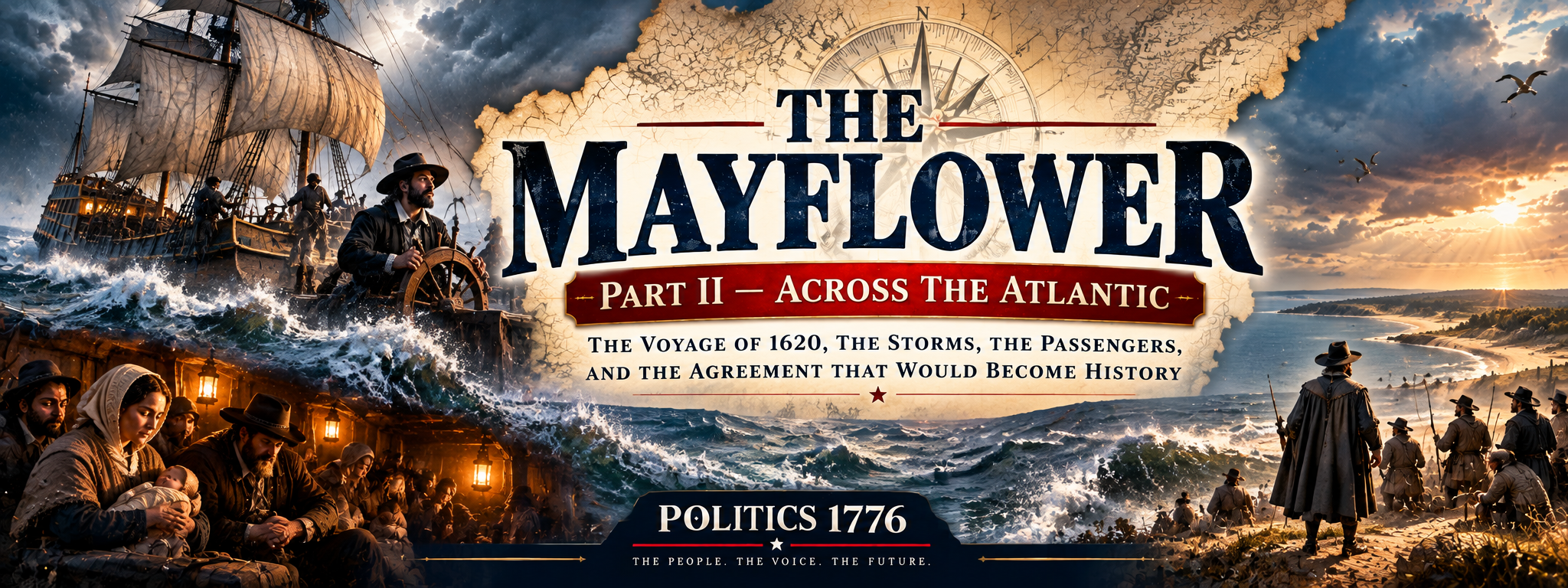
ACROSS THE ATLANTIC
The Voyage of 1620, the Storms, and the Agreement That Would Become History
Imagine standing on the deck of a wooden merchant ship in September 1620.
Behind you lies the English coastline.
Ahead stretches the Atlantic Ocean.
There are no engines.
No radios.
No weather forecasts.
No reliable way to communicate with anyone on shore once the ship disappears beyond the horizon.
The vessel depends upon wind, sails, navigation, and the judgment of its crew.
Below deck, families have crowded themselves among supplies and personal belongings.
Some passengers have already spent years preparing for this moment.
Others joined the expedition more recently.
They are not all members of the same religious congregation.
They do not all share the same ambitions.
But for the coming weeks, their lives will depend upon one another.
The ship is the Mayflower.
Its destination is English North America.
And its passengers are about to begin one of the most remembered voyages in American colonial history.
But the journey that later generations would celebrate was far from certain to succeed.
Before the Mayflower could become a symbol, it had to survive the Atlantic.
September 1620 — The Departure
On September 6, 1620, according to the calendar then used in England, the Mayflower departed Plymouth, England.
That date corresponds to September 16 on the modern Gregorian calendar.
The ship carried approximately 102 passengers, along with its crew.
The voyage had already been delayed by difficulties involving the smaller ship, the Speedwell.
As we explored in Part I, the original plan called for two vessels.
But after repeated problems with the Speedwell, the organizers abandoned that arrangement.
Some prospective emigrants remained behind.
Others transferred to the Mayflower.
The result was a crowded ship beginning its voyage later in the season than originally intended.
This mattered.
The North Atlantic could become especially dangerous during autumn.
Storms could be severe.
The days were growing shorter.
And every week spent at sea reduced the time available for establishing shelter before winter.
Yet the expedition proceeded.
For many passengers, the voyage represented years of preparation and sacrifice.
Turning back again could mean abandoning their hopes for settlement.
A Merchant Ship, Not a Passenger Vessel
The Mayflower was not designed as a comfortable passenger ship.
It was an English merchant vessel, associated with its master, Christopher Jones.
Its exact dimensions are not securely documented, although it is generally described as a ship of approximately 180 tons burden.
That measurement referred to carrying capacity, not the ship's weight in the modern sense.
The Mayflower had sailed on commercial voyages before 1620.
Its crew understood the demands of maritime transportation.
But carrying more than one hundred passengers across the Atlantic created a different challenge.
The passengers occupied cramped spaces.
They had limited opportunities for privacy.
Food and water had to be stored for the crossing.
Personal belongings and supplies competed for space.
And the ship itself would be constantly moving.
For people accustomed to life on land, the experience could be exhausting.
Life Between the Decks
Most passengers spent much of their time in the area commonly called the between-decks space.
It was not a comfortable cabin with private rooms.
It was a crowded area where families lived among their belongings.
The ceiling was low.
Ventilation was limited.
Natural light was scarce.
Passengers had to endure the ship's rolling and pitching.
Seasickness could make daily life miserable.
Cooking opportunities were restricted, especially during bad weather.
Meals depended heavily upon preserved provisions.
Salted meat.
Dried foods.
Hard bread.
Cheese.
And other supplies that could survive a long voyage.
Drinking water was stored in barrels, although its quality could deteriorate.
Beer was also a common shipboard beverage in this period.
The passengers had little control over the weather, the ship's course, or the duration of the crossing.
Their daily lives were shaped by the conditions aboard a working merchant vessel.
The People Below Deck
It is easy to imagine the Mayflower as a ship filled entirely with religious leaders.
But the passengers represented a more complicated community.
There were members of the Leiden Separatist congregation.
There were other English settlers recruited for the expedition.
There were servants.
Families.
Single men.
Women.
Children.
And people with different expectations about life in America.
Some hoped to establish a community where their religious practices could continue.
Others sought employment, land, or economic opportunity.
Some were bound by contracts of service.
The passengers did not all possess equal social standing.
Nor would they all have an equal voice in the colony's future political arrangements.
But aboard the Mayflower, everyone faced the same ocean.
A storm could threaten a wealthy passenger and a servant alike.
Disease could spread through crowded quarters.
And survival depended upon the ship reaching land.
The Crew
The passengers were not the only people aboard.
The Mayflower also carried sailors responsible for operating the vessel.
The exact number of crew members is uncertain, but estimates commonly place the crew at roughly thirty.
These men worked under Christopher Jones.
Their responsibilities included handling sails, maintaining equipment, navigating, steering, and keeping the ship seaworthy.
A seventeenth-century sailing vessel required constant attention.
The crew had to respond to changing winds.
Adjust sails.
Watch for damage.
Pump water when necessary.
And manage the risks of Atlantic weather.
Their work was essential.
The passengers could hope and pray for a safe crossing.
But the sailors possessed the practical skills needed to keep the ship moving.
The First Weeks at Sea
According to William Bradford's account, the Mayflower initially experienced favorable winds and weather.
For a time, the voyage proceeded reasonably well.
But the Atlantic crossing was long.
As the ship moved westward, conditions deteriorated.
Strong winds and rough seas battered the vessel.
The Mayflower rolled heavily.
Passengers were forced to remain below deck for extended periods.
The crew struggled to manage the ship in difficult weather.
The voyage became increasingly uncomfortable and dangerous.
And one incident described by Bradford would become part of the ship's enduring history.
The Passenger Who Was Swept Overboard
Among the passengers was a young man named John Howland.
Howland was traveling as a servant in the household of John Carver.
During a severe storm, Howland ventured onto the deck.
According to Bradford, a violent movement of the ship threw him overboard.
For a moment, he appeared to be lost.
But as he fell, Howland managed to catch hold of a rope trailing from the vessel.
The crew hauled him close enough to the ship to recover him with a boat hook and bring him back aboard.
He survived.
The incident illustrates the danger of life at sea.
There were no modern life jackets.
No motorized rescue craft.
And no guarantee that a person swept into the Atlantic could be recovered.
Howland's survival was extraordinary.
He would later become an important member of Plymouth Colony and live for many decades after the voyage.
But at that moment, his future depended upon a rope and the actions of the crew.
The Ship Begins to Suffer
The storms also threatened the Mayflower itself.
Bradford described damage involving a major structural timber.
The passengers and crew feared that the ship might no longer be strong enough to continue.
A damaged vessel in the middle of the Atlantic presented a terrifying problem.
There was no nearby harbor.
No rescue service.
And no practical way to transfer everyone to another ship.
The crew examined the damage.
Bradford recorded that the passengers had brought a large iron screw, apparently intended for use in their settlement.
The device was used to help raise and secure the damaged timber.
Additional efforts were made to reinforce the structure.
The ship's officers concluded that the Mayflower could continue.
It was an important decision.
Turning back would have meant another dangerous voyage across the ocean.
Continuing west meant trusting that the repairs would hold.
The Mayflower pressed onward.
The Death of William Butten
Not everyone survived the crossing.
A young passenger named William Butten, who traveled as a servant in Samuel Fuller's household, died shortly before the ship reached land.
The precise circumstances of his illness are not fully known.
His death is generally identified as the only death among the passengers during the outward Atlantic crossing itself.
That distinction matters because many more deaths would occur after the Mayflower reached North America.
The first winter would prove far more deadly than the voyage.
But for those aboard, Butten's death was a reminder of their vulnerability.
They were far from home.
They had no access to the medical resources available in established towns.
And they were approaching an unfamiliar coast as winter drew nearer.
A Child Is Born at Sea
The voyage also brought a birth.
Elizabeth Hopkins, wife of Stephen Hopkins, gave birth to a son during the crossing.
The child was named Oceanus.
His name reflected the extraordinary circumstances of his arrival into the world.
A baby had been born aboard a crowded merchant ship in the Atlantic Ocean.
The event reminds us that the Mayflower was carrying families, not merely adult settlers.
Children experienced the same difficult conditions.
Parents had to care for infants and young children in cramped quarters.
Pregnant women faced the risks of childbirth without the comforts or resources available on land.
The Mayflower's story was shaped by these ordinary human experiences as much as by its later political significance.
The Atlantic Was Not an Empty Highway
By 1620, the Atlantic Ocean was already part of an extensive commercial world.
European ships carried fish, timber, manufactured goods, agricultural products, and other merchandise across the ocean.
English, Dutch, French, Spanish, Portuguese, and other maritime interests competed for markets and influence.
The forced transportation of enslaved Africans was also part of the expanding Atlantic system.
The Mayflower voyage took place within this larger world of trade, colonization, and imperial competition.
Its passengers were not the first Europeans to cross the Atlantic.
They were not the first English settlers in North America.
Jamestown had been established in 1607.
Other European settlements existed elsewhere in the Americas.
And Indigenous peoples had inhabited North America for thousands of years.
The Mayflower became famous because of the particular colony and historical memory associated with it.
Not because it marked the beginning of human settlement or European arrival in America.
After More Than Two Months at Sea
The voyage lasted approximately sixty-six days.
On November 9, 1620, using the English calendar of the time, the passengers sighted land.
They had reached the coast of Cape Cod.
For those who had endured weeks of confinement and dangerous weather, the sight of land must have been a profound relief.
But arrival did not mean the expedition had reached its intended destination.
The settlers had planned to establish themselves farther south, in territory associated with their arrangements under the Virginia Company.
Cape Cod lay north of that intended region.
The ship's officers attempted to sail south.
But dangerous shoals and unfavorable conditions complicated the effort.
Rather than continue risking the ship, they turned back toward Cape Cod.
The Mayflower entered the waters of what is now Provincetown Harbor.
The passengers had reached North America.
But they were not where they had expected to be.
And that created a serious problem.
The Problem of Authority
The passengers' original arrangements had been made with settlement in a different jurisdiction in mind.
Now they were preparing to establish a community outside the territory covered by the patent on which they had expected to rely.
That raised a practical question.
What authority would govern them?
The passengers had different backgrounds and interests.
Some belonged to the Separatist congregation.
Others did not.
According to Bradford's later account, certain passengers argued that because the group had arrived outside the intended jurisdiction, they would not be bound by the authority expected under the original arrangements.
Bradford's account is the principal source for this reported disagreement.
We should therefore recognize that it presents the episode from the perspective of a leading member of the colony.
Nevertheless, the underlying issue was real.
The settlers needed a workable political arrangement.
They would soon be living in a difficult environment.
They needed cooperation.
They needed rules.
And they needed a recognized way to make decisions.
Before going ashore, a group of the adult male passengers agreed to establish a civil political community.
The resulting document became known as the Mayflower Compact.
November 11, 1620 — The Mayflower Compact
On November 11, 1620, according to the English calendar, forty-one adult male passengers signed an agreement aboard the Mayflower.
The date corresponds to November 21 on the modern Gregorian calendar.
The document is now known as the Mayflower Compact.
The original signed manuscript has not survived.
Its text is known through early copies, including versions preserved by William Bradford and in Mourt's Relation, an early account of Plymouth Colony.
The Compact was relatively short.
But its purpose was significant.
The signers agreed to establish a civil political body and to create laws and offices for the colony's general welfare.
One of its most frequently quoted phrases described their intention to:
“covenant and combine ourselves together into a civil Body Politick.”
The agreement reflected the settlers' need to establish a functioning government.
But it is important to understand exactly what the document did—and what it did not do.
What the Mayflower Compact Actually Established
The Mayflower Compact was an agreement among its signers to form a political community.
They pledged to enact and obey laws, ordinances, acts, constitutions, and offices considered appropriate for the colony's general good.
It was a practical response to the circumstances of settlement.
The signers needed a way to maintain order and coordinate decisions.
The Compact provided a foundation for civil government within their community.
But it was not a declaration of independence.
The document explicitly expressed loyalty to King James I.
Its signers did not claim to be establishing a sovereign nation.
They understood themselves as English subjects undertaking a colonial settlement.
Nor was the Compact a detailed constitution.
It did not establish the complete structure of Plymouth's government.
It did not define a modern system of separated powers.
It did not guarantee universal voting rights.
And it did not provide political equality for everyone living in the region.
Its historical significance lies in the agreement its signers made to organize civil authority and obey laws adopted for their community.
Who Signed—and Who Did Not?
Forty-one adult men signed the Mayflower Compact.
Among them were William Bradford, John Carver, William Brewster, Edward Winslow, Miles Standish, and other passengers.
Women did not sign.
Children did not sign.
Some adult male passengers also did not sign, including certain servants and others whose status or circumstances differed.
The agreement therefore did not represent universal political participation.
It was created within the social and political assumptions of seventeenth-century English society.
The signers were also making decisions concerning a colony they intended to establish on land already inhabited and used by Indigenous peoples.
Those Indigenous communities were not parties to the agreement.
This distinction matters when evaluating the Compact's historical legacy.
It was an important document in the development of Plymouth's colonial government.
But it was not an agreement among all the people whose lives would be affected by English settlement.
Was This the Beginning of American Self-Government?
The Mayflower Compact is often described as a foundational document of American self-government.
There is a reason for that reputation.
It demonstrated that a group of colonists could establish civil authority through a written agreement among themselves.
The signers committed to forming a political community and following its laws.
Later generations found meaning in that example.
But the Compact did not mark the beginning of self-government in North America.
Indigenous nations already possessed their own governing institutions and political traditions.
European colonial governments also existed before the Mayflower arrived.
In English Virginia, the House of Burgesses first met in 1619, establishing an early representative assembly.
The Mayflower Compact was therefore one development within a much larger history.
Its importance should not be diminished.
But neither should it be separated from the broader historical record.
The Compact was an early written agreement for civil government among English colonists—not the invention of government or democracy in America.
The Compact and the Consent of the Governed
One reason the Mayflower Compact became so influential in American historical memory is its connection to the idea of political consent.
The signers agreed among themselves to establish a civil body politic.
They promised obedience to laws made for their community.
That principle would later resonate with broader American discussions about government by consent.
But the historical relationship should be understood carefully.
The Mayflower Compact was written in 1620.
The Declaration of Independence was adopted in 1776.
More than a century and a half separated the two documents.
The Founders of the United States drew upon many sources of political thought, including English constitutional traditions, Enlightenment philosophy, colonial experience, and debates over representation.
The Mayflower Compact became part of the historical tradition later Americans used to explain the development of self-government.
But it should not be treated as a direct blueprint for the Constitution.
Its significance is more specific.
It provides an early example of settlers agreeing to organize political authority through a written commitment.
And it shows how practical circumstances could lead colonists to establish governing arrangements of their own.
John Carver Becomes Governor
After the Compact was adopted, John Carver was chosen as governor.
Carver had already played an important role in organizing the expedition.
Now he would help lead the settlement through its earliest challenges.
The position was not an easy one.
The passengers had reached an unfamiliar coast late in the year.
They needed fresh water.
Food.
Shelter.
A suitable location for settlement.
And a way to maintain cooperation among people with different backgrounds and expectations.
The Compact provided a political framework.
But it did not solve their immediate problems.
The greatest challenges were still ahead.
The Coast They Had Reached
Cape Cod was not an unknown or uninhabited region.
The area was part of the homeland of Indigenous peoples, including communities of the Wampanoag world and the Nauset people of Cape Cod.
These communities possessed their own histories, political relationships, agricultural practices, and trading networks.
European ships had visited portions of the coast before the Mayflower.
Fishing and trading expeditions had created contacts between Europeans and Indigenous communities.
Some encounters involved trade.
Others involved violence, coercion, and kidnapping.
European diseases had also caused devastating epidemics in parts of coastal New England before 1620.
The Mayflower passengers entered a region already transformed in important ways by earlier European contact.
They did not arrive in an untouched landscape.
And their presence would further change the lives of the people who already lived there.
The First Explorations
After anchoring near Cape Cod, the settlers began exploring the surrounding area.
They needed to find a suitable place for a permanent settlement.
The weather was cold.
Winter was approaching.
Some passengers were already ill or weakened by the voyage.
Exploration parties traveled along the coast.
They examined possible landing places.
Searched for fresh water.
And looked for signs of food and resources.
During these explorations, members of the party encountered evidence of Indigenous habitation.
They found cultivated land, burial sites, and stored food.
In one episode, the settlers took corn from an Indigenous storage place, later acknowledging an obligation to compensate its owners.
This was not an encounter with empty land.
It was an encounter with an inhabited region whose residents had established ways of living and storing resources.
The settlers' actions would become part of the complicated relationship between Plymouth Colony and neighboring Indigenous communities.
The First Encounter
In December 1620, an English exploring party encountered armed Nauset people near Cape Cod.
The encounter involved an exchange of arrows and gunfire.
The English later referred to the episode as the First Encounter.
No English deaths were reported in the surviving account.
The incident reflected the uncertainty and tension surrounding the arrival of strangers.
The Nauset had reasons to distrust Europeans.
Earlier English expeditions had kidnapped Indigenous people from the region.
The Mayflower passengers, meanwhile, were anxious about their safety and uncertain about the people they might encounter.
The confrontation did not establish the pattern of every future relationship.
But it demonstrated that settlement would involve more than finding land and building houses.
The colonists were entering a world of existing communities, political relationships, and memories of earlier encounters.
Searching for a Permanent Home
The Mayflower remained anchored while exploration continued.
The passengers needed a place where they could build shelters and begin supporting themselves.
They considered the availability of fresh water.
Access to the coast.
Defensible terrain.
Land suitable for cultivation.
And the practical challenges of establishing a settlement during winter.
Eventually, the explorers selected a location on the western side of Cape Cod Bay.
The place had previously been the site of an Indigenous community known as Patuxet.
An epidemic in the years before the Mayflower's arrival had devastated the population there.
The English settlers would call their new settlement Plymouth.
But the name did not erase the earlier history of the place.
The land already had a story.
And the next stage of the Mayflower expedition would unfold within it.
December 1620 — The Beginning of Plymouth
In December 1620, the settlers began establishing themselves at Plymouth.
The exact chronology of the earliest landings and exploration trips is more complicated than the familiar image of one dramatic step onto Plymouth Rock.
The traditional date associated with the landing at Plymouth is December 21 on the modern calendar.
But the famous story of Plymouth Rock became prominent much later.
Contemporary accounts of the voyage and settlement do not describe the passengers stepping onto that particular rock.
The rock became an important symbol through later tradition.
The historical reality was less ceremonial.
The settlers needed to unload supplies.
Build shelter.
Obtain food.
And survive the winter.
Many were still living aboard the Mayflower while construction began.
The ship had completed its ocean crossing.
But the colony was not yet secure.
The Mayflower's Voyage Was Only the Beginning
The passengers had crossed the Atlantic.
They had endured storms.
Survived damage to their ship.
Experienced a death and a birth.
Reached land far from their intended destination.
And established an agreement for civil government.
These events would become part of American historical memory.
But the voyage itself did not guarantee the success of Plymouth Colony.
The settlers had arrived late in the year.
They faced an unfamiliar environment.
Food supplies were limited.
Illness was spreading.
Shelter was inadequate.
And the relationships they would establish with Indigenous communities remained uncertain.
The first winter would be devastating.
Nearly half of the Mayflower passengers would die before the following spring.
Those who survived would depend upon a combination of their own efforts, leadership, adaptation, and relationships with Indigenous people.
The Mayflower Compact had established an agreement to govern.
Now the settlers had to find a way to live.
THE AGREEMENT THAT OUTLIVED THE VOYAGE
The Mayflower's crossing was an extraordinary event in the lives of its passengers.
But it was not unique simply because Europeans crossed the Atlantic.
Others had done so before them.
Its historical importance developed from what followed.
The establishment of Plymouth Colony.
The written agreement known as the Mayflower Compact.
The colony's relationships with Indigenous nations.
And the way later Americans remembered the expedition.
The Compact became especially important because it expressed a principle that would remain central to American political discussion.
A community could establish civil government through an agreement among its members.
But the document also reflected the limitations of its time.
It did not include everyone.
It did not create a modern democracy.
It did not establish an independent country.
And it did not grant the settlers ownership of the land they intended to occupy.
The Mayflower Compact was both a practical solution to an immediate problem and a document that later generations invested with broader meaning.
Understanding both aspects helps us appreciate its place in history.
The passengers had crossed an ocean seeking a future. Before building their settlement, some of them agreed upon a way to govern their community.
What happened next would test whether that community could survive.
NEXT — PART III
A NEW BEGINNING — PLYMOUTH, THE WAMPANOAG, AND THE FIRST YEARS
Survival, Cooperation, and the Complicated History of a New Colony
The Mayflower has reached North America.
The passengers have signed the Compact.
John Carver has become governor.
And the settlers have chosen the site of Plymouth.
But winter is approaching.
Shelter is limited.
Disease is spreading.
Food is scarce.
And the colony's future is uncertain.
The next chapter follows the devastating first winter and the people whose actions helped shape what came afterward.
We will explore the Wampanoag world before the English settlement, the leadership of Ousamequin, often known as Massasoit, and the remarkable life of Tisquantum, commonly called Squanto.
We will examine the alliance formed in 1621, the role of Indigenous knowledge in the colony's survival, and the harvest gathering later remembered as the First Thanksgiving.
But we will also explore the tensions and consequences that accompanied English settlement.
Because the history of Plymouth cannot be told through the experiences of the Mayflower passengers alone.
It is also part of the much longer history of the Indigenous peoples whose homeland they entered.
THE MAYFLOWER CONTINUES.
Our Money Matters.
Our Choices Matter.
Our Voice Matters.
The People. The Voice. The Future.
Politics 1776