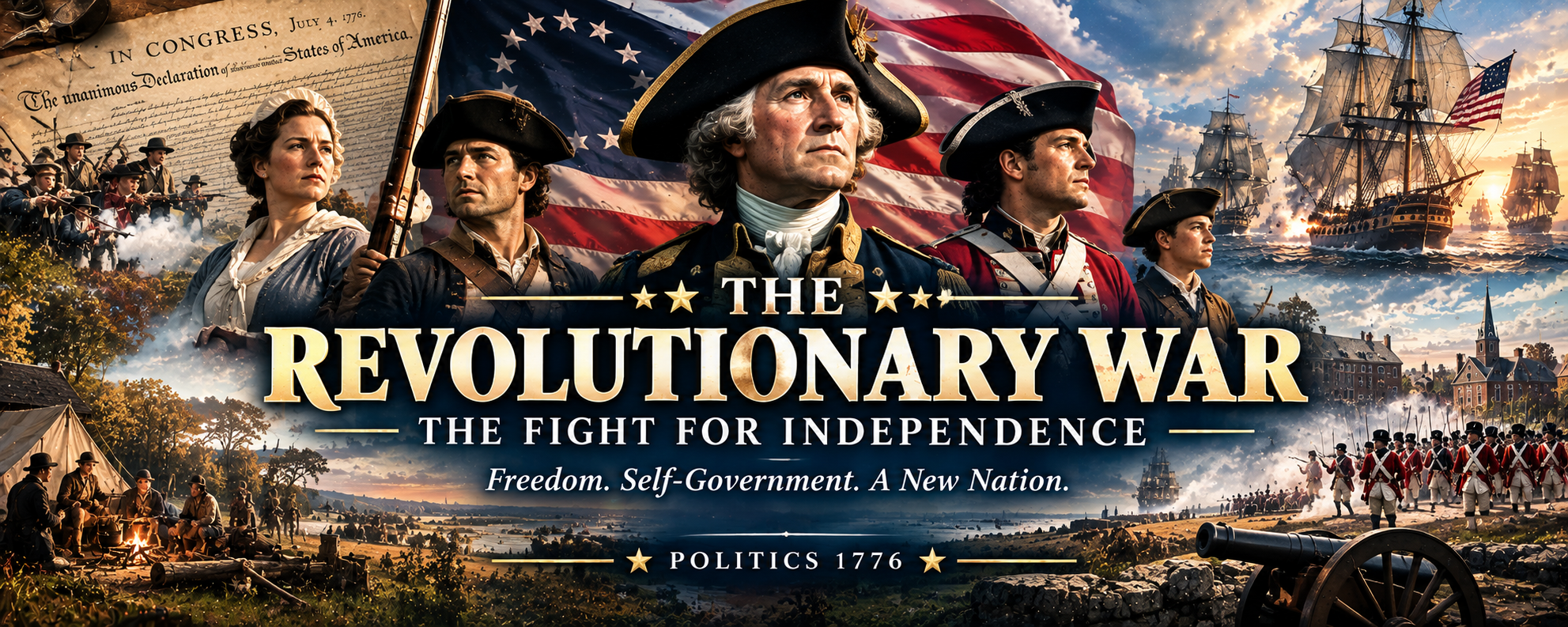
THE AMERICAN REVOLUTION
The War That Created a Country
Before there was a United States of America, there were thirteen British colonies along the Atlantic coast. They had different economies, different cultures, different religions, and different ideas about government. But by the 1760s and 1770s, a growing dispute was beginning to pull them together: Who had the authority to govern them, and where did that authority come from?
The answer would eventually be decided by war.
But the American Revolution did not begin with a declaration of independence.
It began with an argument.
BEFORE THE WAR
For generations, the colonies had been part of the British Empire.
The British government regulated trade and imperial affairs, while colonial assemblies handled many matters of local government. Colonists considered themselves British subjects and had long understood themselves as having the rights of Englishmen.
Then came the French and Indian War, fought in North America from 1754 to 1763 as part of a larger global conflict between Britain and France.
Britain won.
But victory came with enormous costs.
Britain emerged from the war with a much larger national debt and a much greater military presence in North America. British leaders believed the colonies should contribute more toward the cost of defending the empire. Parliament therefore enacted new measures affecting the colonies, including the Stamp Act of 1765 and later the Townshend duties.
Many colonists did not simply object to paying money.
They objected to the principle behind it.
They asked a question that would become central to the American Revolution:
Could a government impose taxes on people who had no elected representatives in the body imposing them?
The phrase “taxation without representation” became a rallying cry.
Resistance spread.
Boycotts were organized.
Petitions were written.
Crowds protested.
Colonial assemblies challenged Parliament's authority.
And the disagreement became increasingly difficult to resolve.
BOSTON
Boston became one of the centers of resistance.
In 1770, British soldiers fired into a crowd, killing five colonists in what became known as the Boston Massacre.
Three years later, resistance reached another famous moment.
On the night of December 16, 1773, colonists boarded ships in Boston Harbor and dumped tea into the water rather than allow the tea to be unloaded under Parliament's new tax system.
The Boston Tea Party was an act of protest—and the British government responded with what colonists called the Intolerable Acts, designed in part to punish Massachusetts and restore British authority.
Instead of ending resistance, the measures helped spread it.
In 1774, representatives from twelve colonies met in Philadelphia for the First Continental Congress.
They did not yet declare independence.
They were still trying to resolve the dispute.
That distinction matters.
The American Revolution was not inevitable from the beginning.
For many colonists, independence was initially unthinkable.
The goal for years was not necessarily to create a new country.
It was to defend what they believed were their rights within the British Empire.
THE FIRST SHOTS
By the spring of 1775, the argument had become an armed confrontation.
On April 19, 1775, British troops marched toward Concord, Massachusetts, in an effort to seize military supplies.
They encountered colonial militia at Lexington.
Shots were fired.
The fighting spread to Concord and along the road back toward Boston.
The war had begun.
The Second Continental Congress assembled in Philadelphia soon afterward.
This Congress now faced a problem that few of its members had expected:
If the colonies were going to fight, they needed an army.
In June 1775, Congress created the Continental Army and selected a Virginian named George Washington as its commander in chief.
Washington had military experience from the French and Indian War, but his selection was about more than experience.
He was from Virginia.
The fighting had begun in Massachusetts.
The Congress needed someone who could represent something larger than one colony.
Washington accepted the command.
And the colonies were now fighting a war they had not yet officially declared a war for independence.
THE LAST ATTEMPT AT PEACE
One of the most interesting parts of the Revolution is that independence was not immediately the goal.
In July 1775, Congress sent King George III the Olive Branch Petition, seeking reconciliation and asking the king to address the colonists' grievances.
The king rejected it.
In August, he declared the colonies to be in a state of “open and avowed rebellion.”
The relationship was breaking.
And events were pushing the colonists toward a decision they had once considered unimaginable.
INDEPENDENCE
Then came 1776.
Thomas Paine published Common Sense, arguing openly for independence and a republican form of government.
The argument gained momentum.
On June 7, 1776, Virginia delegate Richard Henry Lee introduced a resolution declaring that the colonies “are, and of right ought to be, free and independent States.”
Congress debated.
A committee was appointed to prepare a declaration explaining why.
The committee included Thomas Jefferson, John Adams, Benjamin Franklin, Roger Sherman, and Robert Livingston.
Jefferson drafted the document.
Congress edited it.
And on July 4, 1776, the Continental Congress adopted the Declaration of Independence.
The Declaration did something extraordinary.
It transformed the argument.
The question was no longer simply whether Parliament had the right to tax the colonies.
The question was now whether a people had the right to establish their own government.
The Declaration proclaimed that people possess certain “unalienable Rights” and that governments derive their legitimate powers from the “consent of the governed.”
Those words became the philosophical foundation of the new nation.
But declaring independence was easier than securing it.
WASHINGTON'S ARMY
The British Empire did not simply walk away.
Britain possessed one of the most powerful militaries in the world.
The Continental Army was inexperienced, frequently short of supplies, and dependent on soldiers whose enlistments often expired.
In 1776, British forces descended upon New York.
Washington's army suffered major defeats and was driven out of the city.
The situation became desperate.
Washington's army crossed the Delaware River on Christmas night and attacked Hessian troops at Trenton on December 26.
A few days later came the victory at Princeton.
The victories did not end the war.
But they kept the Continental Army alive and gave the American cause badly needed momentum.
SARATOGA
The war continued into 1777.
The British had a plan to isolate New England from the other colonies by controlling the Hudson River Valley.
The plan failed.
British General John Burgoyne surrendered his army at Saratoga, New York, in October 1777.
Saratoga became a turning point.
The victory helped convince France to recognize the United States and enter the war as an American ally.
The American Revolution was becoming an international conflict.
France supplied money, weapons, ships, and soldiers.
Spain and the Dutch Republic also became involved in the broader conflict against Britain.
The Americans were no longer fighting alone.
VALLEY FORGE
Then came the winter of 1777–1778.
Washington's army established its winter encampment at Valley Forge, Pennsylvania.
The soldiers endured cold, hunger, disease, inadequate clothing, and shortages of supplies.
Yet the army survived.
During the winter, Baron Friedrich Wilhelm von Steuben helped train Continental soldiers in military discipline and battlefield techniques.
Valley Forge became part of the American story not because it was a great battlefield victory, but because it represented something else:
endurance.
The Revolution would require more than courage on a battlefield.
It would require people willing to continue when victory seemed far away.
A WAR DIVIDED THE PEOPLE
The Revolution was not simply Americans versus Britons.
The population of the colonies was divided.
Some supported independence.
Others remained loyal to the Crown.
Some tried to stay neutral.
Native American nations made their own decisions based on their interests and the threats they faced.
Enslaved and free Black Americans also experienced the Revolution in very different ways. Thousands of enslaved people sought freedom by joining British forces after British officials offered emancipation to those who fled rebel masters and served the Crown. Others served with American forces or supported the Patriot cause.
The Revolution therefore contained contradictions that would remain unresolved long after the fighting stopped.
The Declaration proclaimed equality and natural rights.
Yet slavery continued.
The Revolution spoke of liberty while many people remained excluded from full political participation.
That contradiction would become one of the great unfinished questions of American history.
The ideals had been written down.
The country would spend generations arguing over who those ideals applied to.
YORKTOWN
By 1781, the war had lasted for years.
Washington and French forces under Comte de Rochambeau moved south toward Virginia.
French Admiral de Grasse brought a fleet into the Chesapeake.
British General Charles Cornwallis found himself surrounded at Yorktown.
The American and French forces pressed the siege.
On October 19, 1781, Cornwallis surrendered his army.
Yorktown was the last major battle of the American Revolution.
But the war was not technically over.
Fighting and negotiations continued.
THE TREATY
Two years later, the war finally came to its formal conclusion.
On September 3, 1783, representatives of the United States and Great Britain signed the Treaty of Paris.
Britain recognized the United States as an independent nation.
The American Revolution was over.
The thirteen colonies were no longer colonies.
They were a country.
But winning independence created a new problem.
What would they do with it?
WINNING THE WAR WAS ONLY THE BEGINNING
The Revolution had removed British authority.
It had not automatically created a successful government.
The new United States operated under the Articles of Confederation, and the national government proved too weak in important ways.
The country faced debt, economic problems, disputes between states, and questions about how much power the national government should have.
The men who had fought against concentrated power now had to figure out how to create a government powerful enough to function without becoming powerful enough to threaten liberty.
That debate eventually produced the Constitution of the United States in 1787.
And the Constitution began with words that connected the new government directly to the people:
“We the People.”
The Revolution had begun with an argument over political authority.
It ended with a new nation facing the much harder question of how free people could govern themselves.
WHAT THE REVOLUTION REALLY CHANGED
The American Revolution did not create a perfect country.
It did not eliminate conflict.
It did not immediately create political equality for everyone.
It did not solve slavery.
It did not settle every question about government.
It did something more fundamental.
It created an independent nation built around a set of political ideas that could be argued over, expanded, challenged, and tested for generations.
That may be one of the most important things to understand about the American Revolution.
The Revolution was not simply the story of Americans defeating a British army.
It was the beginning of an experiment.
Could people govern themselves?
Could government derive its authority from the people?
Could liberty survive political disagreement?
Could a republic hold together without a king?
Could power be divided and limited?
Could a country survive when its citizens disagreed profoundly with one another?
Those questions did not end in 1783.
They had only begun.
THE REVOLUTION WE REMEMBER
Today, we remember the Declaration.
We remember Washington crossing the Delaware.
We remember the Minutemen.
We remember Lexington and Concord.
We remember Saratoga.
We remember Valley Forge.
We remember Yorktown.
We remember the ringing words of July 4, 1776.
But perhaps the greatest legacy of the Revolution is not any single battlefield.
It is the idea that government is not supposed to exist above the people it governs.
The men and women of the revolutionary generation did not agree on everything.
They fought among themselves.
They disagreed over independence.
They disagreed over government.
They disagreed over slavery.
They disagreed over the future.
And yet, somehow, they built something that survived them.
That is why the Revolution belongs to more than 1776.
It belongs to every generation that comes afterward.
Because independence is not something a country wins once and keeps automatically.
Freedom requires institutions.
It requires citizens.
It requires responsibility.
And it requires people willing to understand the history that made their country possible.
The Revolutionary generation gave America its independence.
The generations that followed were given the responsibility of deciding what that independence would mean.
And that responsibility is still ours.
A COUNTRY IS NOT BUILT IN A DAY.
IT IS BUILT EVERY DAY.
THE GREAT EXPERIMENT CONTINUES.
THE PEOPLE. THE VOICE. THE FUTURE.
POLITICS 1776