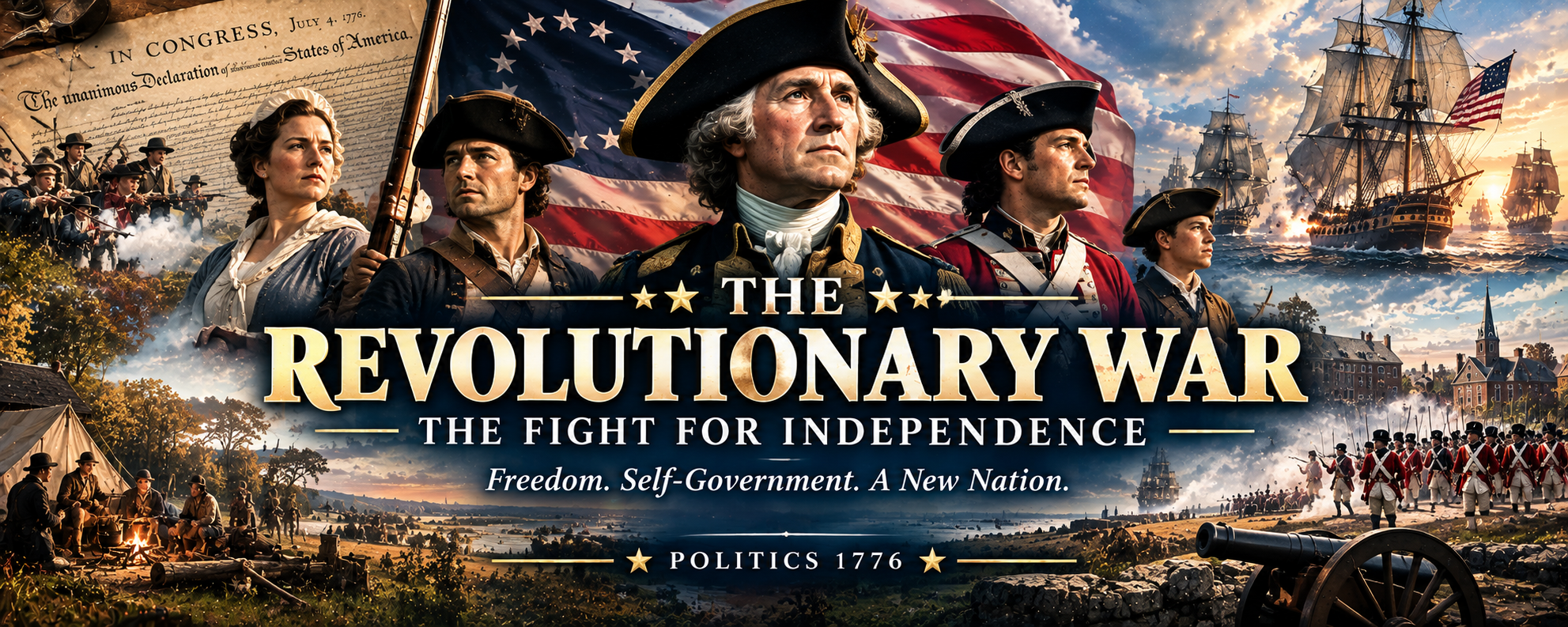
THE AMERICAN REVOLUTION
PART II — FIVE MOMENTS THAT CHANGED AMERICA
The American Revolution was not won in one battle.
It was not won by one man.
And it was not won simply because a declaration was signed.
It was a long, uncertain struggle in which ordinary people, soldiers, political leaders, diplomats, farmers, merchants, enslaved people, free Black Americans, Native nations, and foreign allies all became part of a conflict whose outcome was anything but certain.
Part I told the larger story.
Now we go closer.
To the green at Lexington.
To the room where independence was debated.
To George Washington.
To the winter at Valley Forge.
And finally, to Yorktown.
These are five moments that help explain how an argument became a revolution—and how a revolution became a country.
1. LEXINGTON & CONCORD
The Morning the Argument Became a War
Before sunrise on April 19, 1775, British soldiers were marching out of Boston.
Their orders were to move to Concord and seize colonial military supplies.
The countryside had already been preparing for trouble. Colonial militia companies had been organizing, weapons and ammunition were being gathered, and tensions between the British government and Massachusetts colonists had reached a breaking point.
Alarm riders spread the word.
Paul Revere and William Dawes rode through the countryside. Samuel Prescott continued the warning after Revere and Dawes were captured.
By early morning, colonial militia were gathering.
At Lexington Green, Captain John Parker's men faced the approaching British troops.
Parker ordered his men to disperse.
Then a shot rang out.
No one knows with certainty who fired it.
British soldiers opened fire.
Within minutes, eight Massachusetts militia were dead and others wounded.
The British continued toward Concord.
But they did not find the easy victory they expected.
At North Bridge in Concord, hundreds of colonial militia gathered. British troops guarding the bridge exchanged fire with them.
The confrontation lasted only moments.
But it changed everything.
The fighting spread across roughly sixteen miles as British troops attempted to return to Boston while colonial militia fired from roads, fields, walls, and wooded areas.
By the end of the day, hundreds of men were dead, wounded, or missing.
The argument had become a war.
And perhaps the most remarkable part is what happened next.
The news traveled.
Militia from surrounding communities began moving toward Boston.
What had started as a confrontation in Massachusetts was becoming a colonial rebellion.
The Revolution had begun before anyone knew how it would end.
2. THE DECLARATION
When Rebellion Became Independence
For more than a year after Lexington and Concord, the colonies fought British forces without having formally declared themselves an independent nation.
That distinction matters.
Independence was not automatic.
It had to be debated.
It had to be chosen.
And eventually, it had to be explained.
On June 7, 1776, Richard Henry Lee of Virginia introduced a resolution declaring that the colonies should become free and independent states.
Congress appointed a committee to prepare a declaration.
Thomas Jefferson wrote the draft.
John Adams, Benjamin Franklin, Roger Sherman, and Robert Livingston were also members of the committee.
Congress debated and edited Jefferson's language.
Then, on July 4, 1776, Congress adopted the Declaration of Independence.
The document did something far more important than announcing that thirteen colonies were leaving the British Empire.
It explained why.
The Declaration argued that people possess rights that government exists to protect and that legitimate government derives its authority from the “consent of the governed.”
That was the revolutionary idea.
The colonies were not simply claiming a different ruler.
They were claiming the right to govern themselves.
The Declaration did not magically make the new country free.
It did not win the war.
It did not eliminate the contradictions that existed within American society.
But it gave the struggle a statement of purpose that would outlive the war itself.
And there is something important about that.
Before America had a Constitution, it had an argument about the purpose of government.
The Declaration put that argument into words.
3. GEORGE WASHINGTON
The Man Who Had to Keep the Army Together
George Washington did not begin the Revolution as a king, president, or national hero.
He was a Virginia planter and former military officer who had served in the French and Indian War.
In June 1775, after the fighting had already begun, the Continental Congress selected him as commander in chief of the Continental Army.
He accepted.
What followed was years of defeats, retreats, shortages, political arguments, disagreements with Congress, and enormous pressure.
Washington's army was frequently short of food, clothing, ammunition, and reliable supplies.
The British captured New York.
Washington suffered defeats.
His army sometimes seemed close to collapse.
Yet he kept it together.
After the desperate campaign of 1776, Washington crossed the Delaware River on Christmas night and attacked the Hessian garrison at Trenton on December 26.
He followed that victory with another at Princeton.
Those victories did not win the war.
But they helped preserve an army that might otherwise have disappeared.
Washington's leadership was not simply about winning battles.
It was about keeping an army—and a cause—alive long enough to have another chance.
And Washington faced another danger that is sometimes overlooked.
His authority was never absolute.
He depended on Congress.
He depended on the states.
He depended on soldiers who could leave when their enlistments expired.
He depended on civilians who supplied the army.
He depended on foreign assistance.
The Continental Army was not a private army belonging to George Washington.
It was an army created by the representatives of the new American cause.
Washington commanded it.
He did not own it.
That distinction would become important long after the war.
4. VALLEY FORGE
The Winter That Tested the Army
On December 19, 1777, Washington and more than 12,000 soldiers arrived at Valley Forge, Pennsylvania.
The British had captured Philadelphia.
Washington's army had endured another difficult campaign.
Now it needed somewhere to spend the winter.
Valley Forge became that place.
The popular image is familiar: starving soldiers, freezing temperatures, bare feet, blood in the snow, and an army barely hanging on.
Some of that suffering was real.
Supplies were desperately inadequate.
Disease spread.
Nearly 2,000 people died during the six-month encampment, according to the National Park Service.
But the complete story is more complicated than the famous legend.
The soldiers were not simply helpless men waiting to die.
They built more than 1,500 log huts.
They constructed miles of defenses.
They organized the camp.
They trained.
They worked.
They endured.
And something else happened at Valley Forge.
The army became more professional.
Baron Friedrich Wilhelm von Steuben, a former Prussian officer, helped train the soldiers in discipline, formations, weapons handling, sanitation, and battlefield techniques.
Washington supported the reforms.
The result was a more cohesive Continental Army.
Valley Forge therefore represents something deeper than suffering.
It represents transformation.
The army that entered Valley Forge was not the same army that marched out.
The soldiers had learned.
The officers had learned.
Congress had learned.
Washington had learned.
And the cause itself had survived another winter.
In May 1778, the army celebrated the news of the French alliance.
France would become a critical American ally.
A few weeks later, Washington's army marched out of Valley Forge.
The war continued.
Valley Forge did not win the Revolution.
But it helped create the army that could eventually help finish it.
5. YORKTOWN
When the Impossible Began to Look Possible
By 1781, America had been at war for more than six years.
The United States was exhausted.
The British still held important positions.
Washington still did not know whether independence could actually be secured.
Then the pieces began coming together.
French troops under Comte de Rochambeau joined Washington's army.
French Admiral Comte de Grasse brought the French fleet into the Chesapeake.
On September 5, 1781, the French fleet defeated the British fleet in the Battle of the Chesapeake Capes and established control of the bay.
That decision would help trap the British army at Yorktown.
Washington and Rochambeau moved their combined forces south.
By late September, American and French troops had surrounded the British position.
The siege began.
Artillery battered the British defenses.
American and French forces captured key redoubts.
The noose tightened.
Cornwallis realized that his position was becoming impossible to defend.
On October 17, 1781, the British requested a ceasefire.
Two days later, on October 19, British troops marched out of Yorktown and laid down their arms.
American soldiers stood on one side.
French soldiers stood on the other.
The British marched between them.
It was one of the most dramatic moments of the entire Revolution.
But there is an important detail.
Yorktown was not technically the end of the war.
Fighting continued elsewhere, and negotiations still had to take place.
The Treaty of Paris would not be signed until September 3, 1783, when Britain formally recognized American independence.
But Yorktown changed the political reality.
The British government now faced the enormous cost of continuing a war that had become increasingly difficult to win.
The impossible was becoming possible.
THE MAN, THE DOCUMENT, THE ARMY, THE WINTER, THE VICTORY
Look at these five moments together.
Lexington and Concord showed that the dispute had become a war.
The Declaration of Independence explained what the revolution was claiming.
George Washington held an army together through years of uncertainty.
Valley Forge transformed that army through hardship, discipline, and training.
Yorktown demonstrated that independence could actually be achieved.
None of them happened alone.
The Declaration did not win Yorktown.
Washington did not fight alone.
Valley Forge did not happen without Congress, civilians, soldiers, and communities.
Yorktown was not an American victory without France.
The Revolution was a collective effort.
And that may be one of the most important lessons hidden inside the story.
THE PEOPLE BEHIND THE REVOLUTION
History often gives us a few famous names.
Washington.
Jefferson.
Franklin.
Adams.
Hamilton.
But revolutions are not carried out by famous names alone.
They are carried by people whose names rarely appear in textbooks.
Farmers.
Blacksmiths.
Merchants.
Mothers.
Fathers.
Enlisted soldiers.
Militia members.
Nurses.
Camp followers.
Sailors.
Messengers.
Farm families who supplied armies.
People who risked their homes and livelihoods.
People who supported independence.
People who opposed it.
People who simply tried to survive it.
The Revolution was a human event.
And humans rarely agree completely.
Some Americans remained loyal to Britain.
Some supported independence.
Some tried to stay neutral.
Native nations made their own decisions based on their interests and circumstances.
Enslaved people sought freedom in different ways, including by joining British forces after promises of emancipation, while others fought for the Patriot cause.
The Revolution therefore contained both extraordinary ideals and profound contradictions.
It spoke of liberty while slavery remained.
It spoke of government by consent while many people had no political voice.
It announced a new idea while leaving enormous questions for future generations.
Those contradictions do not make the Revolution unimportant.
They make its history more important.
Because the American experiment would continue asking whether its founding principles could actually be extended into American life.
WHAT WASHINGTON UNDERSTOOD
There is another reason George Washington belongs at the center of this story.
He understood that winning a war was not enough.
The army had to remain under civilian authority.
The new nation needed government.
And the people who had fought the Revolution had to decide what kind of republic they were going to create.
Washington would eventually resign his military commission.
The Continental Army would disband.
The soldiers would return home.
The country would struggle under the Articles of Confederation.
Then Americans would gather again to write a Constitution.
The war had created independence.
But independence still needed a government.
And government still needed limits.
That is where the Revolution becomes connected to the larger Great Experiment.
The war answered one question:
Could America become independent?
The next generation had to answer a harder one:
Could free people govern themselves?
THE REVOLUTION DID NOT END IN 1781
Yorktown was a victory.
The Treaty of Paris made independence official.
But the American Revolution did not simply end and disappear.
Its ideas continued.
Its contradictions continued.
Its questions continued.
What does liberty mean?
Who gets a voice?
What powers should government have?
What rights belong to the individual?
How should power be divided?
How can a republic survive disagreement?
Those questions were not settled by musket fire.
They would be debated in statehouses, Congress, newspapers, courts, town meetings, families, and eventually in the Constitution itself.
The war created the opportunity.
The people had to decide what to do with it.
That may be the greatest lesson of the Revolution.
A country can win its independence in a battlefield.
But freedom is something a people must continue to build.
THE GREAT EXPERIMENT
The men and women of the Revolutionary generation did not know what America would become.
They could not see the Capitol dome.
They could not see the White House.
They could not see America stretching from coast to coast.
They could not see the millions of people who would eventually call this country home.
They saw only the moment in front of them.
A dangerous moment.
An uncertain moment.
A moment when failure was entirely possible.
And yet they continued.
They argued.
They fought.
They wrote.
They negotiated.
They sacrificed.
They rebuilt.
And eventually, they created something that outlived every person who participated in it.
That is why the American Revolution is more than a story about a war.
It is the story of a people attempting something new.
Not perfection.
Not certainty.
An experiment.
And the experiment did not end at Yorktown.
It continues every time Americans ask what freedom means.
Every time citizens use their voice.
Every time government is held accountable.
Every time a generation decides what it will preserve, what it will change, and what it will leave behind.
THE REVOLUTION CREATED THE OPPORTUNITY.
THE PEOPLE HAD TO BUILD THE COUNTRY.
AND THEY STILL DO.
A COUNTRY IS NOT BUILT IN A DAY.
IT IS BUILT EVERY DAY.
THE GREAT EXPERIMENT CONTINUES.
THE PEOPLE. THE VOICE. THE FUTURE.
POLITICS 1776
THE STORY CONTINUES — THE GREAT EXPERIMENT
The Revolutionary War secured American independence, but winning a war and building a country were two very different challenges.
Even before the fighting ended, Americans were debating how their new nation should be governed, how much authority should belong to the states, and what powers a national government should possess.
Those disagreements would shape the Articles of Confederation, the Constitution, and the future of the United States.
Continue the story: The Great Experiment — They Didn't Invent the Idea. They Dared to Try It.