

WHY AMERICA DECLARED INDEPENDENCE
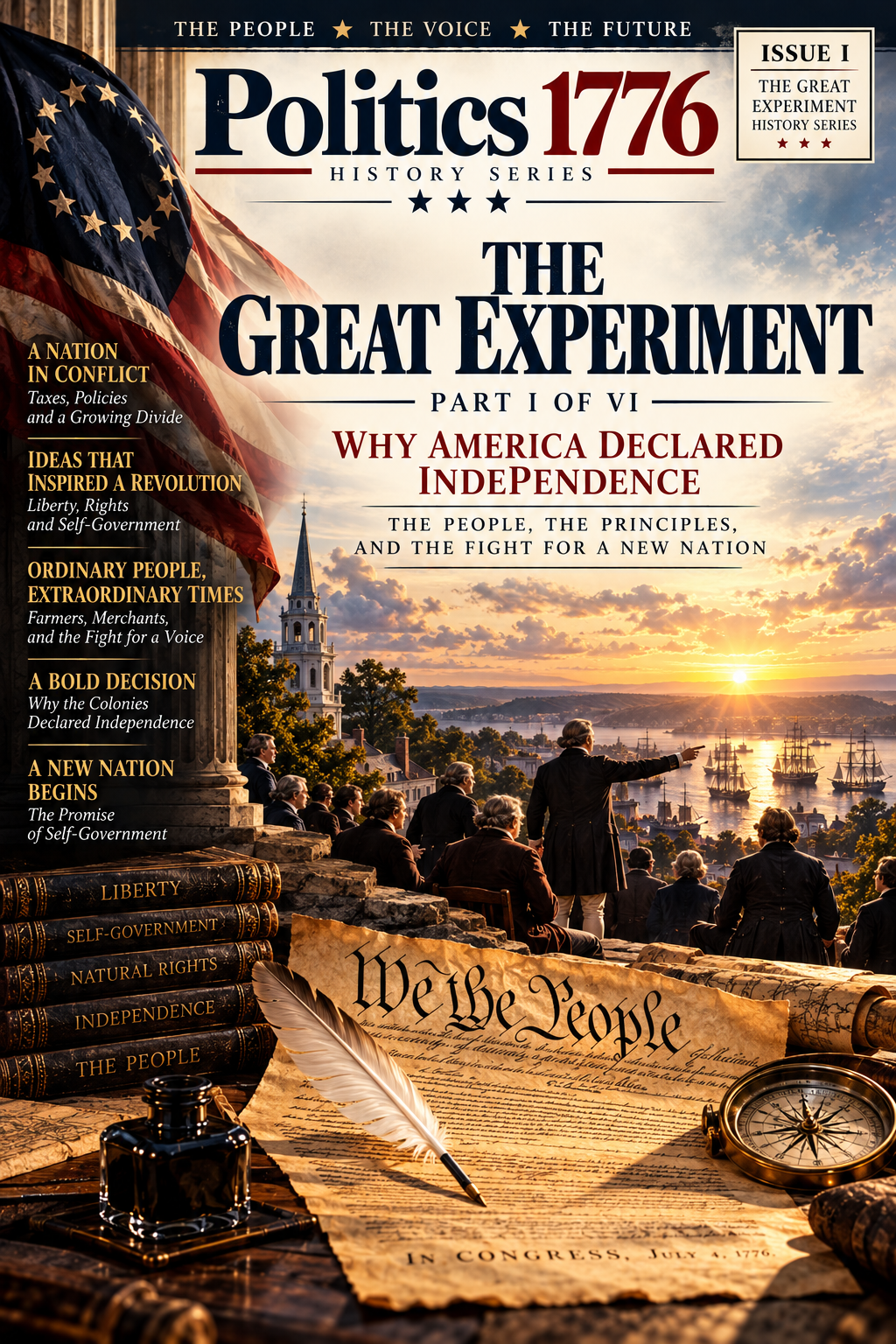
THE GREAT EXPERIMENT
Prologue: They Didn't Invent the Idea. They Dared to Try It.
Before America Was a Country, It Was a Question
It is easy to look backward at the American Revolution and assume that what happened was inevitable.
There are fifty states today.
There is a Constitution.
There is a Congress, a President, courts, elections and more than two centuries of American history behind us.
But none of that existed in 1776.
There wasn't even a guarantee that the thirteen colonies would survive their decision to declare independence.
And perhaps the most remarkable part of the American story is that the people who started it weren't working from a proven blueprint.
They were attempting something uncertain.
Something dangerous.
And for its time, something extraordinary.
They were asking whether a people could build a country in which political authority ultimately came from the people themselves.
The American Idea Had Ancestors
The Founders did not wake up one morning and invent liberty.
They did not invent representative government.
They did not invent republicanism.
They did not invent the idea that rulers should be restrained by law.
Those ideas had been developing for centuries.
More than five hundred years before the Declaration of Independence, English barons forced King John to accept Magna Carta. It was not a democratic document in the modern sense, and it primarily protected the interests of powerful men. But over the centuries it became associated with an enormously important principle:
Even the ruler is subject to law.
American colonists inherited English traditions of common law, representative assemblies and protections they understood as the rights of Englishmen. The National Archives notes that colonial laws incorporated liberties associated with Magna Carta and the English Bill of Rights. National Archives
The Founding generation also inherited ideas from the ancient republics and from generations of European political thinkers.
They read history.
They studied governments that had succeeded.
They studied governments that had collapsed.
They argued about liberty, property, representation, corruption, human nature and political power.
They drew from ideas that existed long before America.
But then they did something different.
They tried to build a country around them.
From Subjects to Citizens
That change is difficult to appreciate from the modern world.
For most of recorded history, ordinary people had not possessed anything resembling the political power Americans now take for granted.
Monarchies and hereditary aristocracies were common features of the political landscape.
Authority frequently traveled downward.
The ruler governed the subject.
The American Revolution advanced a different proposition.
The Declaration of Independence argued that people possessed rights and that governments derived their legitimate powers from the consent of the governed.
That reversed the direction of the political argument.
Government wasn't granting people their fundamental rights.
Government existed to help secure rights people already possessed.
And political authority ultimately came not from a crown—
but from the people.
That was an enormous claim.
But writing it on parchment was the easy part.
Could It Actually Work?
Winning independence would eventually answer one question:
Could the colonies separate from Britain?
It created a much harder one:
Could they govern themselves?
There were republics before the United States.
There were legislatures.
There were constitutions and charters.
There were traditions of limited government.
There were philosophers who had written about natural rights, separation of powers and popular government.
But America now had to turn political philosophy into an operating country.
Thirteen states.
Different economies.
Different religions.
Different interests.
Different laws.
Different sizes.
Different visions of what the new nation should become.
And eventually a continent-sized territory stretching before them.
The experiment was no longer theoretical.
Someone had to collect revenue.
Someone had to settle disputes between states.
Someone had to regulate commerce.
Someone had to conduct foreign policy.
Someone had to provide for national defense.
Someone had to make laws.
Someone had to enforce them.
And somehow they had to accomplish all of that without recreating the kind of concentrated political authority they had just fought a revolution against.
That was the contradiction sitting at the center of the American experiment:
Government needed enough power to govern.
But not so much power that the people ceased to govern themselves.
Their First Answer Didn't Work Very Well
The first American national system reflected the Revolution's suspicion of centralized power.
Under the Articles of Confederation, the states retained extensive authority while the national government remained comparatively weak.
That protected the states from a powerful central authority.
It also created serious problems.
Congress could request money from the states but had difficulty compelling payment. The national government could not effectively regulate interstate and foreign commerce, and disputes among the states threatened the stability of the young union. National Archives
The Americans had discovered something important.
Government could become dangerous when it possessed too much power.
But government could also become ineffective when it possessed too little.
And now the Founding generation faced the problem that would define the next stage of the experiment:
How do you make government stronger without making the people weaker?
Philadelphia, 1787
That question followed the delegates into the Constitutional Convention.
They originally gathered to revise the Articles of Confederation.
Instead, they eventually decided to design an entirely new national framework. National Archives
And they disagreed intensely about what it should look like.
Large states and small states argued over representation.
Delegates argued about national and state power.
They debated the presidency.
They debated taxation.
They debated commerce.
They debated the courts.
They confronted slavery—and made compromises that protected it and carried terrible consequences forward.
Some wanted a stronger national government.
Others feared exactly that.
There was no single "Founders' philosophy."
There were philosophies.
Arguments.
Compromises.
Contradictions.
And competing visions of liberty.
Yet out of those disagreements came something extraordinary.
“We the People”
The Constitution did not begin with the states.
It did not begin with Congress.
It did not begin with the President.
It began:
“We the People of the United States...” National Archives
Those words captured the underlying claim of the new constitutional system.
The National Archives describes the Constitution as vesting the power of the union in the people. National Archives
But the Framers did not simply hand all power to one institution claiming to represent those people.
They divided it.
Congress would make laws.
A President would execute them.
Courts would exercise judicial authority.
Congress itself would be divided between a House and Senate.
Power would be divided again between the national government and the states.
Different institutions would possess different responsibilities.
And the Constitution itself would stand above the ordinary acts of government. The document also contained a mechanism through which future generations could amend it. National Archives
The Founders were not designing a government for a nation in which everyone agreed.
They were designing one for a nation in which people wouldn't.
That Is What Made the Experiment Remarkable
America wasn't remarkable because every political idea behind it was new.
Many weren't.
Its significance was in what the Founding generation attempted to assemble from those ideas.
A republic without a hereditary monarch.
Representative government.
Popular sovereignty.
A written national Constitution.
Separate branches of government.
Checks and balances.
Federalism.
Regular political participation.
A constitutional amendment process.
And, soon afterward, a Bill of Rights placing explicit protections for individual liberties into the constitutional framework.
The system was imperfect from the beginning.
Profoundly so.
Enslaved Americans were denied the liberty proclaimed by the Revolution.
Women lacked equal political participation.
Voting rights were limited.
Native peoples were excluded from the political community envisioned by the new government and would suffer enormously as the nation expanded.
The words “We the People” described an aspiration much larger than the political reality of 1787.
That contradiction cannot be removed from the story.
It is part of the story.
An Experiment, Not a Finished Product
Perhaps that is why The Great Experiment is such an appropriate way to think about the founding.
The Founders didn't create a finished America.
They couldn't have.
They created a framework.
And remarkably, they included a constitutional method for changing that framework.
The National Archives notes that the Constitution produced in Philadelphia became one of the world's longest-lived and most emulated constitutions. National Archives
But its endurance did not mean America stopped changing.
Future generations would abolish slavery.
Expand citizenship.
Expand voting rights.
Change how senators were elected.
Alter presidential succession.
Limit presidents to two elected terms.
And continue debating the meaning of liberty, equality, federalism, representation and government power.
The experiment continued because the original generation did not have the final word.
They Didn't Invent the Dream.
They Put It to the Test.
The Founding generation inherited ideas from people who came before them.
They borrowed.
They studied.
They argued.
They adapted.
And sometimes they contradicted the very principles they proclaimed.
Their accomplishment was not creating political philosophy out of nothing.
It was taking centuries of arguments about liberty, law, rights, representation and political power and saying:
What if we actually try to build a nation around them?
What if government ultimately receives its authority from the people?
What if political power is divided because human beings cannot always be trusted with power?
What if disagreement is expected rather than eliminated?
What if laws govern the rulers as well as the ruled?
What if future generations are permitted to change what the founding generation got wrong?
And above everything else:
Can a people govern themselves?
They didn't know the answer.
There was no United States of America to point toward as proof.
There were only thirteen former colonies, an uncertain future and an extraordinary political gamble.
So they built the framework.
They handed it to the people.
And the experiment began.
THE GREAT EXPERIMENT
They didn't finish it.
They started it.
And every generation since has inherited it.
The People. The Voice. The Future.
Politics 1776
About Politics 1776
Speak up. Share what matters. Get involved. Make your voice heard.
Politics 1776 is a private, independent, grassroots, citizen-driven movement dedicated to putting the voice of the American people back at the center of the conversation. Our country was founded on the idea that government gets its power from the people—not the other way around. We believe that principle still matters today.
Politics 1776 is a place to learn, question, discuss, share ideas, and speak up about the issues affecting our lives, our families, our communities, and our future. We believe people should be willing to ask questions, challenge the status quo, and make sure their elected representatives know what they think.
We don't expect everyone to agree. A healthy democracy depends on people being willing to have honest conversations, hear different perspectives, and respectfully challenge one another. Our goal is not to tell people what to think, but to encourage people to think, participate, and use their own voice.
Politics 1776 is not affiliated with or operated by any political party, candidate, campaign, or government organization. We are a private and independent effort created around a simple idea: the people should have a voice in the government that represents them.
We encourage everyone to participate in our democracy—by learning about the issues, asking questions, sharing ideas, voting, contacting elected representatives, and getting involved in their communities. Speak up, but do it responsibly. Follow the law, respect others, disagree without hatred or threats, and let your voice be heard through peaceful and lawful civic participation.
This isn't about Washington speaking for the people.
It's about the people speaking for themselves.
Government works for the people—not the other way around.
Our money matters. Our choices matter. Our voice matters.