

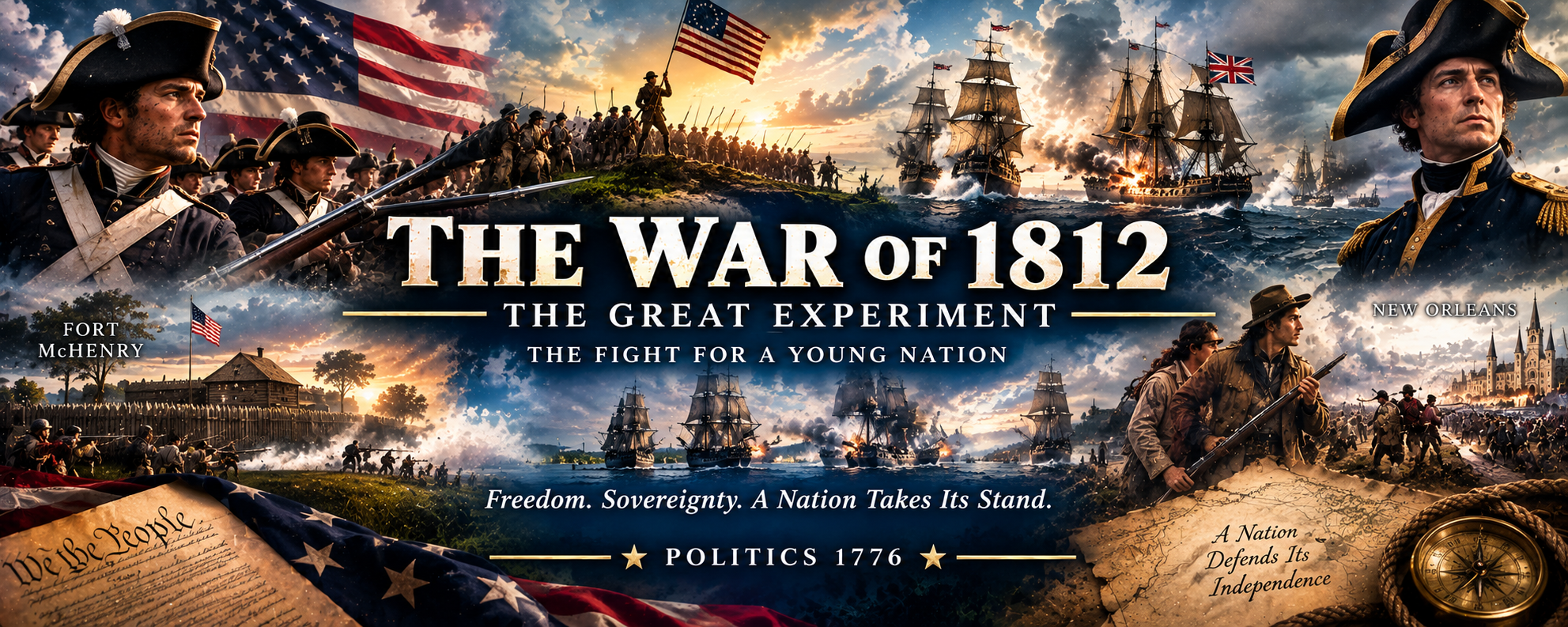
THE WAR OF 1812
When the Young Republic Was Tested
America had won its independence.
The British had recognized the United States as a sovereign nation.
George Washington had become the first president.
A Constitution had been written.
A new capital was rising along the Potomac.
The Capitol was being built.
The President's House was being built.
America was becoming a country.
But independence was still young.
And the relationship with Britain was far from settled.
In 1812, less than three decades after the Revolutionary War, the United States found itself at war with its former ruler once again.
This time, the question was not whether America could declare independence.
It was whether the young republic could defend it.
WHY DID AMERICA GO TO WAR?
The War of 1812 did not have one simple cause.
Europe had been at war for years as Napoleon's France fought Britain and much of the continent.
Britain attempted to restrict neutral trade with France, and the Royal Navy began stopping American ships.
There was another issue that angered Americans even more:
impressment.
British naval forces took sailors from American vessels and forced some of them into British service.
To Americans, this was an attack on the sovereignty of their country and the freedom of its citizens.
There were also disputes over Britain's presence and influence in North America, trade restrictions, and British relationships with Native nations resisting American expansion.
The United States was divided over what to do.
Some Americans demanded war.
Others feared that war would destroy American commerce.
New England merchants in particular had strong economic ties to Britain and often opposed the conflict.
The country was young.
Its military was small.
Its government had limited resources.
And yet, on June 18, 1812, President James Madison signed the declaration of war against Great Britain.
The United States had entered its second major war as an independent nation.
A WAR AMERICA EXPECTED TO WIN
Some American leaders believed the war could be relatively short.
Britain was already fighting Napoleon in Europe.
American leaders believed British North America—particularly Canada—could be attacked while Britain was occupied elsewhere.
That calculation proved badly mistaken.
American invasions of Canada failed.
American forces suffered defeats.
The British navy was vastly larger than the American navy.
And Britain eventually redirected more military resources toward North America after Napoleon's defeat.
The war that some Americans expected to be quick became a three-year struggle.
The United States was learning a difficult lesson:
Declaring independence and defending independence were two very different things.
THE WAR AT SEA
The United States Navy was tiny compared with Britain's Royal Navy.
Britain possessed hundreds of warships.
America had only a handful of major naval vessels.
Yet some American ships achieved remarkable victories.
The USS Constitution, later nicknamed “Old Ironsides,” defeated HMS Guerriere in August 1812.
The victory became an enormous boost to American morale.
Other American naval victories followed.
But Britain eventually imposed a blockade along much of the American coast.
American trade suffered.
Ports struggled.
The young country's economy was under pressure.
The war was becoming more than a military contest.
It was testing whether the United States could function as an independent nation under wartime pressure.
THE WAR COMES HOME
For much of the early war, the fighting occurred far from Washington.
Then, in 1814, the situation changed.
Britain defeated Napoleon in Europe.
British forces could now devote greater attention to North America.
An expedition moved toward Washington.
American forces attempted to stop it near Bladensburg, Maryland.
They failed.
The road to the capital was open.
On August 24, 1814, British troops entered Washington.
And then something happened that Americans would remember for generations.
They burned the capital.
THE NIGHT WASHINGTON BURNED
The Capitol was still unfinished.
The House and Senate occupied separate wings connected by a temporary wooden passage.
The building was not yet the magnificent structure Americans know today.
British troops entered the Capitol and set fire to it.
The Library of Congress was inside.
The House chamber was burned.
The Senate chamber was burned.
The Supreme Court chamber was damaged.
Furniture, records, artwork, and books were destroyed.
The Capitol became, in the words later used by architect Benjamin Henry Latrobe, a “most magnificent ruin.”
The White House was also burned.
Other public buildings were destroyed or damaged.
The navy yard was attacked.
Washington had been invaded.
The government had been driven from its capital.
And the young republic had suffered one of the most humiliating moments in its early history.
But something else happened.
The government did not surrender.
Congress found temporary quarters.
The work continued.
The buildings could be rebuilt.
The republic could continue.
DOLLEY MADISON
One of the most enduring stories from the night Washington burned involves Dolley Madison.
As British forces approached the city, Dolley remained at the White House while others fled.
She helped ensure that important objects were removed from the building, including the famous portrait of George Washington.
The painting could not simply be lifted from the wall, so its frame was broken to allow the portrait to be removed.
The story has become part of American memory because it captures something larger than one painting.
The nation's capital was collapsing around the people who lived there.
And they were trying to save pieces of the country's history.
The White House could burn.
The Capitol could burn.
But the memory of the republic could survive.
THE FLAG OVER FORT McHENRY
The following month, another event in the Chesapeake would create one of America's most recognizable national symbols.
British forces attacked Baltimore.
Their ships bombarded Fort McHenry on September 13, 1814.
The bombardment lasted approximately 25 hours.
American forces refused to surrender.
As the British fleet withdrew, the enormous American garrison flag was raised over the fort.
A lawyer and amateur poet named Francis Scott Key had been watching the attack from aboard a ship.
When he saw the American flag still flying, he began writing the words that would become “The Star-Spangled Banner.”
The poem would eventually become America's national anthem.
The flag became a symbol of survival.
Not because America had won the war.
The war was still being fought.
But because, after a night of bombardment, the flag was still there.
THE WAR WAS NOT OVER
While Washington had burned and Baltimore had resisted, fighting continued across North America.
The Great Lakes became an important theater.
The western frontier became another.
Native nations played a major role in the conflict.
Many Native leaders saw the United States' expansion as an existential threat to their lands and sovereignty.
Some allied with Britain in hopes of stopping or limiting American expansion.
One of the most important Native leaders was Tecumseh, who sought to unite Native nations in defense of their territories.
He was killed at the Battle of the Thames in October 1813.
His death weakened the Native confederacy he had worked to build.
For Native peoples, the consequences of the war were profound.
Britain's eventual peace with the United States removed an important ally, while American expansion continued afterward.
The War of 1812 therefore cannot be understood only as a story between Washington and London.
It was also a war involving Native nations fighting for their own interests, lands, and sovereignty.
AND THEN CAME NEW ORLEANS
By late 1814, diplomats were already negotiating peace.
American and British representatives met in Ghent, Belgium.
On December 24, 1814, they signed the Treaty of Ghent.
But there was a problem.
News traveled slowly.
The treaty still had to be ratified.
And American soldiers in the South did not yet know that peace had been agreed upon.
On January 8, 1815, American forces under Andrew Jackson defeated a major British force at the Battle of New Orleans.
It was a stunning American victory.
It also created one of the most unusual endings in American military history.
The battle occurred after the peace treaty had been signed, but before the news of that treaty had reached the armies.
The soldiers at New Orleans were still fighting a war that diplomats had already agreed to end.
THE TREATY OF GHENT
The Treaty of Ghent did not dramatically redraw the map.
In fact, the basic territorial situation was largely restored to what it had been before the war.
There was no great American conquest of Canada.
There was no British conquest of the United States.
Neither side achieved everything it had wanted.
The treaty essentially restored peace and ended the conflict.
The United States Senate approved it, and the formal exchange of ratifications brought the war to an end in February 1815.
So was the war a victory?
The answer depends on what question is being asked.
America did not conquer Canada.
The treaty did not give the United States major territorial gains.
The war cost thousands of lives.
Washington had been burned.
The economy had suffered.
Yet America had survived another war with Britain.
The young republic remained independent.
And the experience changed the country.
A YOUNG COUNTRY GROWS UP
The War of 1812 exposed weaknesses in America's military system.
The country needed a stronger regular army.
It needed better coastal defenses.
It needed a stronger navy.
It needed better transportation and communication.
The war also strengthened American manufacturing because wartime conditions made imported British goods harder to obtain.
Americans had to produce more of what they needed themselves.
The conflict also contributed to a stronger sense of national identity.
The United States had survived another confrontation with the British Empire.
It had survived the burning of its capital.
It had survived military defeats.
It had survived economic pressure.
And it had come through the other side.
The republic was still standing.
BUT HISTORY HAS ANOTHER SIDE
There is another part of this story that should not be forgotten.
The war had consequences that were very different depending on who you were.
For many Americans, the conflict strengthened national identity.
For Native nations, the aftermath was devastating.
The loss of British support opened the way for further American expansion into Native lands.
For enslaved people, the war exposed a profound contradiction.
The United States was fighting to defend its independence and national sovereignty while slavery remained embedded in American society.
Thousands of enslaved people sought freedom by fleeing to British forces, which offered freedom to those who escaped and served the Crown.
Black Americans participated in the war on both sides.
The conflict therefore revealed something important about the young republic:
America could defend the idea of independence while still struggling to fully define freedom.
That contradiction would not disappear.
It would become part of the larger American story.
THE CAPITOL RISES AGAIN
Perhaps the most fitting ending to the War of 1812 is not a battlefield.
It is Washington.
The Capitol had burned.
The government had been displaced.
The building could have remained a ruin.
Instead, Americans rebuilt it.
Congress temporarily occupied the Old Brick Capitol while the damaged Capitol was reconstructed. Work resumed, and the building continued evolving into the structure that would eventually become the center of the legislative branch.
The White House was rebuilt too.
The capital continued to grow.
The government continued to operate.
The country continued.
That is more than architecture.
It is a statement.
**They burned the buildings.
They did not burn the idea.**
WHAT THE WAR OF 1812 LEFT BEHIND
The War of 1812 is sometimes called America's forgotten war.
Perhaps that is because it does not fit neatly into a simple victory story.
It began with legitimate American grievances.
It included political divisions at home.
It included military failures.
It included moments of extraordinary courage.
It included the burning of Washington.
It produced the Star-Spangled Banner.
It involved Native nations defending their interests.
It involved enslaved people seeking freedom.
It ended with a treaty that largely restored the status quo.
And yet, the country that emerged from the war was not quite the same country that entered it.
The United States had been tested.
Its institutions had been tested.
Its military had been tested.
Its people had been tested.
And the republic survived.
THE GREAT EXPERIMENT
The Revolutionary War had answered one question:
Could America become independent?
The War of 1812 asked another:
Could the young republic defend that independence?
The answer was not simple.
America lost battles.
America suffered enormous destruction.
America's capital burned.
But the government survived.
The Constitution survived.
The country survived.
And the American experiment continued.
That is why the War of 1812 belongs in the story of the White House and the Capitol.
Those buildings were not simply monuments.
They were still being built when the British came.
They burned when the country was young.
And Americans rebuilt them afterward.
The buildings changed.
The country changed.
The people changed.
But the experiment continued.
A COUNTRY IS NOT BUILT IN A DAY.
IT IS BUILT EVERY DAY.
THE GREAT EXPERIMENT CONTINUES.
THE PEOPLE. THE VOICE. THE FUTURE.
POLITICS 1776