THE GREAT EXPERIMENT — WORLD WAR II
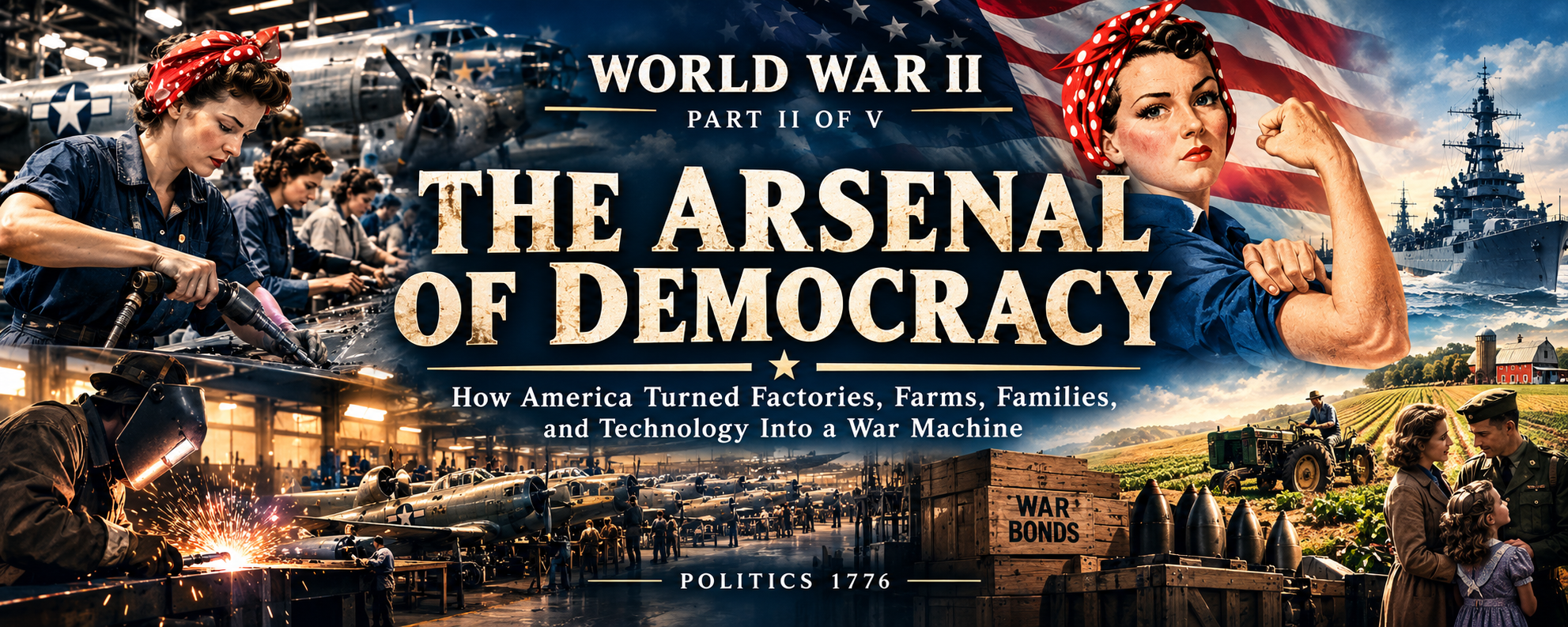
PART II OF V
THE ARSENAL OF DEMOCRACY
How America Turned Factories, Farms, Families, and Technology Into a War Machine
When the United States entered World War II in December 1941, America was not fully prepared for the scale of the war that followed.
The country had a powerful industrial economy.
It had enormous natural resources.
It had factories, railroads, shipyards, farms, engineers, scientists, mechanics, machinists, farmers, truck drivers, welders, electricians, and millions of workers.
But turning all of that into a coordinated war effort was another matter entirely.
The United States had to build an extraordinary amount of equipment—and build it quickly.
Aircraft.
Ships.
Tanks.
Trucks.
Artillery.
Ammunition.
Engines.
Radios.
Uniforms.
Food.
Fuel.
Medical supplies.
And the list seemed almost endless.
President Franklin Roosevelt had already described the challenge before Pearl Harbor.
In December 1940, he told Americans:
“We must be the great arsenal of democracy.”
The phrase became a description of something much larger than government.
America's wartime arsenal was built by factories, businesses, workers, farmers, engineers, scientists, families, and communities.
The government organized.
Industry produced.
Workers built.
And millions of Americans sacrificed.
The Great Experiment had entered a new phase.
FROM CARS TO BOMBERS
One of the most remarkable parts of the American war effort was the transformation of existing industries.
America already knew how to manufacture automobiles on a massive scale.
Now that industrial knowledge could be redirected toward war.
Ford Motor Company became one of the most visible examples.
At Willow Run, Michigan, Ford built an enormous factory specifically for producing B-24 Liberator bombers.
The plant became one of the largest single-story manufacturing facilities in the world.
At its peak, approximately 47,000 people worked there.
Men and women assembled aircraft components, installed engines, riveted fuselages, inspected finished planes, and prepared bombers for flight.
By June 1945, Willow Run had assembled 6,791 B-24s and supplied parts for another 1,893 bombers assembled elsewhere.
This was not simply an automobile factory making a few airplanes on the side.
It was an industrial transformation.
The same basic American idea that had once helped put millions of people behind the wheel of a Model T was now being applied to the production of military aircraft.
Standardization.
Assembly lines.
Interchangeable parts.
Specialized workers.
Mass production.
Logistics.
Quality control.
The factory itself became part of the war.
And Ford was not alone.
Across America, automobile companies, steel companies, aircraft manufacturers, machine-tool companies, chemical companies, electrical manufacturers, shipyards, and thousands of smaller suppliers were pulled into the effort.
The country did not simply manufacture weapons.
It manufactured the ability to manufacture weapons.
That distinction mattered.
THE FACTORY FLOOR BECAME A BATTLEFIELD OF A DIFFERENT KIND
There was no enemy aircraft overhead at Willow Run.
No artillery was falling on the factory floor.
But the work mattered to the people fighting overseas.
Every aircraft had to be assembled.
Every engine had to work.
Every rivet had to hold.
Every radio had to function.
Every truck had to move.
Every replacement part had to arrive.
A war could be lost because soldiers ran out of ammunition.
Ships could be immobilized without spare parts.
Aircraft could remain grounded without engines.
Armies could stop moving without fuel.
The battlefield depended on an enormous industrial system behind it.
That system required organization on a scale Americans had rarely seen.
And it required something even more important:
People willing to do the work.
ROSIE WAS REAL
The image of Rosie the Riveter became one of the most recognizable symbols of the American home front.
But behind the poster were millions of real women.
As millions of men entered military service, American industries needed workers.
Women moved into jobs that had previously been heavily dominated by men.
They worked in aircraft plants.
Shipyards.
Factories.
Machine shops.
Transportation.
Offices.
Laboratories.
And other parts of the war economy.
The change was enormous.
The National Archives describes World War II as a total war that required not only military service but the reorientation of civilian industry and daily life.
Women did not suddenly become part of America's economy during World War II. Women had always worked.
What changed was the scale and the kinds of industrial jobs available to them.
The war opened doors that had previously been much harder to enter.
And millions walked through them.
At Willow Run, for example, thousands of women worked directly in bomber production.
They were not simply symbols.
They were workers.
They were earning paychecks.
They were learning skills.
They were building aircraft.
They were helping keep the production system moving.
The war would change expectations about what women could do in American industry.
But the changes were complicated.
Many women were encouraged into wartime jobs because the country needed them. After the war, many faced pressure to leave those jobs as millions of servicemen returned.
The lesson was not that the war permanently solved every question about women and work.
It demonstrated something simpler:
The American workforce was capable of doing far more than many people had previously assumed.
AMERICA BUILT SHIPS
Aircraft get much of the attention.
But a global war requires ships.
Lots of them.
Troop transports.
Cargo ships.
Destroyers.
Submarines.
Cruisers.
Aircraft carriers.
Landing ships.
Tankers.
Repair ships.
Escort carriers.
The Navy expanded dramatically.
Shipyards expanded.
New shipyards appeared.
And American industry learned how to build ships at extraordinary speed.
The aircraft carrier became especially important.
At the beginning of the war, the United States Navy had only a limited number of first-line carriers.
As the war expanded, the construction program accelerated dramatically.
By the end of 1943, more than 50 carriers of various types had entered Navy service.
Aircraft carriers would become one of the defining weapons of the Pacific War.
They allowed aircraft to bring air power far beyond the reach of land-based airfields.
They changed naval warfare.
And they demonstrated another lesson of industrial war:
Technology changes the battlefield.
But production determines how much technology can actually be put into the fight.
THE AMERICAN FARM
Not every contribution came from a factory.
America also had to feed itself—and its allies.
Farmers faced their own wartime demands.
Farm labor was disrupted as workers entered military service or moved into defense industries.
Farmers had to produce more with fewer available workers and changing markets.
Food became a strategic resource.
The home front was encouraged to conserve food and grow more of it.
Victory Gardens appeared across the country.
Backyards.
Schoolyards.
Community gardens.
Vacant lots.
People planted vegetables because food was needed.
The National Archives notes that Victory Gardens became a significant part of the home-front effort, with backyard production eventually accounting for an estimated 40 percent of America's fresh fruits and vegetables.
A garden might seem small compared with a battleship.
But World War II was built from millions of small contributions.
A garden.
A ration book.
A war bond.
A factory shift.
A scrap-metal collection.
A train carrying supplies.
A farmer working another field.
A woman learning a new machine.
A child collecting materials.
A family saving gasoline.
None of these things won a battle by itself.
Together, they became part of the war effort.
RATIONING: WHEN AMERICA HAD TO DO WITH LESS
America was producing enormous quantities of military equipment.
That meant fewer resources were available for civilian consumption.
Gasoline was rationed.
Tires were restricted.
Sugar was rationed.
Meat and other goods were affected by wartime controls.
The government established price controls and rationing programs to manage scarce resources and reduce inflationary pressures.
For ordinary Americans, the war became personal.
You could not simply buy whatever you wanted whenever you wanted it.
You had to make choices.
Drive less.
Save fuel.
Reuse materials.
Repair things.
Grow food.
Wait for products.
Accept substitutes.
Buy war bonds.
The war effort reached into the kitchen, the garage, the grocery store, and the family budget.
It was not glamorous.
But it was part of the price of total war.
WAR BONDS
The government needed enormous amounts of money.
Americans were encouraged to buy war bonds.
A person did not have to be a soldier to contribute financially to the war effort.
A factory worker could buy bonds.
A teacher could buy bonds.
A family could buy bonds.
A child could save money and purchase a bond.
The message was simple:
If the country was fighting a war, everyone could contribute something.
The government borrowed from the American public while using taxation and other financial measures to fund the enormous cost of mobilization.
The home front was not simply watching the war.
It was helping finance it.
SCIENCE ENTERS THE WAR
World War II was also a war of science.
Radar.
Sonar.
Aircraft technology.
Long-range communications.
Improved navigation.
Medical research.
Penicillin production.
The proximity fuze.
Nuclear physics.
Computing and codebreaking.
Some technologies already existed before the war.
Others were developed or accelerated because the military demanded solutions to enormous problems.
Radar could help detect aircraft and ships.
Sonar helped locate objects beneath the water.
The proximity fuze allowed certain artillery shells to explode when they came near their target rather than requiring a direct impact.
Medicine advanced rapidly because armies had to treat enormous numbers of wounded people.
And behind all of it were scientists, engineers, technicians, universities, laboratories, factories, and military organizations working together.
The war demonstrated something that would become increasingly important in modern America:
Scientific knowledge could become national power.
But it also created difficult questions.
How much should government direct scientific research?
How much should private industry control?
What happens when scientific discoveries become weapons?
Those questions did not disappear when the war ended.
They became part of the modern world.
CODE TALKERS
Some of America's wartime contributions came from communities whose members had not always been treated equally by the country they were defending.
Native American servicemen played important roles in the war.
Among the most famous were the Navajo Code Talkers.
The original group of 29 Navajo Marines developed a code based on the Navajo language for military communications.
More than 400 Navajo Marines eventually served as code talkers.
Other Native American languages were also used in military communications.
Their work demonstrated a powerful reality of American history:
A country can contain contradictions.
The United States was fighting for its survival and for principles of freedom while many Americans at home still faced discrimination and unequal treatment.
The war did not erase those contradictions.
But the contributions of people who served helped expose them.
THE COST OF MOBILIZATION
The American home front was often remembered as a story of unity.
There was certainly enormous cooperation.
But unity should not be confused with equality.
Japanese Americans experienced one of the darkest examples.
Following Pearl Harbor, the federal government forcibly removed and incarcerated more than 100,000 people of Japanese ancestry, most of them U.S. citizens.
Families lost homes, businesses, farms, and freedom.
The policy remains one of the clearest examples of how fear during wartime can collide with constitutional rights.
It belongs in this story because World War II was not a simple story in which America always lived up to its ideals.
America fought a war against dictatorships and militarism.
At the same time, America made decisions that denied liberty to some of its own people.
Both facts are part of the history.
A serious history has to hold them together.
AN AMERICA THAT COULD BUILD
By 1944, American industrial production had reached its wartime peak.
The United States was producing aircraft, ships, vehicles, weapons, ammunition, fuel, food, communications equipment, and supplies on a massive scale.
American industry had become one of the foundations of Allied military power.
But it is important not to turn this into a simplistic story.
Industrial production alone did not win World War II.
Millions of Allied soldiers, sailors, Marines, airmen, resistance fighters, and civilians fought and suffered.
The Soviet Union endured enormous losses on the Eastern Front.
Britain survived years of war.
China had been fighting Japan since 1937.
The Allied victory was the result of many nations, many armies, many battles, enormous sacrifice, and years of fighting.
But American production mattered enormously.
The country had discovered that its industrial capacity could be transformed on a scale few had imagined.
The automobile factory could build aircraft.
The shipyard could build vessels faster than anyone expected.
The farm could feed an army.
The laboratory could produce technologies that changed warfare.
The worker could learn a new skill.
The family could sacrifice.
The citizen could contribute.
The nation could mobilize.
THE GREAT EXPERIMENT
This is where World War II becomes part of the larger American story.
The Great Experiment has never been about proving that America is perfect.
It is about discovering what a free society can build—and whether its institutions can respond when history demands something extraordinary.
During World War II, America was asked to do something enormous.
It had to turn a peacetime economy into a wartime economy.
It had to coordinate government, business, labor, science, agriculture, transportation, finance, and millions of ordinary citizens.
And it did.
Not without mistakes.
Not without injustice.
Not without arguments.
But on a scale that changed the world.
The American worker became part of the military supply chain.
The factory became part of the battlefield.
The scientist became part of national defense.
The farmer became part of the logistics system.
The family became part of the war.
And the citizen became part of the effort.
That is the deeper story behind the phrase:
The Arsenal of Democracy.
It was not just a collection of factories.
It was a country mobilizing its people.
WHAT AMERICA BUILT
The machines of World War II were enormous.
But the most important thing America built was not an airplane.
It was not a tank.
It was not a ship.
It was a system capable of taking millions of individual efforts and turning them into something much larger.
A factory worker did not need to know where his part would eventually go.
A farmer did not need to know which soldier would eat the food he produced.
A woman riveting an aircraft did not need to know the name of the pilot who would fly it.
A family buying a war bond did not need to know which ship their money helped support.
They simply did their part.
And millions of individual parts became a national effort.
That may be one of the most important lessons of the American home front.
Great things are rarely built by one person.
They are built by people doing their part.
THE GREAT EXPERIMENT CONTINUES
World War II changed America.
It changed American industry.
It changed the role of women in the workforce.
It accelerated science and technology.
It expanded the federal government's role in managing the economy.
It transformed America's relationship with the rest of the world.
And it left behind a generation that would spend the rest of its life living in the world created by the war.
But the story is not finished.
The factories have quieted.
The ration books are gone.
The bombers no longer roll down Willow Run's assembly lines.
The victory gardens have disappeared from most backyards.
The men and women who built the arsenal have mostly passed into history.
But the question they left behind remains:
What can a free people build when they decide that something matters?
Part III will leave the factories and return to the battlefield.
North Africa.
The Atlantic.
The Pacific.
Midway.
Guadalcanal.
Europe.
D-Day.
The island campaigns.
The skies over Europe.
And the soldiers, sailors, Marines, airmen, and allies who carried the machines built at home into war.
The arsenal had been built.
Now it had to be used.
THE GREAT EXPERIMENT CONTINUES.
THE PEOPLE. THE VOICE. THE FUTURE.
Politics 1776