THE GREAT EXPERIMENT — WORLD WAR II
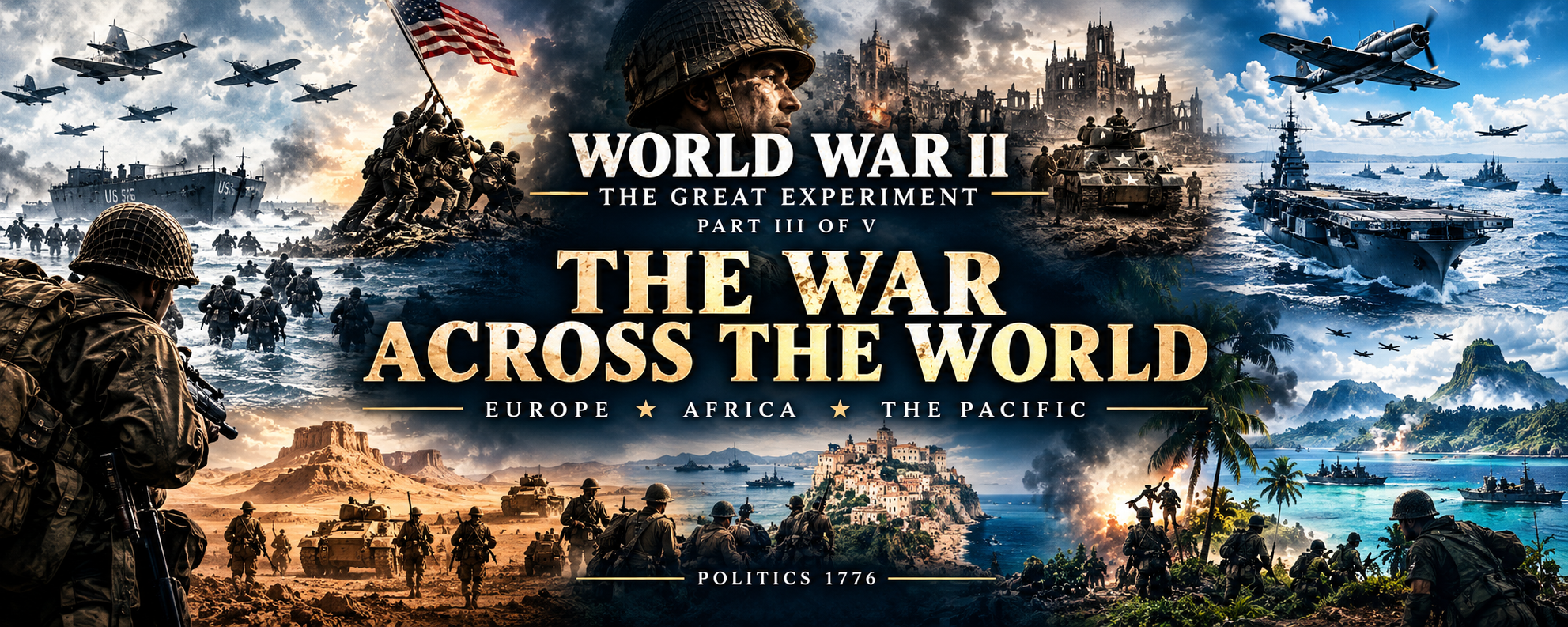
PART III OF V
THE WAR ACROSS THE WORLD
Europe. Africa. The Pacific. One War That Reached Across the Globe.
In Part I, America watched the world move toward war.
In Part II, America became an arsenal.
Now the story moves to the places where those weapons were used.
World War II was not one battlefield.
It was a war spread across oceans, deserts, islands, cities, mountains, forests, beaches, and skies.
American forces would fight in North Africa.
Across the Mediterranean.
Through Italy.
Across the Atlantic.
In the skies over Europe.
On the beaches of Normandy.
Across France and Belgium.
And thousands of miles away, across the Pacific.
The war would demand almost everything.
And it would take an enormous human toll.
THE WAR BEGINS TO TURN
The early years of the war belonged largely to the Axis powers.
Germany controlled much of continental Europe.
Japan had conquered enormous areas of Asia and the Pacific.
But by 1942, the direction of the war began to change.
It did not happen in one battle.
It happened through a series of battles and campaigns.
In the Pacific came the Coral Sea and Midway.
In Europe and North Africa came the Allied buildup.
Then Guadalcanal.
Then North Africa.
Then Sicily and Italy.
Then Normandy.
The road to victory would take years.
MIDWAY — A BATTLE OF CARRIERS AND CODE
Six months after Pearl Harbor, the United States faced Japan at Midway.
The Japanese plan was ambitious.
Japanese commanders hoped to capture Midway Atoll and draw the American Pacific Fleet into a battle where it could be destroyed.
But American codebreakers had learned enough about Japanese plans to give U.S. commanders an extraordinary advantage.
The battle began in June 1942.
Japanese aircraft attacked Midway.
American aircraft attacked the Japanese carrier force.
The fighting was chaotic.
Some American attacks suffered devastating losses.
But American dive bombers eventually found the Japanese carriers.
Four Japanese fleet carriers were lost.
The battle did not end the Pacific War.
But it changed the strategic situation.
Japan had suffered a major carrier loss at a moment when replacing experienced crews and ships would become increasingly difficult.
The United States, meanwhile, was beginning to bring its enormous industrial capacity into the war.
The Pacific would still be brutally difficult.
But the direction had changed.
GUADALCANAL — THE FIRST MAJOR OFFENSIVE
In August 1942, American Marines landed on Guadalcanal and Tulagi in the Solomon Islands.
It was the first major American offensive operation against Japanese forces in the Pacific.
The objective included an unfinished Japanese airfield on Guadalcanal.
That airfield became Henderson Field.
The battle that followed lasted roughly six months.
It was fought on land.
At sea.
And in the air.
American and Japanese forces repeatedly fought for control of the waters surrounding the island.
Ships were sunk.
Aircraft were destroyed.
Men fought in jungle terrain under brutal conditions.
Disease and exhaustion became enemies of their own.
The fighting was so intense that Guadalcanal became one of the defining campaigns of the Pacific War.
By February 1943, Japanese forces had withdrawn.
The United States had gained more than an island.
It had gained momentum.
The Pacific War had become an American offensive rather than simply a desperate defense against Japanese expansion.
NORTH AFRICA — THE AMERICANS ENTER THE WAR
While the Pacific fighting continued, American forces were also entering the war against Germany and Italy.
In November 1942, American and British forces landed in French North Africa.
The operation was enormous.
American troops were entering a theater where German and Italian forces were already fighting British forces.
The campaign eventually pushed Axis forces out of North Africa.
But it was not easy.
American troops experienced hard fighting and difficult lessons.
At Kasserine Pass in February 1943, German forces under Field Marshal Erwin Rommel and other Axis units badly defeated elements of the inexperienced U.S. II Corps.
The defeat was painful.
But the American Army adapted.
Leadership changed.
Training improved.
Tactics improved.
And the lessons of North Africa would follow American troops into later campaigns.
By May 1943, roughly 275,000 German and Italian troops surrendered in Tunisia.
North Africa had become an Allied base for the next step.
The next target was Sicily.
SICILY — THE DOOR TO ITALY
In July 1943, Allied forces invaded Sicily.
The operation combined American, British, and Canadian forces.
The island was captured over the following weeks.
The campaign also exposed the weakness of Fascist Italy.
On July 25, Benito Mussolini was removed from power.
Italy eventually surrendered to the Allies in September.
But the war in Italy did not end.
Germany occupied much of the country and continued fighting.
The Italian campaign became a long, difficult advance through mountains, valleys, rivers, towns, and fortified positions.
Places such as Anzio and Monte Cassino became symbols of the difficulty.
The Allies eventually captured Rome in June 1944.
But fighting continued northward.
Italy demonstrated a lesson that would be repeated throughout the war:
Capturing territory is one thing. Defeating an army is another.
THE BATTLE IN THE SKY
While armies fought on the ground, another war was taking place thousands of feet above them.
The Allied bombing campaign against Germany expanded dramatically.
British bombers generally conducted large-scale nighttime raids.
American heavy bombers increasingly conducted daylight bombing operations.
The combination created an extraordinary aerial campaign.
Thousands of aircraft crossed Europe.
German fighters rose to meet them.
Anti-aircraft guns filled the sky.
Crews navigated through darkness, clouds, smoke, flak, and enemy aircraft.
The bombing campaign targeted military and industrial objectives, transportation networks, oil production, and cities.
It also caused enormous civilian destruction.
That reality cannot be separated from the history.
Strategic bombing became one of the most controversial aspects of the war.
Supporters argued that destroying industrial and transportation capacity could weaken Germany's ability to fight.
Critics questioned the military effectiveness and human cost of attacks that caused large civilian casualties.
Both the technological achievement and the human consequences belong in the story.
The skies over Europe had become another battlefield.
D-DAY
By 1944, the Allies were preparing for the operation that had been planned for years.
A massive invasion of Nazi-occupied France.
The operation was called Overlord.
The date was June 6, 1944.
D-Day.
More than 175,000 Allied soldiers, sailors, and airmen were involved in the initial invasion operation.
Aircraft carried airborne troops behind German lines.
Ships carried soldiers toward the French coast.
Warships bombarded German defenses.
Landing craft moved toward the beaches.
The operation depended on an enormous amount of coordination.
And there was no guarantee it would work.
Weather threatened the operation.
German defenses remained strong.
The invasion fleet was enormous.
And thousands of young men were about to step into one of the most heavily defended coastlines in history.
General Dwight Eisenhower had written a message to the invasion force.
It began:
“Soldiers, Sailors, and Airmen of the Allied Expeditionary Force!”
He told them:
“The eyes of the world are upon you.”
Then came the moment.
The landing craft approached the beaches.
Men climbed down.
Machine guns opened fire.
Artillery struck.
Aircraft filled the sky.
The beaches became chaos.
But the Allied forces established a foothold.
The invasion had succeeded.
Not perfectly.
Not easily.
But it had succeeded.
And from Normandy, the liberation of Western Europe began.
THE PRICE OF THE BEACHES
It is easy to look at a map and see D-Day as an arrow pointing toward Germany.
For the people who landed there, it was something completely different.
It was fear.
Noise.
Confusion.
Smoke.
Water.
Blood.
Friends disappearing.
Men trying to move forward while others were trying simply to survive.
The beaches have names now known around the world:
Utah.
Omaha.
Gold.
Juno.
Sword.
But each name represents thousands of individual stories.
Some men were wounded.
Some survived.
Some never left the beach.
And some carried memories of that day for the rest of their lives.
D-Day was not simply a military operation.
It was a human event.
BREAKING OUT OF NORMANDY
The invasion created a foothold.
But the Allies still had to break out.
Fighting through Normandy was difficult.
Hedgerows, fortified positions, difficult terrain, and determined German resistance slowed the advance.
Eventually, the Allied armies broke through.
American forces pushed west and south.
British and Canadian forces fought eastward.
The German position in France began to collapse.
Paris was liberated in August 1944.
The war was moving toward Germany.
But the Germans were not finished.
THE BATTLE OF THE BULGE
In December 1944, Germany launched a major offensive through the Ardennes.
The goal was to split the Allied armies and reach the port of Antwerp.
The surprise attack created a huge German advance.
The shape of the front gave the battle its name:
The Battle of the Bulge.
American troops were suddenly fighting a major German offensive in winter conditions.
At Bastogne, American forces became surrounded.
The German commander demanded surrender.
Brigadier General Anthony McAuliffe's famous reply was:
“Nuts!”
The meaning was clear enough.
The Americans were not surrendering.
The siege continued.
American forces eventually broke through.
The German offensive failed.
It had cost Germany enormous numbers of men and equipment it could not easily replace.
The war in Europe was entering its final months.
THE PACIFIC WAS A DIFFERENT WAR
While Europe moved toward liberation, the Pacific was a completely different battlefield.
There were no Normandy-style fronts stretching across a continent.
Instead, the war moved from island to island.
Guadalcanal.
New Guinea.
The Solomon Islands.
The Gilbert Islands.
The Marshall Islands.
The Marianas.
The Philippines.
Iwo Jima.
Okinawa.
Each island presented a new problem.
Distance.
Weather.
Terrain.
Disease.
Naval warfare.
Air power.
And determined resistance.
The United States developed a strategy sometimes described as island hopping—capturing strategically important islands while bypassing some Japanese positions that could be isolated.
The goal was not necessarily to capture every island.
It was to move American forces closer to Japan while building airfields and naval bases along the way.
THE AIRCRAFT CARRIER WAR
The Pacific demonstrated how completely naval warfare had changed.
Battleships remained important.
But aircraft carriers became central.
The decisive weapon could be hundreds of miles away from the enemy fleet.
Aircraft could find an enemy ship before the ship could ever see the carrier that launched them.
At Midway, carrier aircraft had played a major role in destroying Japanese carriers.
The pattern continued throughout the Pacific.
Naval warfare increasingly became a battle of aircraft, intelligence, fuel, logistics, and distance.
The Pacific was enormous.
That meant the ability to move people and equipment across thousands of miles became a weapon in itself.
IWO JIMA
In February 1945, American Marines landed on Iwo Jima.
The island was small.
But its location made it strategically important.
Its airfields could support American operations and provide emergency landing opportunities for aircraft returning from missions against Japan.
The fighting was brutal.
American forces eventually captured the island after weeks of combat.
On February 23, Marines raised the American flag on Mount Suribachi.
The photograph became one of the most recognizable images of the entire war.
But the photograph can sometimes make the battle look cleaner than it was.
Iwo Jima was not simply a flag-raising.
It was a campaign in which thousands of Americans were killed or wounded.
Japanese forces suffered catastrophic losses as well.
The image became a symbol of victory.
The battle behind the image was something far more complicated.
OKINAWA
In April 1945, American forces invaded Okinawa.
The battle lasted for months.
It became one of the bloodiest campaigns of the Pacific War.
The fighting demonstrated what an invasion of the Japanese home islands might potentially look like.
The Japanese defense included conventional forces, fortified positions, aircraft attacks, and kamikaze attacks.
American forces eventually captured Okinawa.
But the human cost was enormous.
By this point, American leaders were facing a difficult question:
How would the war against Japan actually end?
THE WAR IN EUROPE ENDS
In Europe, the answer came first.
Allied armies were closing in on Germany from the west.
Soviet forces were advancing from the east.
Berlin was surrounded.
Adolf Hitler died on April 30, 1945.
Germany surrendered in May.
Victory in Europe—V-E Day—was celebrated across the Allied nations.
But the war was not over.
Japan was still fighting.
American forces remained deployed across the Pacific.
And the final chapter would be unlike anything that had come before.
TWO WARS, ONE WORLD
By 1945, the United States had fought a war across almost unimaginable distances.
American soldiers fought in North Africa.
Italy.
France.
Belgium.
Germany.
American Marines and soldiers fought across Pacific islands.
American sailors crossed enormous oceans.
American aircraft flew thousands of missions.
American ships transported millions of tons of supplies.
And behind them stood the industrial system described in Part II.
The factory worker and the soldier were connected.
The farmer and the sailor were connected.
The engineer and the pilot were connected.
The mechanic and the Marine were connected.
The war was one enormous system.
BUT VICTORY HAD A COST
It is tempting, especially from the distance of eighty years, to tell World War II as a simple story:
America entered.
America fought.
America won.
The reality was much harder.
Millions of people around the world were killed.
Entire cities were destroyed.
Europe was devastated.
The Soviet Union suffered enormous losses.
China endured years of war and occupation.
Japan's empire collapsed.
Germany was destroyed as a Nazi dictatorship.
And millions of civilians were caught in the middle.
The Holocaust had murdered six million European Jews, along with millions of other victims of Nazi persecution and mass murder.
The war also brought forced displacement, starvation, bombing, imprisonment, and atrocities on a scale difficult to comprehend.
Victory did not erase the suffering.
It ended the war.
That distinction matters.
WHAT THE SOLDIER SAW
History often remembers commanders.
Eisenhower.
Patton.
Bradley.
MacArthur.
Nimitz.
Montgomery.
Marshall.
But armies are made of ordinary people.
The private.
The corporal.
The sergeant.
The lieutenant.
The sailor.
The Marine.
The pilot.
The mechanic.
The medic.
The radio operator.
The engineer.
The truck driver.
The nurse.
The corpsman.
The people who carried ammunition.
The people who repaired engines.
The people who pulled wounded men from battle.
The people who wrote letters home.
The people who wondered whether they would ever see home again.
The famous generals planned the campaigns.
Millions of ordinary people carried them out.
And many of them never came home.
THE GREAT EXPERIMENT
World War II tested the United States in a way the Founders could never have imagined.
The Constitution had been written for a young republic.
Now that republic was fighting a global war involving aircraft, aircraft carriers, radar, submarines, strategic bombing, tanks, codebreaking, industrial production, and weapons capable of changing civilization itself.
The American system had to adapt.
Presidents made enormous decisions.
Congress funded the war.
Military leaders planned campaigns.
Scientists developed new technologies.
Factories produced equipment.
Citizens accepted rationing and restrictions.
Millions served.
And millions waited.
The country was not perfect.
It made terrible mistakes.
It committed injustices.
It faced questions about civil liberties, military necessity, race, citizenship, and the limits of government power.
But it also demonstrated an enormous capacity to organize, produce, fight, adapt, and ultimately prevail.
The Great Experiment was being tested not in theory, but in the real world.
THE WAR WAS NOT YET OVER
Germany had surrendered.
Japan had not.
American forces were preparing for what could have been an enormous invasion of the Japanese home islands.
The Pacific War had reached its final stage.
But another development was about to change history.
A weapon unlike anything the world had ever seen had been developed in secret.
The Manhattan Project had succeeded.
And in August 1945, the United States would use atomic weapons against Hiroshima and Nagasaki.
The consequences would extend far beyond the end of World War II.
They would shape the Cold War.
Nuclear strategy.
American foreign policy.
International relations.
And the future of humanity itself.
But before that final chapter, there is one thing worth remembering.
The war was won by machines.
It was won by strategy.
It was won by industrial production.
It was won by alliances.
It was won by intelligence.
But it was also carried by people.
People who left home.
People who waited.
People who worked.
People who fought.
People who suffered.
People who never returned.
PART IV
THE PEOPLE WHO FOUGHT IT
The next part of this story will step away from maps and campaigns.
It will focus on the people.
The soldiers.
The sailors.
The Marines.
The airmen.
The nurses.
The medics.
The Code Talkers.
The Tuskegee Airmen.
The women who entered wartime industry.
The prisoners of war.
The families who waited.
The children who grew up during the war.
And the veterans who came home to an America that had changed while they were away.
Because wars are remembered through battles.
But they are lived by people.
THE GREAT EXPERIMENT CONTINUES.
THE PEOPLE. THE VOICE. THE FUTURE.
Politics 1776